'Lalitpur's Journalism History' Book Published
History is the collective memory of a nation, society, or institution. It is not just a chronological account of past events, but also a basis for understanding the present and a guide for the future. The main purpose of writing history is to systematically record facts, experiences, and contributions that may be lost over time.
For this reason, local history writing is now considered the basis for building national history worldwide. The history of the entire nation cannot be complete without systematically documenting the histories of local society, culture, education, politics, and communication. The same reality applies to the history of journalism in Nepal.
Although some significant research has been done on the history of journalism in Nepal, it is mostly focused on national media or the capital. Efforts to systematically document the development of district-level journalism, the contributions of local media organizations, the expansion of journalism education, and the struggles of journalists are limited.
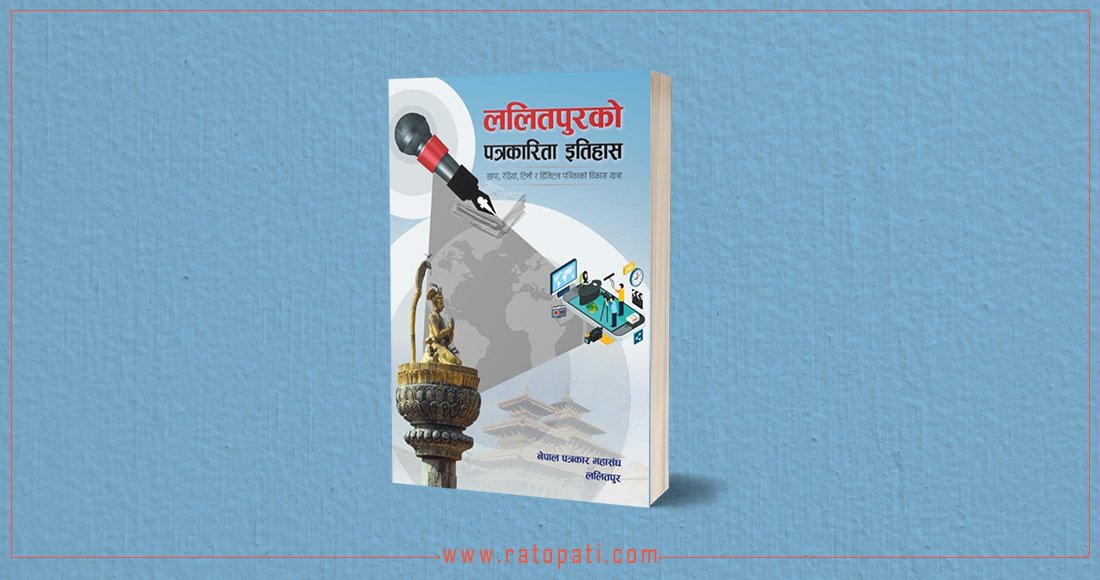
To fill this gap, 'Lalitpur's Journalism History', written and edited by journalist and researcher Ram Hari Karki, has been published. This 248-page work, published by the Federation of Nepali Journalists, Lalitpur, is not just the media history of a district; it is a document that serves as a fundamental reference for the study of local journalism in Nepal.
The book presents about seven decades of journalism journey in Lalitpur district, connecting it with facts, records, statistics, memoirs, and institutional history. It relates the development of local journalism to the overall journey of national journalism, offering an opportunity to view media history from a new perspective.
The most notable aspect of the book is its historical research. The author has presented with evidence the fact that journalism in Lalitpur began with the quarterly magazine 'Kalakar', published in 2009 BS under the editorship of cultural expert Satya Mohan Joshi. Thus, the book has not only repeated history but has also rediscovered and re-published forgotten pages of history. Such subtle discoveries in journalism history are considered the real achievements of research.
The structure of the book, divided into four sections, is balanced and systematic. The first section presents a detailed introduction to print, radio, television, and online media along with the development of journalism in Lalitpur.
The author has included detailed information about 382 newspapers registered in the district until the end of Asar 2082 BS, 227 online media, 27 television organizations, and various radio stations. Such statistics elevate the book far above a general descriptive book, making it a researchable document. As the establishment, development, transformation, and expansion of media are presented chronologically, it can serve as reliable foundational material for future generations of researchers.
The structure of the book, divided into four sections, is balanced and systematic. The first section presents a detailed introduction to print, radio, television, and online media along with the development of journalism in Lalitpur. It covers the journey of publications ranging from Arthik Dainik to Himal Khabapatrika, Nepal Samacharpatra, Janastha, Godawari Post, and Nami Saptahik.
Regarding radio, the development of Radio Sagarmatha, Ujyalo, Kantipur, Classic FM, Radio Nation, and Radio Lalitpur is presented, while for television, the contributions of organizations such as Nepal Mandal, Mountain Television, GNN, Business Plus, and Krishi Television have been documented.
The priority given to online journalism in the book is particularly commendable. In the current situation where the rapid expansion of digital communication is changing the nature of journalism, factual details of online media, from Ratopati, Setopati, Desh Sanchar, Lokantar, Clickmandu, HimalKhabar to local online media, can become invaluable sources for future research.
Another significant contribution of the book is its inclusion of the history of journalism education. The fact that journalism studies began at Patan Multiple Campus in 2036 BS, along with details of other campuses and secondary schools offering journalism, shows that the development of media education has been given equal importance. This does not limit the book to just a list of media outlets; it also encompasses the educational structures that produce journalism.
The second section covers the history of journalism-related organizations. The introduction and contributions of organizations such as the Federation of Nepali Journalists, Press Center, Press Chautari, Press Union, Socialist Press Organization, Janapatrakar Sangathan, Phonij, Newa Journalists National Daboo, and Tamang Journalists Association Lalitpur help in understanding the institutional development of journalism. Journalism is not just an individual practice; the book clarifies how institutional structures have directed it.
The third section is the soul of this book. Reading the life journeys, struggles, professional experiences, and memoirs of 23 veteran journalists provides an experience of encountering the living history of Nepali journalism. This section confirms that history is not just a record of dates and events; history is also the story of people's experiences, pains, dedication, and struggles. The experiences of journalists from veteran Ram Krishna Karmacharya to the new generation highlight the values, ethics, and social responsibility of journalism. This section can be a source of inspiration not only for journalism students but also for young people aspiring to enter journalism.
The fourth section includes details of the organizational structure and leadership of the Federation of Nepali Journalists, Lalitpur Branch. This provides the necessary basis for understanding the journalism movement from an institutional perspective.
Another feature of the book is its simple, easy, and research-friendly language. The author has prioritized the clear presentation of facts over unnecessary linguistic complexity. This makes the book useful for everyone, from students to researchers. The balanced combination of facts and experiences makes the book neither just history nor just memoirs, but a powerful fusion of both.
However, there were also grounds on which the book could have been further enriched. If more analysis had been done on the impact of social media in recent years, fact-checking, data journalism, artificial intelligence, and the changes brought about by the digital economy in journalism, the book could have been more strongly connected with contemporary journalism. Similarly, if critical coverage had been given to the economic challenges of local media, the state of press freedom, the advertising market, political influence, and issues of digital transition, the research depth would have increased. But these aspects do not diminish the overall importance of the book; rather, they indicate potential areas for expansion in future revised editions.
If other districts of Nepal can take inspiration from this work and collect and publish their journalism history, the overall journalism history of Nepal will become richer and more authentic.
The importance of local history writing has increased today. In the era of globalization and digital communication, if local history, culture, and institutional memories are not preserved, they risk disappearing over time. In this context, 'Lalitpur's Journalism History' is not just a book, but a campaign for memory preservation. It has not only secured the past of journalism in Lalitpur but has also opened doors for new research for future researchers.
If other districts of Nepal can take inspiration from this work and collect and publish their journalism history, the overall journalism history of Nepal will become richer and more authentic. This book practically proves the notion that national history is a summation of local histories.
Overall, 'Lalitpur's Journalism History' is one of the best works published in recent years in the field of local journalism study, media research, history writing, and documentation. Due to the reliability of facts, comprehensiveness of content, balance of structure, and historical perspective, this book has succeeded in becoming an essential reference for students of journalism, media studies, history, and sociology, as well as researchers, media professionals, and policymakers.
This work has not only preserved the journalism history of a district; it has also initiated a new chapter in the writing of local journalism history in Nepal. For this reason, Lalitpur's journalism history can be called not just a book, but an important intellectual property left for future generations.
(Joshi is an active researcher and critic in the education sector.)
This specific news has been automatically translated by AI. As a result, there may be some inaccuracies or language errors.
_Uz8WJxoKcj.jpg)