
Meter-Interest Victims Protest Again Due to Unresolved Issues

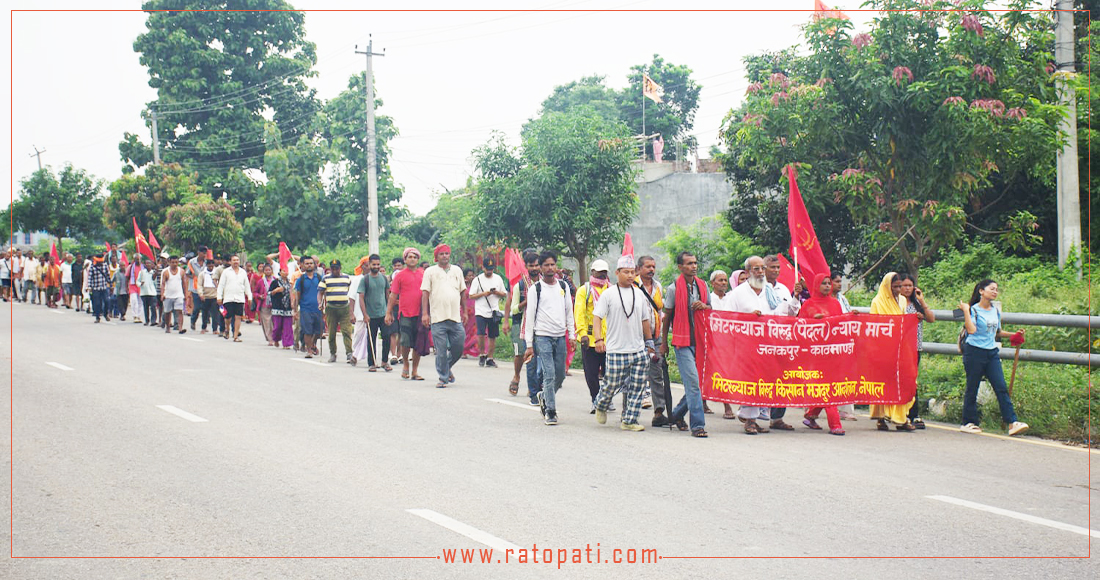
Kathmandu. Citing the incompleteness of commissions formed and legal systems introduced by the government in the past and the failure to resolve the problems, meter-interest victims from across the country have once again taken to the streets in protest. The foot march, which began from Janakpur on Thursday, reached Bardibas in Mahottari on its second day, Friday. Approximately 200 victims, who have embarked on a foot journey in search of justice, are moving forward with the goal of reaching the federal capital Kathmandu within 11 days. Upon reaching Kathmandu, they plan to enter the Darbar Marg area directly and gather meter-interest victims from all over the country to pressure Singha Durbar and Baluwatar. Umesh Koiri, an activist against meter-interest and central president of People Force Nepal, stated that they were forced to return to the streets because the mechanisms created by the government were not victim-centric. The victims complain that the commission and mechanisms formed by the government to register complaints at the District Administration Office and facilitate discussions between the two parties are very weak. Activist Koiri said that even though the commission has assigned the responsibility of problem-solving to the District Administration Office, the complaints have been left in limbo due to the lack of concrete legal and executive authority to resolve the issues. "The law brought under Section 249 of the Muluki Criminal Code is incomplete, due to which the police are refusing to register the victims' complaints. On the other hand, taking advantage of this legal loophole, moneylenders are intensifying the process of filing cases in court by showing old promissory notes and checks," Koiri said. He added that the courts are making one-sided judgments, auctioning off houses and land, and moneylenders are increasing threats in villages, forcing them to choose the road again. According to him, this movement is progressing under the 'Meter-Interest Against Farmer-Laborer Movement Nepal', and the security and management of this movement have been taken up by 'People Force Nepal', comprising victimized youths. Warning that the protest will not stop without a long-term solution. Koiri says that the government's practice of repeatedly forming commissions and signing agreements, but not implementing them, has forced meter-interest victims to come to the streets again. He complains that due to legal ambiguity and lack of local authority, victims are facing threats and mental stress from moneylenders in their villages. "The foot march of the victims heading towards Kathmandu will indeed put pressure on the state's mechanisms. As long as the state does not provide easy financial access, health security, and legal shelter to the poor, the cycle of this victim's movement will not stop," Koiri said. Two commissions were formed, but the problem remains the same. This is not the first time that meter-interest victims have come to Kathmandu to protest for justice. After protesting several times, the government formed the 'Commission for Investigation of Undue Transactions (Meter Interest) 2079' under the chairmanship of former Supreme Court Justice Gauribahadur Karki on Chaitra 17, 2079. Approximately 28,000 complaints were received by the commission from across the country. Out of these, the commission was able to mediate only about 5,000 complaints, while the remaining 22,000 complaints were handed over to the police for investigation. The victims once again took to the streets in Kathmandu on Magh 16, 2080, citing the commission's ineffective work and non-implementation of agreements. Following the long struggle and pressure from the victims, a 6-point agreement was reached on February 28, 2080, between the then Home Minister Rabi Lamichhane and the meter-interest victims to form a new investigation commission. At that time, it was agreed to take a proposal to the Council of Ministers to form a new commission under the Investigation Commission Act, 2026, with a report to be submitted within three months. As per the agreement, the new commission was to be given the responsibility to investigate nine different issues. These included serious matters such as creating promissory notes for more than the actual amount, adding interest to the principal, collecting interest higher than the prevailing law, threatening debtors, forcibly transferring property, and forcibly signing blank checks. The old commission also issued a notice on Jestha 11, 2081, calling for complaints to be filed at the District Administration Office within 21 days, but no details were available regarding how many complaints were received. On February 26, 2081, the then government led by KP Sharma Oli formed a new commission under the chairmanship of Baburam Regmi, with Bharat Bahadur Bohara and Badrinath Bhattarai as members. The victims allege that despite the formation of the new commission, no concrete work has been done to solve the problem, and the commission has not even submitted its report. Why haven't the victims' problems been solved? Prof. Dr. Sanjeev Upreti, an activist of the Broad Civil Movement, stated that the reason why the problems remain unresolved even after the government formed commissions twice to solve the problems of meter-interest victims and the commissions completed their work is the structural complexity. According to him, meter-interest moneylenders are financially well-off and have strong political influence. They also have strong ties with the local bureaucracy and mechanisms, which always puts the poor and helpless victims in a bind. "There is a big problem in Nepal's overall structure and legal system. The law exists here, but in practice, the law seems to stand in favor of the perpetrator rather than the victim," Upreti said. However, he believes that the movement has not been a complete failure. He interprets the declaration of meter-interest as illegal and some victims receiving relief as major achievements of this movement. Nevertheless, Upreti states that complete justice has not been achieved because the entire structure is favorable to the perpetrators. He added that meter-interest victims are once again forced to come to Kathmandu by undertaking a difficult foot journey. "Some victims have reached the stage of becoming landless by selling off all their assets to repay the moneylender's debt. Having lost everything, they are forced to come to Kathmandu like this out of desperation," Upreti added. The desire of civil society is that the victims should get justice as soon as possible, and for this, the state must become responsible, he suggests. Complaint that Karki Commission's report has not been implemented. Uttamraj Subedi, a former Additional Inspector General of Police (AIG) and a member of the first investigation commission, also expressed concern that the commission's report has not been practically implemented. He said that although the report was submitted to the Prime Minister and Home Minister after working for about 10 months at that time, its continuity has not been seen. Subedi said, "We worked for about 10 months from Chaitra 2079 to Mangsir and submitted the report to the then Prime Minister and Home Minister, but sadly, that report has not been practically implemented." According to Subedi, out of approximately 30,000 applications received, about 7,000 were fully resolved, and a total of 12 to 13,000 applications, including partial ones, were settled. Although hearings were initiated by forming a committee comprising the government attorney and police officers under the chairmanship of the Assistant Chief District Officer at the District Administration Offices, the problem has worsened due to the lack of continuity, he believes. Subedi has pointed out the need for some concrete structural reforms to prevent the situation where victims have to come to the streets again. He said that the report particularly emphasized four main issues. According to Subedi, first, the meter-interest desks at the District Administration Offices should be kept operational until the work is completed, and the employees working there should be guaranteed additional service facilities. Second, to remove the compulsion for youths going for foreign employment to take loans at high interest, it was suggested in the report to arrange for concessional loans from the approximately 50 billion rupees in the Foreign Employment Fund based on the recommendation of the local government. He said that with such an arrangement, a banking system could be created where the interest and principal would be deducted directly from the worker's first month's salary. As a third reform, he emphasized the need to create an environment where poor farmers can get agricultural loans easily, similar to the small farmer program, as they often turn to moneylenders due to the cumbersome procedures of commercial banks. Fourth, and a very sensitive issue – since some impoverished families fall into the trap of meter-interest loans for emergency medical treatment, it is necessary to make government health insurance effective and for the state to bear the premium for citizens below the poverty line through local governments, he mentioned. What did the new commission do? Baburam Regmi, Chairman of the new commission for investigation of undue transactions (meter interest), said that only the legal remedy for meter interest is not effective and a permanent mechanism is needed at the district level for its long-term solution. In a conversation with Ratopati, he informed that the commission completed its 3-month tenure and submitted a report with detailed suggestions to the Home Ministry in Ashar 2082. Chairman Regmi clarified that although the law was amended to make meter interest a criminal offense, it has not been sufficient. "The law has been made, but it has not been very effective; it is difficult to take action (level) against anyone when the case is being heard," he said. According to Chairman Regmi, it is practically impossible for a temporary body like a commission to resolve cases or issues in the districts. He said that meter-interest cases are very complex and cannot be resolved with a single day's discussion. "These cases require two, three, or even four rounds of discussions. The principal amount taken by the victim's side also needs to be found and repaid on time. Therefore, it is not a matter that can be concluded simply by agreeing and saying the matter is settled there," Regmi added, "For this, a mechanism of the District Administration Office, police, and government attorney needs to be formed, and they need to work regularly." The commission was formed in February 2081 and prepared a report after understanding the problems by visiting districts for three months. Regmi urged to contact the Home Ministry regarding the implementation of the report, which has already been submitted to it. He said that such a mechanism would prosecute those who misbehave and prevent the tendency of people trying to frame someone out of spite or unwillingness to pay money. Chairman Regmi said that it was found that some organizations operating in the name of meter-interest victims were exploiting the victims themselves. "We have found that people who come saying they are meter-interest victim organizations are themselves exploiting them," he said, "In some places, these very organizations, claiming to be representatives, have opened shops for very old and settled issues. Even when the parties have reached an agreement, various problems are created by saying that payment is not required." Regmi informed that this problem, which was previously more prevalent in the Terai-Madhesh region, has now reached the hilly districts and Kathmandu. Mentioning that the nature of the problem in Kathmandu is different, he said, "In Kathmandu, people first take money at high interest voluntarily for business, and later, if their business does not run, they classify it as meter interest." The commission was formed in February 2081 and prepared a report after understanding the problems by visiting districts for three months. Regmi urged to contact the Home Ministry regarding the implementation of the report, which has already been submitted to it. Home Ministry spokesperson Anand Kafle did not respond when attempts were made to inquire about the implementation of the report.
This specific news has been automatically translated by AI. As a result, there may be some inaccuracies or language errors.
_Uz8WJxoKcj.jpg)


_QgiUA4ADS9.jpg)