'Queen's Well' in Lamjung Holds Centuries of History

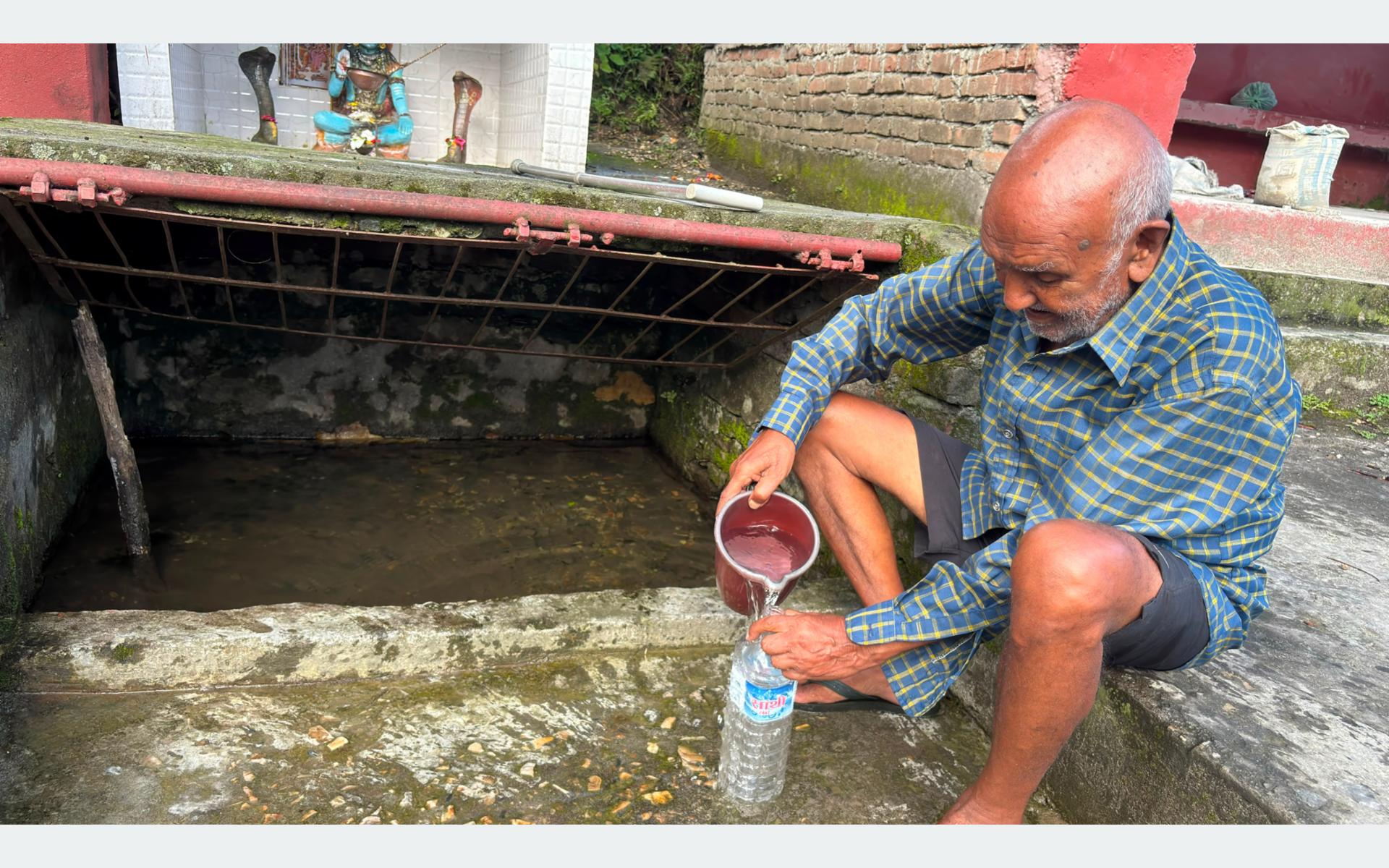
Lamjung. Anyone traveling along the Dumre-Besisahar road section may notice an old well by the roadside. For those in a hurry, it might just be a normal water well, but within its silent depths lies the history of the 16th-century Lamjung Durbar. It preserves the lifestyle of the then royal family, the stories of travelers' journeys, the changes in local society, and the faith passed down through generations.
This was once a well used by the queen or the royal family. As it was the main source of water for those coming and going to the Ghaigharsahar Durbar, it came to be called 'Queen's Well'. This explanation is based on local oral tradition; no confirming inscription or official history is available to date. Although much has changed over time, the 'Queen's Well' still carries the footprints of history. There are not many official historical records available about the origin of the name Lamjung's Queen's Well, but some facts can be found based on local folklore and the historical environment of the place.
The settlement falls under Queen's Well, located in Besisahar Municipality-3 (formerly Ghaigharsahar Village Development Committee). The Ghaigharsahar area is considered an important historical center of the then Lamjung state. With the old palace, administrative structures, and religious sites in this area, Queen's Well also appears to have developed as a part of that historical environment. Queen's Well is not just a settlement but an important entry point to Ghaigharsahar. The current city plan also mentions the construction of an entrance to Ghaigharsahar, Kaulepani, Purano Kot Gadhi, and Nalma at Queen's Well.
This well, connected to Lamjung Durbar, is believed by local folklore to have been constructed during the reign of King Yashobrahma Shah. It is believed that the well was dug to provide safe drinking water and bathing facilities for the queens in the palace. For this reason, locals say its name became 'Queen's Well'. According to local folklore, the names of Ghaigharsahar and Besisahar are also linked to the style of Lamjung Durbar and the then settlement. Locals say these names came into use due to the practice of living in the upper region during the summer and the lower region during the winter. Later, as settlements expanded in the lower region, Besisahar's identity is believed to have developed.
According to local elders, the folklore that the well was named Queen's Well because royalty or palace people used the water here at one time is prevalent. However, no verified historical documents confirming this have been publicly found to date. According to 86-year-old local resident Madhav Prasad Ghimire, the Queen's Well was initially limited to the use of the royal family. Over time, settlements expanded around it, and locals also started using water from this well. He says that although its use has decreased with the availability of modern drinking water, its historical significance remains.
According to local history expert Angaraj Ghimire, the place where the road is now was a footpath before. Travelers used to rest at the 'Queen's Chautara' above that path and drink water from this well. According to him, queens also used to come to this area, bathe, and use the water from the well. Therefore, Queen's Well is not just a water source but a living witness to the relationship between the then royal life and the local society. According to Ghimire, Kusmakhar played an important role in bringing King Yashobrahma Shah to Lamjung, as requested by the six clans of Lamjung. The contribution of Kusmakhar Ghimire among them is specifically mentioned in local history and folklore. He states that Kusmakhar Ghimire, known for his astrological, political knowledge, and foresight, is also associated with the initial concept of the national flag.
His role in the initial form of the flag, marked with a 12-cornered sun and an 8-cornered moon, used before the unification of Nepal, is found in local folklore. According to Rajendra Bohora, Chairman of the Lamjung Durbar Conservation Committee, Queen's Well and Lamjung Durbar cannot be viewed separately. He says that the conservation of Queen's Well is equally necessary to understand the history of the palace. According to him, preserving history is not just about saving old structures but also about conveying the facts, folklore, culture, and collective memory associated with them to future generations.
Due to lack of adequate conservation, natural degradation, and increasing human pressure, preserving the originality of historical heritage in the palace area, including Queen's Well, is becoming challenging. Chairman Bohora said that a process is underway to prepare a master plan for long-term conservation, management, and tourism promotion, encompassing the palace, Queen's Well, Queen's Chautara, and surrounding heritage. Lamjung Durbar is a historically and culturally important heritage. He says that efforts are being made by the provincial government and various bodies for its conservation and promotion.
Queen's Well is located on the route to Ghaigharsahar Durbar, and local belief suggests that this place may be related to the then Lamjung state. Government development plan documents also mention the Queen's Well-Historical Ghaigharsahar Durbar road, indicating the historical connection of this area. Local beliefs are also associated with the historical spring in the palace area. Chairman Bohora says that the tradition of bathing in that spring before participating in the fair held at the palace on the occasions of Chait Dashain and Phoolpati still exists.
Local authorities have also stated that they have prioritized the conservation and promotion of Queen's Well. According to Ward Chairman Chitra Bahadur Danai, Queen's Park was constructed at a cost of approximately Rs 6 lakh a few years ago for the beautification and promotion of the Queen's Well area. He says that further efforts are being made for its conservation, historical study, and tourism promotion. He believes that there is a plan to develop Queen's Well, Lamjung Durbar, and the surrounding historical sites as a single tourist circuit.
Meanwhile, the construction of a statue of Kusmakhar Ghimire in the historical complex is in its final stages. According to Srikanth Ghimire, Chairman of the National Foundation Committee, his wife Himadevi Ghimire and sons Gunaraj Ghimire and Toyaraj Ghimire, along with their family, have provided four annas of land in memory of the late Dilli Raj Ghimire. He informed that more than 95 percent of the work on the statue, being built with a budget of Rs 15 lakh from the Gandaki Provincial Government, has been completed. According to him, the statue, built in Bhaktapur, has been brought to the Queen's Well complex and will be installed after selecting an auspicious date. He says that the statue is being built with the aim of introducing the historical contribution of Kusmakhar Ghimire to the new generation.
According to Chairman Srikanth Ghimire, Queen's Well and its surrounding area are archaeologically important. Therefore, he believes there is a need to coordinate with the Department of Archaeology to make its conservation, study, documentation, and promotion effective. Queen's Well is not just an old well today; it is a living witness to Lamjung's history, folklore, royal tradition, local life, and cultural identity. The statue of Kusmakhar Ghimire being constructed next to it is an effort to introduce another historical figure to the new generation.
It is said that if the heritage connected with Queen's Well, Lamjung Durbar, Queen's Chautara, historical spring, and Kusmakhar Ghimire can be developed as a single conservation and tourism circuit, it can give a new dimension not only to Lamjung's history but also to Nepal's cultural tourism. Such heritage of history is not just structures of stone, soil, or water; they carry the story of a society's memory, identity, and continuity. Queen's Well, even today, stands as a silent witness to that history, connecting the future with the past.
This specific news has been automatically translated by AI. As a result, there may be some inaccuracies or language errors.