Prime Minister Balen Shah Meets ADB President Masatoanda, Breaks Solo Meeting Stance

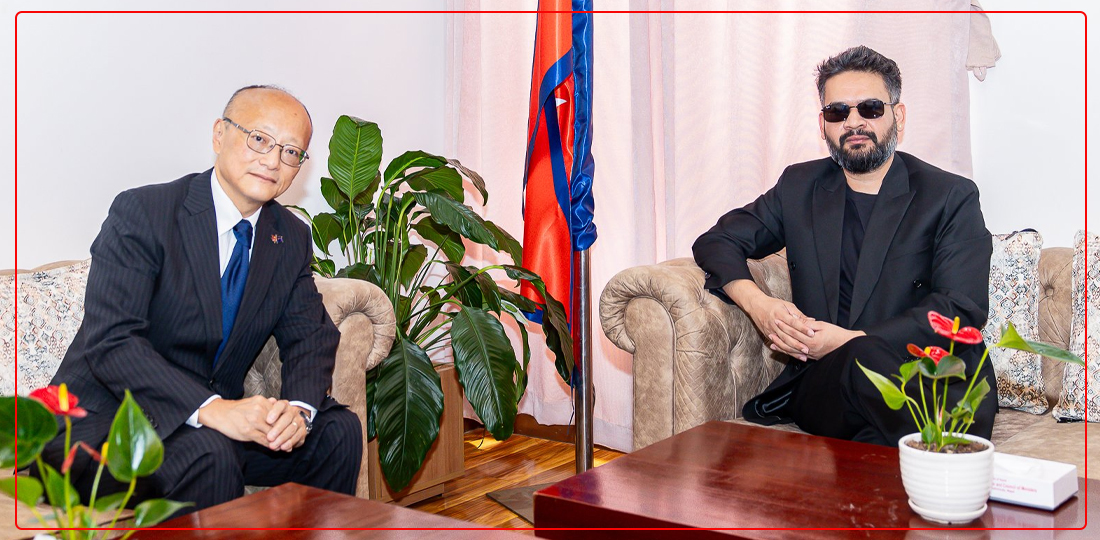
Kathmandu. Prime Minister Balen Shah has shown flexibility in his stance of not holding solo meetings with foreign diplomats, except for collective ones, since taking leadership of the government. He broke his stance by holding a meeting with Asian Development Bank (ADB) President Masato Kanda.
Earlier, he had held collective meetings twice with heads and representatives of diplomatic missions. He had refused to meet representatives from America, China, and India who came or were scheduled to come.
Since Balen was appointed Prime Minister on Chaitra 13, the first high-level delegation to visit Nepal was from America. Assistant Secretary of State for South and Central Asian Affairs, Paul Kapur, visited Nepal in Baishakh.
He met with Foreign Minister Shishir Khanal and Finance Minister Dr. Swarnim Wagle. Although he wanted to meet Prime Minister Balen, Balen did not grant him an audience.
Ten days after Kapur's departure, Sergio Gore, Special Envoy of US President Donald Trump and US Ambassador to India, also visited Nepal. He also requested a meeting with Prime Minister Balen. However, Balen did not give him time.
Gore also returned after meeting Foreign Minister Khanal and Finance Minister Wagle.
After that, in Jestha, Deputy Assistant Secretary of State for Public Diplomacy of the US government, Sarah B. Rogers, visited Nepal. Balen also refused to meet her.
During this period, there were also various visits from China, but Prime Minister Balen refused to meet anyone. A high-level visit was being prepared from India. However, after Prime Minister Balen did not give time for a meeting, the visit was postponed.
Chinese Communist Party leader and Deputy Minister Yan Dong is visiting Nepal. He, who arrived in Nepal on Monday, also requested a meeting with Prime Minister Balen through his embassy, but Balen did not give him time.
However, on the same day, Prime Minister Balen held a meeting with ADB President Kanda, who was visiting Nepal. An official from the Ministry of Foreign Affairs said, 'This is not an ordinary meeting. This meeting holds great significance for the country's development. There is a world of difference between meeting other diplomats and meeting the ADB Chairman. It is better to view this meeting from a development perspective rather than a diplomatic one.'
Research Director of the Nepal Institute for International Co-operation and Engagement, Dr. Pramod Jaiswal, has a similar understanding. He said, 'This meeting is under the development diplomacy set by the Balen government, and it can also be called economic diplomacy.'
Jaiswal's statement indicates that Prime Minister Balen prioritizes development. 'ADB also wants to do something for Nepal. That's why a meeting at the prime ministerial level might have happened,' he said.
He clarified that Balen, who wants to make great strides in infrastructure development during his tenure, believes that no other organization is more suitable than ADB for this purpose. 'The Prime Minister may have given importance to this meeting because ADB can provide more assistance than others,' he said.
Jaiswal stated that it would be wrong to assume that meeting ADB President Kanda has opened the door to meeting other diplomats.
However, an international affairs expert said that development diplomacy holds great significance. According to him, meeting ADB President Kanda is similar to meeting a US representative.
Former Ambassador Hiranyalal Shrestha said that the visit and meeting became easier because Swarnim Wagle, who has worked at ADB, is the Finance Minister. Asserting that this meeting is under the government's development diplomacy, he clarified that similar meetings should be held with representatives of other countries as well. He speculated that Prime Minister Balen, who adopted a one-door diplomacy until completing 100 days in office, might now break his silence and meet representatives of other countries.
Former Ambassador Shrestha said that the meeting with ADB President Kanda has sent a very significant diplomatic message for Nepal and that the current government should continue this approach.
Although ADB was established for the development of the Asia-Pacific region, America has the strongest hold on its policy-making and decisions. America and Japan have the largest investments in this bank.
America and Japan have an equal share of 15.6 percent in ADB. Based on this, these two countries have the largest voting rights of 12.8 percent. Since the bank's establishment, its president has always been from Japan. The current president, Masato Kanda, is also a Japanese citizen.
China has a 6.4 percent share and India has a 6.3 percent share in this bank. Therefore, Prime Minister Balen's meeting with ADB President Kanda has significant diplomatic implications. Experts say that how China and India view this will determine the future diplomatic journey.
This specific news has been automatically translated by AI. As a result, there may be some inaccuracies or language errors.