Ilam Tea Gardens Face Crisis Amidst Privatization Dispute

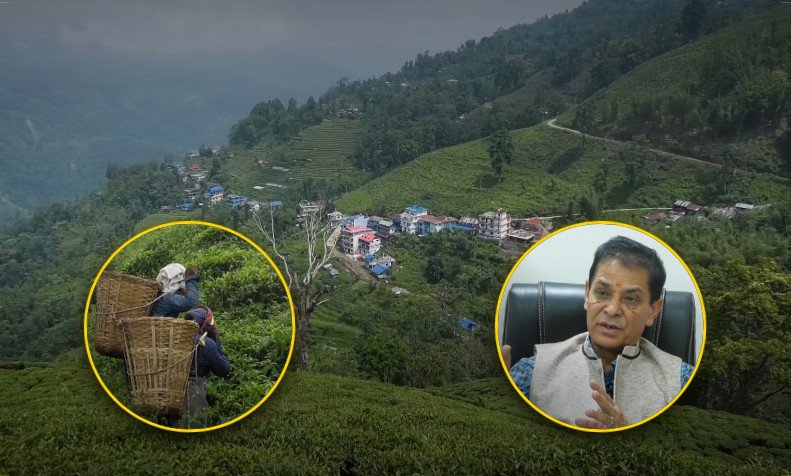
Ilam. Historical tea gardens, considered the starting point of Nepal's industrial history, have fallen into extreme distress and crisis after being privatized for over two and a half decades. The legacy of tea cultivation, which began in 1920 BS when then Badahakim Gajrajsingh Thapa planted saplings brought from China in the soil of Ilam, has now become a victim of commercial interests and government apathy.
In 2057 BS, the government sold 65 percent of the shares of Nepal Tea Development Corporation Limited to Triveni Shanghai Group, leasing the gardens for 50 years. Since then, not only has corporate monopoly emerged in this sector, but gardens bearing national identity have gradually become desolate and ruined. Due to the operating group's policy of merely making the gardens a means of profit without conserving the environment and historical structures, the conflict between the local government and private management has reached its peak.
The deplorable condition of the gardens, the failure to plant new saplings in place of dead tea plants, and the disappearance of centuries-old historical British processing machinery clearly indicate the extreme irresponsibility of the management. Regarding this, Ilam Municipality Mayor Kedar Thapa said that the condition of the tea gardens has been deteriorating day by day since privatization, and there have been legal and managerial disagreements with the operating group for a long time.
He said, 'All seven tea gardens in Nepal have been privatized and taken by the Shanghai Group. We are having a lot of arguments with Shanghai. We write letters from here, and they write from there. New saplings have not been planted in place of dead plants in the tea gardens they leased. Even the maintenance and care of the existing ones are lacking. We don't know where the machine brought during the British era has been taken. I want to draw the attention of the central government: what commitments did they make when they took the lease? I have heard that they have not paid royalties as mentioned in the agreement.'
Mayor Thapa alleges that the Shanghai Group is operating a self-willed mechanism within the gardens, violating the jurisdiction of the local government and prevailing laws. With the implementation of federalism, according to the Local Government Operation Act, municipalities have repeatedly urged the corporation to pay property, land revenue, asset, and business taxes, but the corporation has continuously ignored these requests. The group is refusing to pay local taxes, stating that since they have only leased government land, they will pay all taxes to the federal government. This is a direct attack on the constitutional right of the local government to collect taxes.
Recently, when Ilam Municipality started a campaign to plant tea in empty spaces and beautify the area to save the historical tea garden, the Shanghai Group sent a letter warning them to stop the work. In a letter sent on Jestha 10 using the corporation's letterhead, threatening language was used, calling the municipality's actions unnecessary interference. Expressing serious objection to this, Mayor Thapa said, 'We are also a government, not an individual! Their behavior of telling us not to build by sending employees for beautification is not good.'
Highlighting the insensitive behavior of the management, Mayor Thapa said that the tea garden is turning into ruins. He stated that the municipality itself has initiated conservation efforts as the gardens began to become desolate due to a profit-oriented mindset. He added, 'We care more than they do because we were born at the foot of this tea. We have planted decorative plants around the tea garden. We have deployed municipal police to control livestock grazing in the tea garden. We express regret over their attempt to stop the beautification of empty land by the municipality. They calculate profit and loss; we look at how to save it.'
This dispute of the Ilam Tea Garden has also exposed the weaknesses of Nepal's national land policy and federal governance system. In the past, due to the lack of clear legal provisions regarding the rights and responsibilities of local levels in long-term agreements made by the federal government, the private sector is taking advantage of it to seek tax exemptions. Mayor Thapa laments being helpless in their own area due to the lack of clarity on the rights of the local government over old decisions.
He emphasized that letters have been sent to the Ministry of Finance repeatedly on this matter and that the federal government must now show the right path. Thapa revealed that the municipality plans to conserve the 160-year-old tea garden as a historical heritage and establish a tea museum. He said, 'We are thinking of starting the tea museum possibly this year. To brand tea, Ilam Municipality is currently engaged in an organic production and certification campaign with the Tea Alliance.' He stated that after becoming a research center for tea and cardamom, it will be easier to enter the international market, and the federal government should pay special attention to the production of herbs and raw materials from across the country.
This specific news has been automatically translated by AI. As a result, there may be some inaccuracies or language errors.