Stigma and Discrimination Against HIV and TB Persist, Stakeholders Say

Kathmandu. Stakeholders have stated that stigma and discrimination related to HIV and TB still persist severely. Although significant improvements have been made in prevention, testing, and treatment services, the affected communities are still not receiving equal and respectful services due to social perceptions, misinformation, institutional behavior, and structural weaknesses.
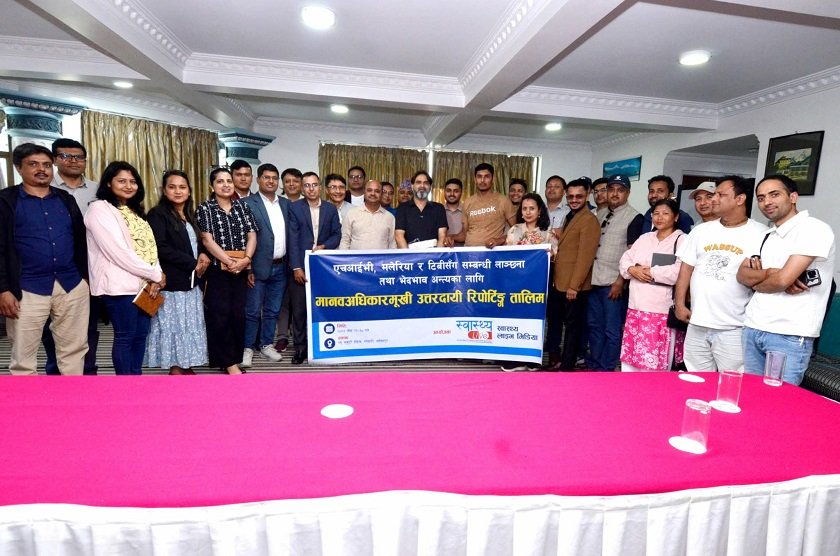
Stakeholders stated that the affected communities are still not receiving equal and respectful services at the training program on human rights-oriented responsive reporting for the eradication of stigma and discrimination related to HIV, Malaria, and TB, organized by Swasthya Live for journalists from all seven provinces.
Dr. Sarvesh Sharma, Director of the National Centre for AIDS and Sexually Transmitted Diseases Control, stated that although significant improvements have been made in HIV control and treatment, challenges remain. According to him, it is estimated that there are more than 34,000 HIV-infected individuals in Nepal, of whom 19,821 are men, 14,516 are women, and 1,058 are children below 14 years of age. According to him, the statistics show that 614 new infections occur annually and 568 deaths occur due to HIV.
According to Sharma, in 2025 alone, HIV testing was conducted on 516,351 pregnant women, of whom 134 tested positive for infection. He stated that due to timely initiation of medication, infection was detected in only 4 children. He mentioned that although progress has been made in the first two phases of the "95-95-95" goal set for HIV control, the third phase, viral load suppression, remains challenging.
According to him, individuals infected with HIV can now live long and healthy lives like ordinary people by regularly taking medication. He said, "HIV-infected individuals now live longer than those with diabetes and hypertension. The average life expectancy of Nepalis has reached 71 years, while infected individuals who regularly take medication are living longer than 74 years." However, he stated that the problem has not been fully resolved due to the misconceptions and stigma that still exist in society.
Bishnu Sharma, Executive Director of Recovering Nepal, stated that there has been significant improvement in HIV control and treatment compared to the past. According to him, in the past, a large number of infections were detected when testing high-risk groups, but now there has been an improvement in prevention, testing, and treatment services. He said, "HIV infection does not mean death now. A long and healthy life is possible with regular treatment and medication." However, he stated that social perceptions have not changed yet, and discrimination persists due to old myths.
Loknath Bastola of the National Human Rights Commission stated that although the constitution and international human rights laws guarantee the rights to identity, confidentiality, health, education, employment, dignified life, and equality for people living with HIV, challenges remain at the practical level. According to him, service delivery is still affected by prejudice and stigma in health services, education, employment, and public services. In some cases, delays in service, changes in behavior, and breaches of confidentiality are still observed after disclosing HIV status.
Samata Bam, Program Coordinator of CWIN Nepal, stated that stigma related to HIV and TB is prevalent at social, institutional, and structural levels. According to her, due to the fear of external stigma and discrimination, affected individuals even develop self-stigma, which results in delays and obstacles in treatment and other services.
According to community representatives, discrimination still persists against HIV-infected individuals and gender and sexual minority communities. The situation where government hospitals refuse or delay surgeries but private ones provide services is still observed. They also stated that there is a situation of feeling insecure and facing discrimination while using public toilets.
According to the National Centre for AIDS and Sexually Transmitted Diseases Control, structural, managerial, and technical challenges still exist in the implementation of programs related to HIV, Hepatitis, and Sexually Transmitted Infections. Problems such as the lack of multi-year procurement plans, issues with the supply of medicines and kits, and difficulties in achieving viral load suppression targets have been observed.
Stakeholders have stated that policy, service systems, and social thinking need to change to end stigma and discrimination related to HIV and TB. They emphasized the need to use fact-based, sensitive, and non-discriminatory language in journalism.
This specific news has been automatically translated by AI. As a result, there may be some inaccuracies or language errors.