Nepal Tightens Quarantine Checks on Imports Amidst Pest and Disease Risks

Kathmandu. Nepal's agricultural sector is facing a high risk of various harmful diseases and pests that could enter from abroad in recent days. To protect the domestic agricultural system, billions of rupees in investment, and the livelihoods of farmers, the government has tightened quarantine checks at border crossings.
According to the Plant Quarantine and Pesticide Management Center, steps such as banning imports and setting new standards have been taken after harmful diseases and organisms were found in agricultural products imported from various countries.
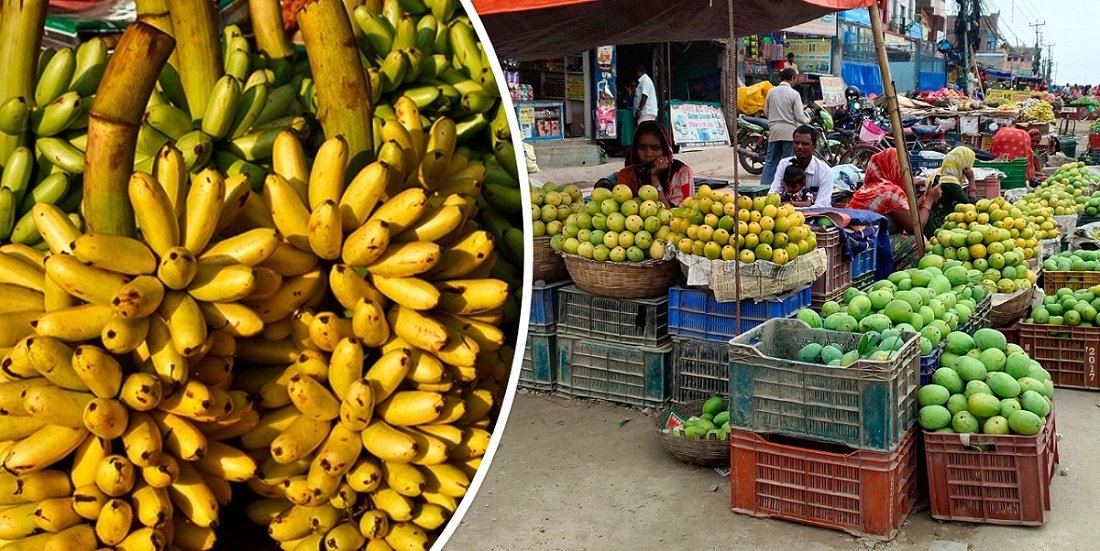
The risk of 'Panama disease' in Nepal's banana cultivation, the 'Kharaj' pest found in coriander imported from China, 'Phytophthora palmivora' found in Ugandan avocados, and the 'Hot Water Treatment' standard imposed on Indian mango imports have caused these items to be held at the border.
'Black Death' Crisis in Banana Cultivation
The government has taken strict measures to protect Nepal's banana cultivation, worth billions of rupees, from the devastating 'Panama disease' (TR-4). An import permit for banana imports from India was banned effective from October 2nd. This arrangement is now being made more effective and stringent through local governments.
Plant Quarantine and Pesticide Management Center and Nepal Agricultural Research Council (NARC) have issued 'Biosafety Systems' for banana plantations. Local administrations have also been instructed to report any illegal import of banana saplings from neighboring countries and to destroy illegal bananas.
This disease, dubbed 'Black Death', has the potential to destroy entire banana plantations once it attacks. According to the Plant Quarantine and Pesticide Management Center, banana cultivation covers about 12 to 13 thousand hectares in Nepal. Farmers and businesses have invested more than 12 billion rupees in this sector.
According to Roshan Adhikari, an official at the center, if this disease spreads nationwide, not only will Nepal's dream of self-sufficiency in bananas be shattered, but thousands of farmers could become landless. Keeping this risk in mind, the government has banned the import of banana saplings and fruits from India.
Plant Quarantine and Pesticide Management Center and Nepal Agricultural Research Council (NARC) have issued 'Biosafety Systems' for banana plantations. Local administrations have also been instructed to report any illegal import of banana saplings from neighboring countries and to destroy illegal bananas.
Harmful 'Kharaj' in Coriander Imported from China
The Plant Quarantine and Pesticide Management Center has stopped a large consignment of coriander seeds imported from China to Nepal at the customs border after finding the harmful 'Kharaj' pest. Approximately 30 tons of coriander seeds, which entered through the Tatopani border crossing, contained a quarantine pest (insect) that is internationally banned.
According to Roshan Adhikari, Information Officer and Senior Plant Protection Officer at the Plant Quarantine and Pesticide Management Center, the consignment of coriander was found to be 'non-compliant' (against standards). Laboratory tests revealed the presence of the 'Kharaj' pest in the coriander, which is considered very dangerous from an agricultural and food security perspective.
The coriander, which was stopped at the Tatopani border around May 26th, is currently undergoing quarantine procedures. The center maintains its stance of not allowing Nepal to become a 'dumping site' and only permitting the import of quality goods that meet international standards.
According to Senior Plant Protection Officer Adhikari, the Kharaj pest can completely destroy food crops and stored food items. 'It has been declared a quarantine pest at the international level,' Adhikari said, 'If this pest enters, it can remain dormant for a long time (4-5 years) and re-infect when conditions are favorable. Therefore, allowing it into Nepal is very risky.'
After the pest was found, the center has formally notified the relevant Chinese authorities through a letter. Information has also been provided to international bodies such as the World Trade Organization and the International Plant Protection Convention. According to Adhikari, the import process for coriander will remain suspended until China provides a clarification and ensures that such pests will not be found in the future.
The coriander, which was stopped at the Tatopani border around May 26th, is currently undergoing quarantine procedures. The center maintains its stance of not allowing Nepal to become a 'dumping site' and only permitting the import of quality goods that meet international standards.
Risk of 'Phytophthora palmivora' in Ugandan Avocados
The government has completely banned the import of avocados from Uganda, Africa, after a harmful disease was found in them. The Plant Quarantine and Pesticide Management Center has stopped issuing import permits after the presence of a disease capable of destroying Nepal's domestic agriculture was found in Ugandan avocados, which are sometimes brought in via India or disguised as Tanzanian produce.
The center found a serious disease in Ugandan avocados during market surveillance. The presence of 'Phytophthora palmivora', a disease banned in Nepal and capable of spreading to domestic Nepalese avocado crops, was detected in Ugandan avocados. According to the center, avocado imports from Uganda have been halted for the past two weeks.
Nepal is preparing to formally inform Uganda about this matter in accordance with international trade agreements and the WTO's SPS Agreement. The pathogen has been sent for molecular verification of the disease. Adhikari says, 'After the report is received, we are preparing to issue a 'Notification of Non-Compliance' according to WTO rules.'
A devastating fungal plant disease (pathogen) has been found in Ugandan avocados. Its infection not only rots the avocado fruit but also rots the roots and stems of the plant, killing the entire tree.
According to the center, this disease, which spreads rapidly through water and soil, is considered extremely dangerous for Nepal. This is because if the bacteria from imported infected avocados, purchased from the market, are carelessly discarded, their germs can easily mix into our soil.
Biosafety Standards for Indian Mangoes
Nepal has also imposed biosafety standards on the import of Indian mangoes. Although there were rumors of a ban on mango imports for the past few days, both Nepal's Plant Quarantine and Pesticide Management Center and the Ministry of Agriculture and Farmers Welfare of the Indian government have issued separate clarifications and statements clarifying that mango imports have not been stopped, but new standards have been set due to Nepal's biosafety sensitivities.
For mangoes imported from India, new standards have been implemented to ensure freedom from certain harmful pests, in line with international practices. According to this arrangement, mangoes must undergo 'Hot Water Treatment' (hot water treatment) for 1 hour (60 minutes) at a water temperature of 48 degrees Celsius during import. The center stated that if a 'Plant Health Certificate' from the official plant protection organization of the Indian government, certifying such treatment, is presented, import permits are being issued for entry into Nepal without any obstacles.
'We are conducting regular pest risk analysis': Plant Quarantine Chief
According to Bhojraj Sapkota, the chief of the center, this center, working as Nepal's national plant protection organization, regularly conducts 'Pest Risk Analysis' to ensure Nepal's biosafety in accordance with the 'Plant Quarantine and Protection Act 2064'.
In this context, biosafety measures for vegetables and fruits have been tightened recently. Sapkota stated that despite various rumors circulating in the market regarding biosafety, the center is focusing on biosafety. He also refuted rumors that Nepal had tightened Indian mango imports in retaliation for difficulties faced by Nepali tea exports to India.
'We do not engage in 'counter measures' regarding biosafety. It is purely based on science and international regulations,' Sapkota said. He informed that such steps are taken only based on the rules of the World Trade Organization's Sanitary and Phytosanitary Agreement and the International Plant Protection Convention.
Sapkota also explained that quarantine checks and pesticide residue testing at border crossings are separate matters. Quarantine deals only with harmful diseases and pests (biosafety) that are not present in Nepal and could destroy its native agriculture, not with pesticides.
'Risk Analysis is Not Static'
'Risk analysis is a dynamic process. It is not static. Just as security policies changed during the Corona pandemic, rules are modified according to new challenges for agricultural security,' Sapkota told Ratopati.
He clarified that the import of avocados from Uganda was halted after the detection of the dangerous 'Phytophthora palmivora' disease, the import of Chinese coriander was stopped at customs due to the presence of the harmful 'Kharaj' pest, and imports were tightened to protect banana cultivation from 'Panama disease', known as 'Black Death', stating that the objective is purely to save agriculture from destruction. 'This is purely related to biosafety,' he said.
He stated that it is Nepal's sovereign right and responsibility to mitigate the risks of potential diseases and pests when importing agricultural products from the international market.
'This is not done by a new law'
Roshan Adhikari, Senior Plant Protection Officer at the Plant Quarantine and Pesticide Management Center, said that this crackdown is not due to any new external law but is a result of the implementation of Nepal's existing laws and internal systemic reforms.
'The quarantine system, which appeared somewhat lax in the past, has now been further strengthened and made technology-friendly,' Adhikari said, 'Increased monitoring at the border is visible due to the initiation of full legal compliance.'
According to Adhikari, the role of the National Plant Protection Organization has become more effective with important decisions made by the committee on November 28, 2024, for organizational strengthening and policy clarity. He stated that although some technical and legal aspects were overlooked in the past, the current active role of the committee and the center has made the regulatory system at the border legal and systematic.
He mentioned that the mandatory implementation of 'Pest Risk Analysis', another important scientific aspect, is currently in effect at the border crossings. Under this system, detailed scientific analysis is conducted on what kind of goods are being imported from which country and what harmful pests or diseases could enter that could damage Nepal's agricultural sector.
'We are currently performing commodity pathway analysis based on the specifics of each product and country,' he said, giving the example of apples imported from India and China. 'Since apples from India and China carry different risks, separate import conditions have been set for both countries and are being strictly enforced.'
This specific news has been automatically translated by AI. As a result, there may be some inaccuracies or language errors.
_jTxZlsYHbB.jpg)