Urban Slum Women in Kathmandu Valley Receive Less Postnatal Care Despite Early Antenatal Check-ups

Kathmandu. A report has stated that although most urban slum women in the Kathmandu Valley receive early antenatal healthcare, the number of those receiving maternal health services is low.
According to a recent study by the Central Department of Population Studies (CDPS) at Tribhuvan University, 92.2 percent of women had at least one antenatal check-up (ANC). However, the proportion of women completing maternal health services, including postnatal care (PNC), was found to be only 71.7 percent.
The study was conducted by Associate Professor Dr. Bijayaman Devkota of CDPS, Associate Professor Dr. Tantrika Khanal of Mahendraratna Campus, Tahachal, and Associate Professor Bhaktiprasad Subedi of Bhaktapur Multiple Campus.
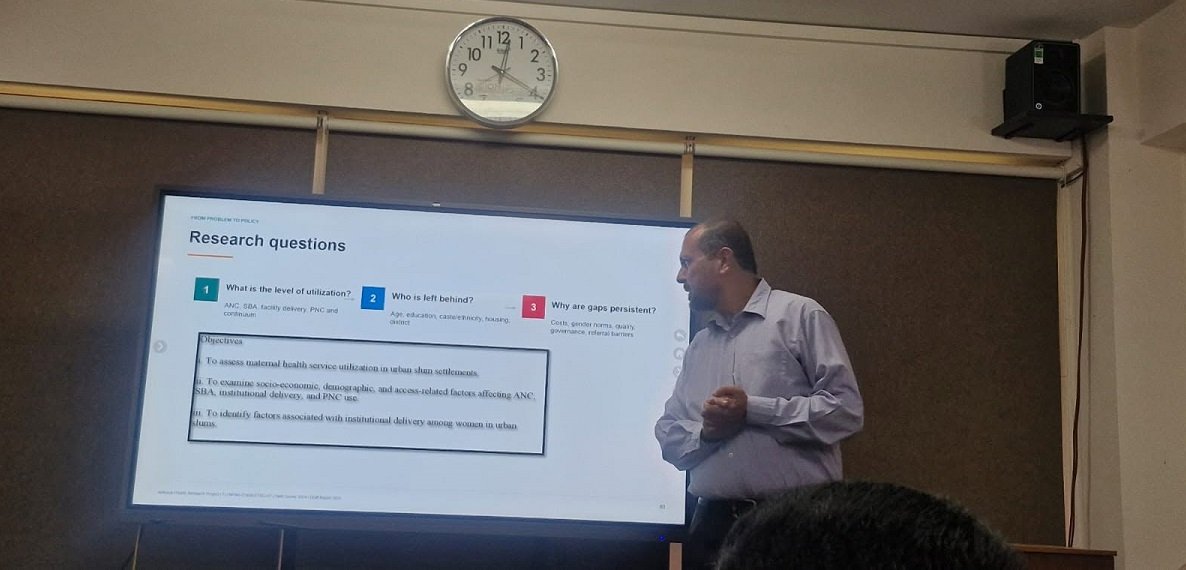
While presenting the report publicly in Kirtipur on Thursday, Dr. Devkota stated that although women go for health check-ups at the beginning of pregnancy, the number of women who go for health check-ups after childbirth is low. According to him, women did not avail ANC and PNC services due to unstable income, informal employment, unemployment, insecure housing, and limited financial resources.
“Even though these health services are free, women were found not to go to health institutions for their own and their child's health check-ups, citing reasons such as cost of medicines, diagnostic tests, transportation, and loss of daily wages,” Devkota said, sharing the study's conclusion.
The study was conducted in the then slum areas of Thapathali, Balkhu, Manohara, Godavari, among others, with the support of the Tribhuvan University Research Directorate.
Associate Professor Dr. Tantrika Khanal, a member of the study team, informed that 283 married women aged 15-49 years were included in the study. Although 580 households were selected as a sample for the study, the data of 283 women who had given birth to at least one live child in the last two years were used in the final analysis. The study showed that education, economic status, ethnic identity, and geographical location are the main determinants of maternal health service utilization.
Women who have attained secondary or higher education were found to be more likely to complete the entire cycle of maternal health services. Similarly, the study indicated that the utilization of ANC and skilled delivery services is comparatively lower among women of the Dalit community.
The study identified the lack of policies targeting slum areas, indirect costs, weaknesses in monitoring service quality, and the absence of programs suitable for the urban context as major challenges. To address this problem, the study suggested targeted cash assistance, expansion of community-based health access, improvement of service quality, and strengthening of urban health institutions.
According to the researchers, ensuring the continuity of services, rather than just access to maternal health services, is the current major challenge. This could also affect the achievement of Sustainable Development Goals (SDGs), concluded the study team's Dr. Khanal.
In the program, Dean of the Faculty of Humanities and Social Sciences Prof. Dr. Dubinanda Dhakal, Research Director Ishwar Koirala, Public Health Expert Dr. Khem Karki, former Head of CDPS Prof. Dr. Ramsharan Pathak, Associate Professor Dr. Uddhav Sigdel, among others, stated that government bodies should be urged to implement the report.
Yashoda Aryal, spokesperson for the Ministry of Health and Population, expressed commitment that the government would take the main problems identified in the report seriously and take concrete steps towards improving maternal and child health.
This specific news has been automatically translated by AI. As a result, there may be some inaccuracies or language errors.