CPN-UML Concludes National Workshop, Acknowledges Public Disconnect
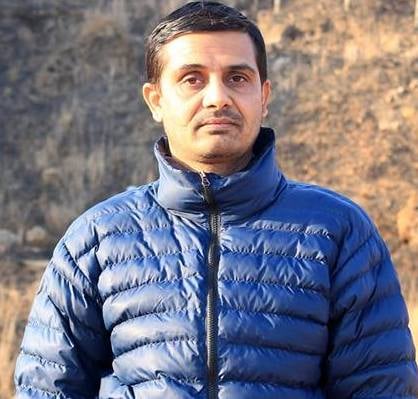
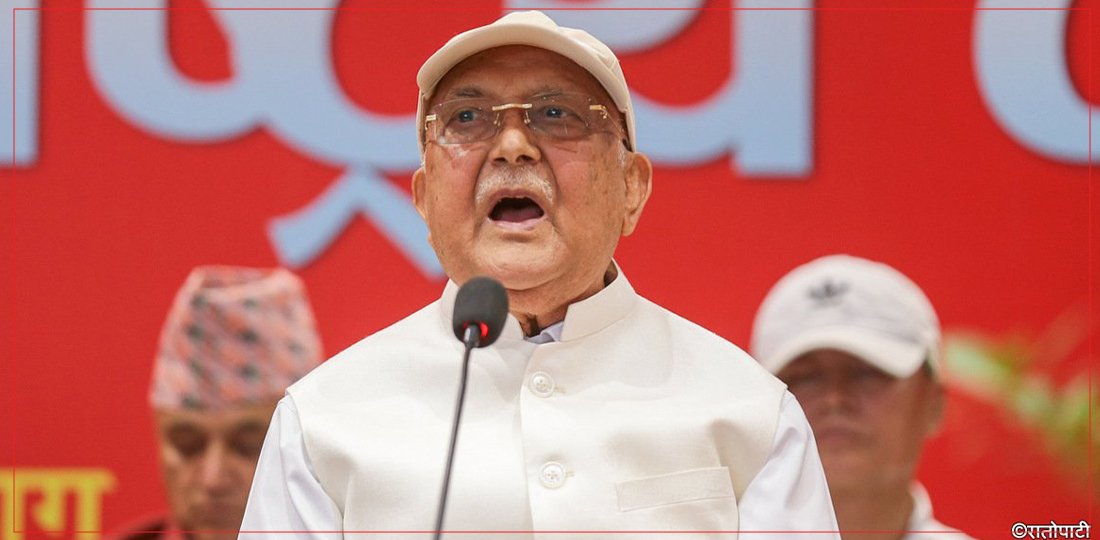
Kathmandu. CPN-UML has determined that the party's relationship with the public has drifted away due to the increasing luxurious and ostentatious lifestyles of leaders and the lack of good conduct and behavior. This conclusion was presented by leaders after group discussions at the two-day 'Party Membership Renewal and Expansion Motivation National Workshop' organized by the Organization Department in Kathmandu. The CPN-UML organized the two-day workshop with the aim of making the party effective after suffering a shameful defeat in the parliamentary elections held on February 21. The workshop, inaugurated by Chairman KP Sharma Oli on Wednesday, concluded with team leaders presenting the findings on how to make organization building more effective after group discussions in 10 groups on Thursday. In the workshop, leaders Krishna Prasad Jaishi from Sudurpashchim, Narayan Silwal from Capital Province, Navraj Sharma from Gandaki Province, Radhakrishna Kandel from Lumbini, Gulabjung Shah from Karnali, Chandreshwor Mandal from Madhesh Province, Ghanshyam Khatiwada from Koshi Province, Dawa Dorji Lama from Bagmati Province, Ashok Thkuri from Contact Coordination Group, and Maharaj Gurung from Mass Organization Group presented their group presentations. While presenting the conclusions, Jaishi from Sudurpashchim stated that to expand the organization and strengthen the party, leaders and cadres need to improve their lifestyles and conduct to systematize membership and improve the party's relationship with the public. 'We also need to pay attention to membership expansion and new distribution,' he said while presenting the group's conclusion at the workshop, 'We must admit that membership distribution and renewal have not been effective and take policies accordingly.' He stated that to improve the party's estranged relationship with the public, leaders and cadres must make extensive improvements in their lifestyles, their conduct and behavior should be simple, they should abandon expensive and ostentatious lifestyles, and adopt behavior that the public can easily accept. 'It is necessary to introspect on mistakes and weaknesses and go to the public after correcting mistakes,' Jaishi said, 'Leaders' economic and moral conduct must be clean.' Similarly, some team leaders suggested establishing a practice of properly evaluating the work done by mass organizations to make them effective and streamlining bloated committees. Some leaders who expressed their views suggested that the party would be strengthened only if plans were made for 5 members of the party committee to work full-time. 'If the party is to be strengthened after the election defeat, the party can move forward if the views coming from the grassroots are heard and corrected,' Jaishi told Ratopati. Maharaj Gurung, the team leader from the Youth Association representing the mass organizations, presented the conclusion. In the conclusion presented by Gurung on behalf of the mass organizations, it was suggested that organized members should have the right to choose candidates in the elections of their respective areas. 'The party leadership should also be chosen directly,' the source quoted Gurung as saying. Gajendra Thapaliya, a leader who participated in the group discussions on behalf of the mass organizations, said that most team leaders concluded that 'the party cannot function in its current state.' 'The party cannot function in its current state; it is mandatory to improve it – this was the summary from many,' Thapaliya said, 'What to improve can be a subject for another discussion.' Ghanshyam Khatiwada, the team leader from Koshi Province, told Ratopati that suggestions came up to resolve the complexities seen particularly in membership. 'Regarding party building, membership renewal from the bottom up and proper management of cadres should be done, which can make the organization and committees streamlined,' Khatiwada said, 'Some have also suggested extending the deadline for membership renewal and distribution.' Concluding the workshop, CPN-UML General Secretary Shankar Pokharel said that the party's policies and leaders need to change to 'battle' the changing psychology of society. 'Leaders must also change with time.' 'Every individual can present themselves effectively in society only up to a certain period,' said General Secretary Pokharel, 'Similarly, a policy or perspective can attract public attention for a certain time. For that, leaders must change themselves, and parties must also be able to change their policies and plans.' General Secretary Pokharel stated that the public seeks some change every ten years, and in such a situation, parties must be able to establish trust with the public and rebuild broken relationships. He said that People's Multiparty Democracy is the most important perspective for CPN-UML's party building, and the question of how much it has been implemented in practice has become a major issue for CPN-UML. The national workshop concluded by passing a 10-point resolution. The resolution announced the immediate advancement of the online renewal of the party's organized membership with the direct presence of the concerned individual. The workshop also resolved to create a minimum of 3 new party members for every 1 organized member. 'This workshop resolves to actively participate in the revolution of science and technology and social media, transforming party life into a digital revolution,' stated the resolution proposed and passed by Organization Department Chief Bhanubhakta Dhakal. 'Resolving to immediately complete the membership renewal work and re-energize the entire party from the local level to the ward, municipality, district, province, and the entire party,' said CPN-UML.
This specific news has been automatically translated by AI. As a result, there may be some inaccuracies or language errors.