
Youth Leadership and Systemic Change Crucial for Nepal's Progress, Experts Say

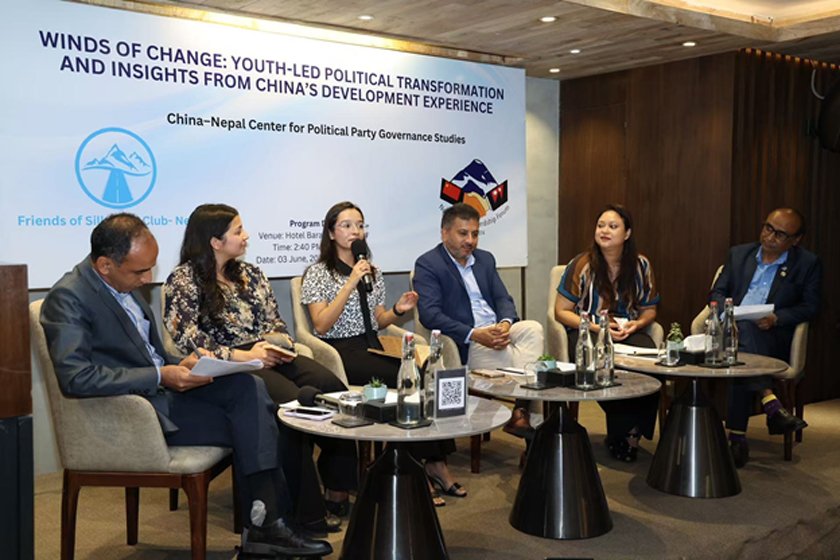
Kathmandu. Stakeholders have stated that timely change and youth leadership are essential for bringing about reforms in society and the state system. They emphasized that the pace of development has been hindered by the inability to adapt to the changing global environment, and stressed the need to change the 'comfort zone' and traditional leadership standards of the older generation. Their analysis suggests that the political awareness and activism seen in the younger generation, 'Gen-Z', in recent times can open a new door to good governance and prosperity in the country.
Dr. Jagdish Kumar Chhetri, a geriatric health specialist and director of the Nepal Geriatrics Center, stated that timely change is necessary to bring about reforms in society and the state system. He pointed out that the inability to adapt to the changing global environment is the main problem, and clarified that the pace of development has been obstructed because the older generation prefers to stay in the same 'comfort zone' for a long time and hesitates to learn new things.
Recalling the challenges of operating the 'Nepal Geriatrics Center' for the first time in Nepal, he mentioned that it required a lot of effort to establish and explain it, even though it was a new concept in South Asia. He expressed concern that the old standard of needing to be of advanced age or having spent a long time in jail to be a leader still persists in Nepal, and interpreted the current social and political changes as a process of 'updating' the system.
He believes that social change, like computer software updates, happens gradually and instills confidence in the younger generation. He says, 'Due to not moving forward with the times, the world has progressed so much, and we are still in the same old state. This problem is not just of the youth but also of the elderly and the old generation. We do not want to easily understand new things and accept change, which is why it takes time to identify any new work. The current youth generation wants to update rapidly. They are trying to move forward according to the global environment, but the old system was stopping it.'
Prof. Dr. Arjun Kumar Baral, Executive Director of the Center for Economic Development and Administration Research (CEDA), stated that only nations that embrace change can accelerate their development. Interpreting the 'Gen-Z Movement' as a link in that change, he mentioned that change is inevitable in the course of world development.
He depicted the end of the Rana regime, the restoration of democracy in 2046 BS, the Maoist armed conflict, and the republic and federalism established through the People's Movement of 2062/63 BS as important milestones of change, and stated that major political and social changes have been occurring in Nepal at intervals of every 10 to 15 years.
He gave examples of neighboring countries China and India, stating that China has achieved unprecedented development in a short period by rapidly adopting the currents of change, and India has also followed the same path, establishing itself as the world's strongest economy. He argued that the positive attitude towards change is the basis of development in America and Europe, and that the activism seen in the younger generation today should be viewed in conjunction with the natural process of development. He says, 'The world is changing, and the nation that can embrace and implement change in time will progress faster.'
Apeksha Shah, Associate Professor at the Department of International Relations and Diplomacy, Tribhuvan University, said that although the pace of development and good governance in Nepal is slow, the voice of the citizens is gradually becoming stronger. Analyzing recent political and social developments, she described the public outrage of the last Gen-Z generation as a result of decades of pent-up dissatisfaction.
According to her, recent movements were specifically focused on clear issues of economy and good governance. She indicated that continuous protests by teachers and various groups at places like Maitighar for the past two years signal deep dissatisfaction in society, and stated that there is a large gap between policymakers and the general public.
She believes that the current situation has arisen because policymakers have had ample time to seriously review the situation but have failed to properly respect public sentiment. She says, 'Policymakers did not pay the necessary attention to understanding and addressing the growing extreme dissatisfaction among the public in a timely manner. Ignoring these signs in society and the subsequent public disclosure of corruption scandals further fueled the anger among citizens.'
Recently, political awareness and activism among the Nepali youth generation have significantly increased. Neha Dahal, who holds a Master's degree in 'Business Analytics and Digital Transformation' from the Asian Institute of Technology (AIT) in Thailand, interprets this change in youth as a positive political awakening. Considering last year's Gen-Z demonstrations as an important turning point, Dahal mentioned that the movement has awakened even those youth who were indifferent to politics. According to her, youth who previously showed little interest in politics and governance are now capable of debating and advocating on serious issues such as the country's current situation, policy-making, and the budget.
This awakening has inspired youth not only to protest but also to closely observe and analyze the country's overall political and economic situation. She says, 'Youth who previously knew nothing about politics are now fully aware of what is happening in the country. The interest shown by youth in issues like the recent budget clearly shows how politically aware they have become.'
Barsha Katuwal, People, Culture & Business Operations Chief at 'Nepal Tea Collective' and a Zonta Scholar, stated that any new reform or change has two aspects, and the main objective of the Gen-Z movement is to end traditional leadership and opaque decision-making processes. She said that in the past, ordinary citizens did not have access to government decision-making processes and nepotism was rampant, and in its place, a new system is being sought.
She mentioned that the country is currently in a transitional phase with the formation of a new government, and the '100-point Governance Reform' plan put forward by the government is a positive start. However, she argues that as reform efforts continue, it will take some time to see concrete results, and that will be the real test for new leadership.
She says, 'Although no major change has been seen exactly yet, a kind of alertness in the style of work is felt. Previously, there used to be disagreements among family members about watching the news at home, but now a situation has arisen where the younger generation and parents sit together and discuss current news updates of the country. This change is real.' She has experienced that transparency in government activities has increased to some extent recently, public access to information has increased, and citizens appear more responsible and aware of news and information.
This specific news has been automatically translated by AI. As a result, there may be some inaccuracies or language errors.
_fkg5u05PqN.jpg)


_6BsDewPY2j.jpg)