Congress Whip Niskal Rai Discusses Parliamentary Issues and Government Accountability


Kathmandu. Opposition parties are protesting, stating that Prime Minister Balendra Shah (Balen) is unresponsive to Parliament. Their argument is that the House of Representatives meeting is not being conducted according to parliamentary practice, tradition, and dignity. On the May 7th House of Representatives meeting, two of the four parties in opposition even surrounded the well, while the main opposition Nepali Congress protested by standing. The Labour Culture Party, however, boycotted that day's House of Representatives meeting.
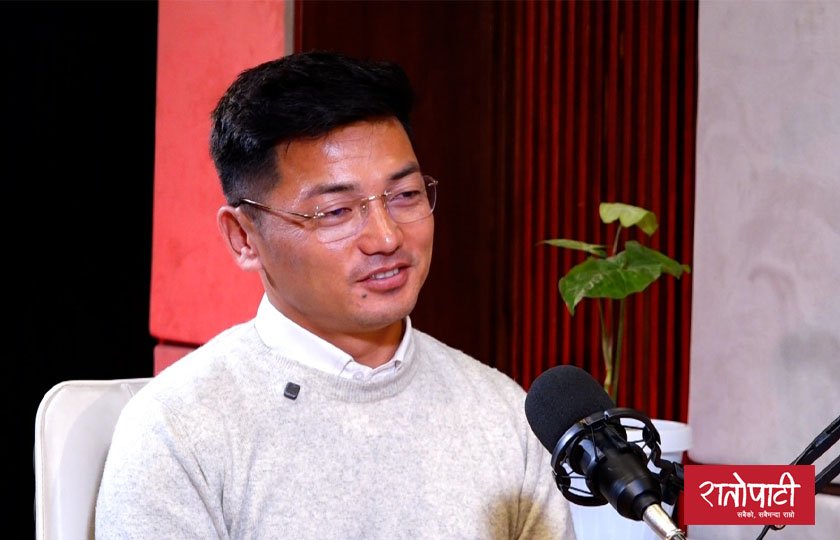
Currently, although Congress is the main opposition, some are commenting that it has not been able to fulfill that role, and instead, the Labour Culture Party is taking that place. In the Rato Pati podcast 'Talk Forward', Nepali Congress Parliamentary Party Whip Niskal Rai was directly asked this question - Is Congress not effectively fulfilling its role as the main opposition? It seems the Labour Culture Party is trying to bear that burden?
He replied, 'Congress is the custodian of this constitution and the democratic system. What we understand is that anarchy and noise do not provide solutions. The role of the opposition should not be measured solely by banging tables or chanting slogans. We are holding the government accountable through reasoned, policy-based, and citizen-centric issues.'
In an interview lasting about an hour, Rai, the elected Member of Parliament from Ilam Constituency No. 1, discussed issues of squatters, the current political landscape, the process from recommendation to appointment of the Chief Justice, and his political career. Here is the edited excerpt of the interview with Congress Whip Rai (detailed video can be watched and listened to):
You must be fine. But it seems Parliament is not so well. Is that so? Why is Parliament not well?
Parliament is an institution that should function in accordance with parliamentary practice and dignity. However, looking at the recent activities in the house, our assessment is that this institution is moving away from its established dignity. The dignity and vitality of Parliament lie in questions and answers. When we, as representatives, come here, the faces of all Nepalis should be depicted there. Whether it is a citizen from a remote village in Taplejung or from Dadeldhura, the government must answer their issues and questions. The more responsive and accountable the government is to the house, the greater the dignity of Parliament. However, the current situation where the government is unresponsive to the house and even doubts are cast on the Speaker's role means that Parliament is not functioning properly. In this sense, Parliament is not well.
Specifically, there was a dispute in the house regarding the Prime Minister's presence and question-and-answer session. The opposition parties went as far as standing protests and surrounding the well. Even though the rules themselves allow a minister designated by the Prime Minister to answer in his absence, why did you obstruct?
It is true that Rule 38, Sub-rules 3 and 4 of the House of Representatives Regulations 2079, provide for a designated minister to answer in the absence of the Prime Minister. However, the underlying spirit of this rule needs to be understood. This rule is used when the Prime Minister is out of the country, attending a meeting on a serious national crisis, or is in very poor health. But in the context of yesterday (May 7th), the Prime Minister was in the Prime Minister's Office, only two hundred meters away from the house. He was healthy and within the country. Not coming to face the house in such a situation is an insult to Parliament. Article 76(10) of the Constitution provides that the Prime Minister and ministers are collectively accountable to the house. As long as the Prime Minister is not accountable to the house, we are beginning to feel that he is moving towards autocracy. In our democratic model, the house belongs to the opposition, where the government must face the citizens' questions.
You also expressed dissatisfaction with the Speaker's role, why?
The Speaker is the guardian of the house. When making rulings, they must consider the sentiments of all parties and parliamentary dignity. Even when opposition parties were surrounding the well, the agenda of the house was advanced. In such a situation, the Speaker should have initiated dialogue. Instead of adjourning the house and seeking a solution through the Business Advisory Committee or party leaders, the process of passing bills was unilaterally advanced.
It is said that the Speaker went twice to request the Prime Minister to come to the house?
The Speaker himself went to meet the Prime Minister, which is not appropriate in parliamentary tradition. He should have coordinated through the concerned minister or parliamentary mechanism. This undermines the independent existence and dignity of the house.
There are also comments that Congress has not been able to effectively fulfill its role as the main opposition. Instead, the new party, Labour Culture Party, seems to be the main opposition?
Congress is the custodian of this constitution and the democratic system. What we understand is that anarchy and noise do not provide solutions. The role of the opposition should not be measured solely by banging tables or chanting slogans. We are holding the government accountable through reasoned, policy-based, and citizen-centric issues. Congress has a long political history and patience. We are a responsible opposition that exercises restraint to save the house from disaster and strengthen the system.
_pf0a2aTb7d.jpg)
Congress's stance was not seen in anything. It was the same in the recommendation for Chief Justice appointment. A written dissent was registered when the appointment was recommended by the Constitutional Council, but later it was unanimous in the parliamentary hearing committee. Why this 'U-turn'?
This is not a disagreement with the individual, but a disagreement with the process and method. Our objection is to the wrong precedent being set that the consent of 3 out of 6 members in the Constitutional Council is considered a majority. 3 out of 6 is never a majority. The government cannot disregard the provisions of the constitution and laws for its convenience. We have also raised procedural errors in the parliamentary hearing. The qualification of a judge should be based on the guidelines and precedents set by their judgments, not just by counting the number of judgments. We have held the government accountable when it attempts to undermine the rule of law.
What is your party's 'stand' on the squatter issue?
We are clear that the issue of landless and squatters must be resolved logically. We thank the government for its efforts in this direction. However, the government has completely ignored the human aspects involved in this process. Some actions taken in the name of 'fast track' have caused serious humanitarian crises. During the displacement of settlements, some citizens have committed suicide, and displaced mothers have not even received minimally nutritious food. The death of an elderly woman due to a heart attack while her house was being demolished is an extremely painful and sensitive issue. Before removing any settlement, the government should have had a clear action plan for their alternatives and management. Demolishing settlements without a definite goal of when and how they will be resettled is not justified. Currently, the displaced people have been housed in places like Banepa, but the government itself seems uncertain about how long and how they will be managed there.
But the government claims that previous governments complicated this issue for years and that they are now trying to provide a solution?
The government may consider it right from its perspective. We should not have a prejudiced mindset of thinking everything we do is right and everything others do is wrong. Before removing settlements, the impact it would have and the public reaction should have been considered. Displacement done without a plan is oppression of citizens, which is not permitted by the fundamental rights guaranteed by our constitution.
Previous governments also did not want to solve this problem. The commission for the landless and squatters had also done a lot of work before. Data has been collected in many local levels, and land ownership certificates have even been distributed to the landless in some places. Instead of acknowledging these achievements, the government's attempt to start the process from scratch is only a waste of time and resources.
It would be wise to proceed with the work based on the data already available at the CDO office and local levels. Such actions, disregarding human sensitivity and without a concrete plan for management, appear oppressive. Our emphasis is only that the courage to work is positive, but it must be humane and planned. Oppression without a plan is unacceptable.
_jd3CN4fihb.jpg)
You have been protesting the crackdown on businessmen through your social media. Is your assessment here too that the government has not followed legal procedures?
The government should create an intervention-free and independent investment environment for the private sector and industrialists. However, the behavior the government has shown towards some industrialists recently is extremely worrying. The 'arrest first, listen later' approach being adopted is contrary to democratic and legal systems.
If any businessman has made a mistake, there are many legal processes and bodies in the country for it. Investigations and actions should be carried out according to these established procedures. The government's dual character of intimidating investors on one hand and saying 'there is an investment environment' on the other cannot lead the country's economy in the right direction.
The government has set a target of 7 percent economic growth. The private sector is the main contributor to achieving this goal. Actions that discourage the sector that contributes the most to the economy and create an atmosphere of fear among them will hinder the journey of prosperity. It is this contradiction between the government's words and actions that we have alerted and informed the government about. Increasing the confidence of the private sector for the country's economic development should be the government's primary responsibility.
What about the ordinances?
Bringing ordinances is not entirely wrong in itself, but the main question is at what time and in what circumstances they are brought. Just because previous governments did so does not justify the current mistake. On one hand, setting a date for the convening of the parliamentary session through the Honourable President, and on the other hand, postponing the House of Representatives meeting to bring ordinances is an attack on the parliamentary system. This process is not right under any circumstances.
The government has such a large majority, and there is Parliament for discussion. Parliament is the forum for listening to and conveying the voices of citizens and voters. There is no justification for choosing the path of ordinances by bypassing this sovereign house where representatives are present.
The government says it brought ordinances to work quickly according to the mandate?
It may take some time to make laws through the parliamentary process, but if we break the democratic tradition and sequence in the name of doing things quickly and disregard the law, it will lead to disaster. The government must have democratic patience along with the zeal to work.
So, in the view of the main opposition party, Congress, is the current government not doing anything good?
We always support the good work done by the government. We are also providing constructive cooperation to the government on many issues. If we were only opposing for the sake of opposition, our presence in the house might be different. But our disagreement is with the government's wrong style of work. For example, the obsession with ordinances and the current 'bulldozer terror'. We have a clear opposition to these issues. Overall, I don't think the current government has been able to do concrete work that wins the hearts of the citizens. I don't think even some honorable members of the ruling party are satisfied with the government's style of work and pace. The government needs to show 'accountability' in its actions rather than just talking about 'breaking the sequence'.
Let's talk about your political career now. What prompted a young man studying college to suddenly enter parliamentary politics?
My journey in student politics began in 2065 BS from Shankar Dev Campus. I ran for member from the Nepal Student Union in the Swabiu election, but I couldn't win. I completed my MBS from Shankar Dev and also taught there for some time. But after my mother's death in 2078 BS, my father became alone, and I returned to my home district, Ilam. I became active in the party organization there. In the last election, the party trusted me and nominated me as a candidate, and with the support of the citizens, I have come this far.
Parliament is a forum where one can serve the country through policy-making, so I have taken it as both an opportunity and a challenge.
_9inN6pGzUm.jpg)
Looking at the internal situation of Congress, the party seems to be in more trouble after the special general convention. Are the signs that Congress will no longer be united visible?
It is natural for a large democratic party like Congress to have diversity of thought. A general convention is a democratic process where leadership competition takes place. In a competition, someone wins, someone loses. But our core value is the same - the protection of democracy and the constitution. Having some dissatisfaction and different opinions on leadership is a sign of movement. This will bring further refinement to the party. We will take the party further reformed by the time of the next general convention. Congress never shrinks; it can change itself according to the times.
The 15th general convention of Congress is scheduled for next October. You won in your first attempt in parliamentary politics. You have made a kind of 'leap' by getting a prestigious responsibility like Whip. Have you thought of contesting for a party office bearer position in the general convention?
You said 'leap', but I consider it a profound responsibility rather than personal ambition. Currently, I am focused and concerned about how to do justice to the role of Whip that I have received and how to efficiently advance the proceedings of the house.
Matters of party leadership or position are linked to 'teamwork'. I cannot reach the goal just by running forward saying 'I will become this'. For this, the support, cooperation, goodwill, and trust of party colleagues are necessary. The issue of groups or factions in politics is natural, but I prefer to call it 'ideological groups'. Just as looking at the same number from one side appears as '6' and from the other side as '9', in politics too, there can be different perspectives on the same issue.
Regarding the upcoming general convention, it is not something I can decide alone. I will proceed based on the collective sentiment after consulting with party colleagues. I will be seen in the role that my colleagues deem me suitable for. My main objective is not just to obtain a position but to make the party stronger and more dynamic. I am ready to fulfill with full loyalty whatever responsibility the general convention entrusts me with.
Video/Photo: Manoj Khadka/Rato Pati
This specific news has been automatically translated by AI. As a result, there may be some inaccuracies or language errors.