Nepal's Eviction of Squatters Sparks Legal and Human Rights Concerns


Kathmandu. The government has removed squatter settlements from areas like Thapathali and Manohara in Kathmandu on Saturday and Sunday. There is a risk of constitutional, legal, and human rights complications arising from the eviction of squatters or unorganized residents without proper verification.
Currently, there are 1,152,870 families landless across the country. While squatter settlements in the Kathmandu Valley are being cleared, the problem of squatters and landless people nationwide is likely to become more complex. As Nepal's constitution and existing laws protect citizens' right to housing, evicting people without following due process will be challenging for the government.
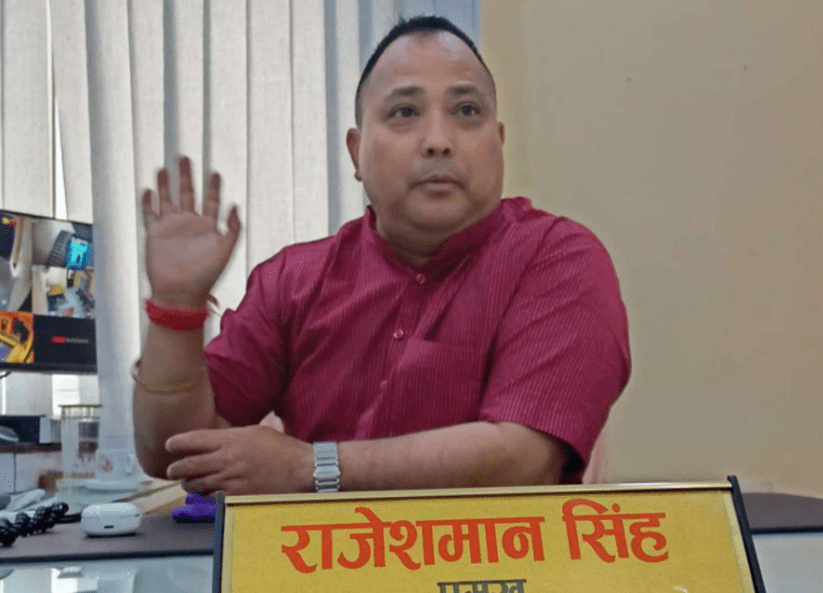
Senior advocate Rajupraasad Chapagain asserted that the government made an abrupt decision to remove the settlements without verifying the squatters. Chapagain stated that this creates a problem of how to manage them in the long term.
Article 37 of the Constitution of Nepal guarantees the fundamental right to 'adequate housing' for every citizen. Subsection (2) of the same article states: 'No citizen shall be evicted or encroached upon from their owned dwelling without due process of law.'
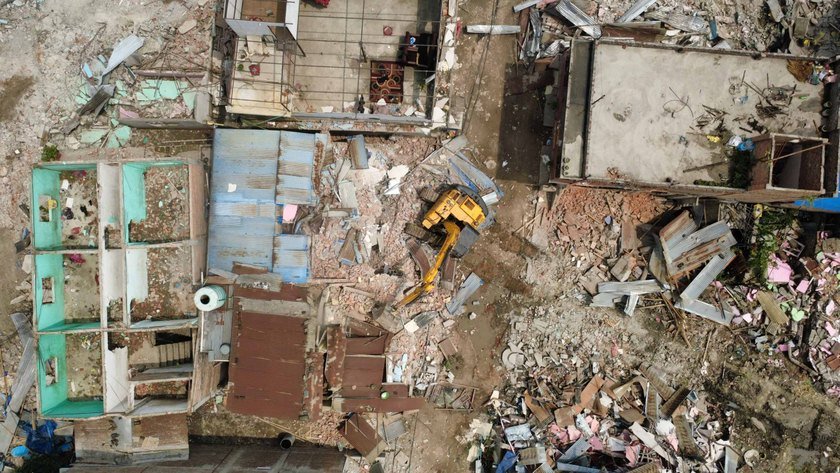
Although squatters do not own land, evicting them without due legal process is considered contrary to the spirit of the constitution. A writ petition was also filed in court against the eviction of squatters without management. In that writ, on Bhadra 17, 2080, a joint bench of judges Ramesh Dhakal and Dhruwachandra Nanda of the Patan High Court issued an order to identify squatters and verify them within six months, naming the Kathmandu Metropolitan City and 13 others as respondents.
The order of the High Court has not been implemented by the Kathmandu Metropolitan City and 13 other bodies even after three years.
The government, by issuing a notice within a week to remove squatter settlements without identifying and verifying squatters, has created a challenge in how their management will be carried out.
The Supreme Court has issued important orders regarding the eviction of squatters at various times. The court has clearly stated that before evicting any citizen from their housing, alternative arrangements for their residence must be made.
The court has ruled that the state cannot leave its citizens stranded on the streets. The Supreme Court had drawn attention to the fact that evicting without verification does not distinguish between 'genuine squatters' and 'occupiers' (those who are wealthy but seize land), leading to the genuine victims suffering.
Senior advocate Chapagain stated that the government's strategy to remove squatter settlements not only in the Kathmandu Valley but across the country will present management challenges. He described the recent actions taken by the government and local administration to remove squatter settlements as 'illegal' and 'arbitrary'.
He argued that evicting citizens from their dwellings solely based on the Home Minister's order, disregarding due process and legal procedures, is contrary to democratic values and norms.
Chapagain said it is regrettable that force is being used to resolve the squatter problem when there are clear laws and procedures. 'This is not happening based on a court order; no law gives any authority to the Home Minister to order the eviction of people from their dwellings,' he said.
The government's governance reforms 91 and 92 have specified clear procedures for the management of squatters and unorganized residents. Accordingly, the provision is that squatters must first be identified and verified, and only then managed or relocated as needed. Chapagain claims that attempting to remove them directly by violating the law, which aims for verification within 60 days and problem resolution within 1000 days, is illegal.
He said, 'The court had previously ordered the metropolis to complete the verification of the Thapathali squatters within six months, but failing to do so for two years and now suddenly bringing in bulldozers is a mockery of judicial orders as well.'

Reminding that the constitution guarantees the right to housing as a fundamental right, Chapagain stated that the procedures to be followed before eviction, as per Section 5(4) of the 'Right to Housing Act', have not been complied with.
Citing land reform data, he said that approximately 1.2 million families are squatters, landless, and unorganized residents across Nepal, and about 5 million people will be directly affected.
'This is a nationwide problem,' he said. 'If evictions continue in this manner without verification and planning, it will lead to a major social and legal crisis in the country.'
The Land Act, 2021 (eighth and ninth amendments) envisions a National Land Commission to solve the problems of squatters and unorganized residents. The act assigns the commission the responsibility of identifying landless squatters, collecting their data, and verifying them. Stakeholders say that removing them as illegal until the commission completes the data collection and verification process is contrary to the spirit of the act.
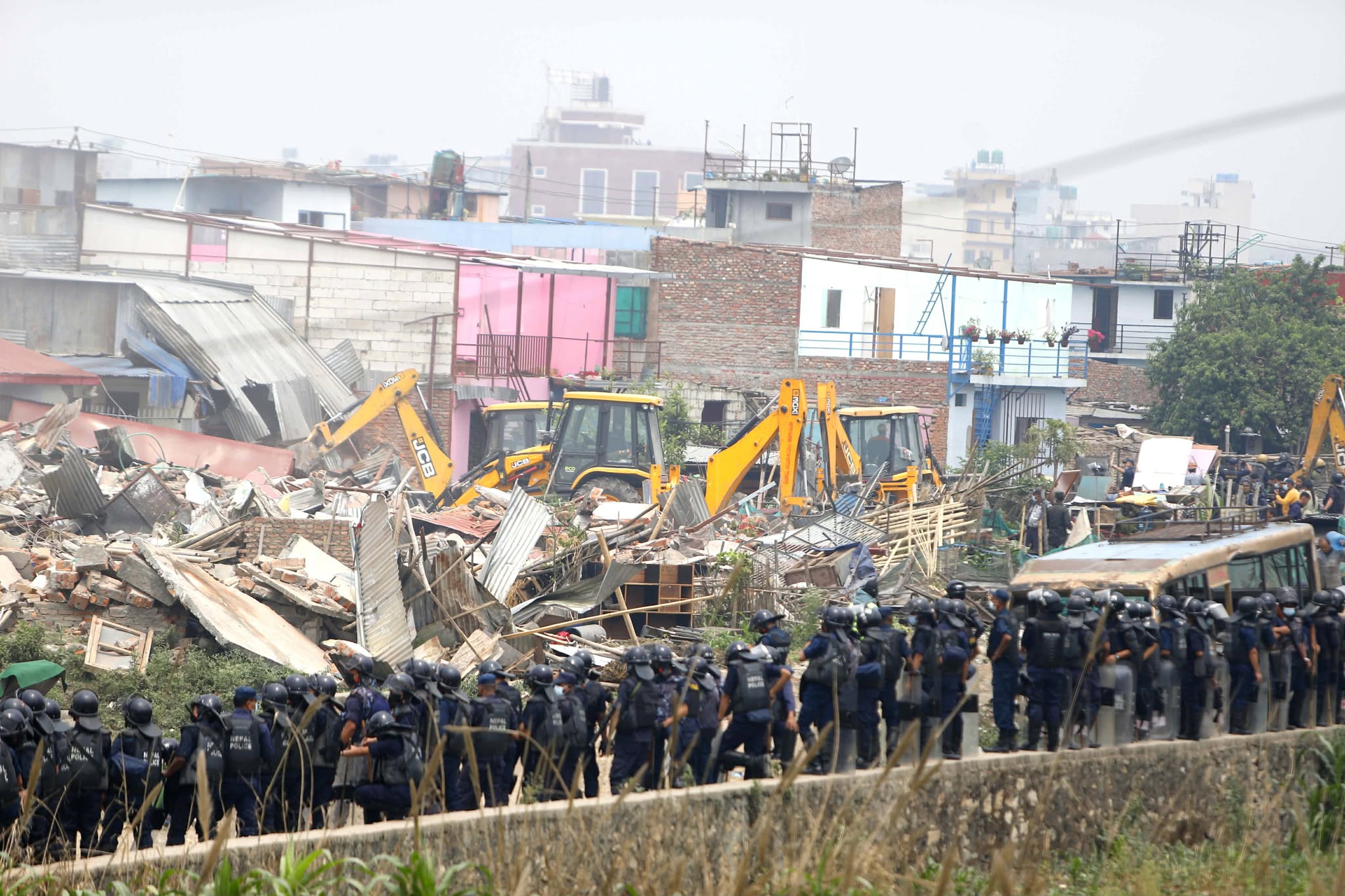
The Local Government Operation Act, 2074, gives local levels the authority to protect public land. However, squatter management falls under the purview of the federal government's Land Commission. When the commission is working, local levels forcibly removing them creates a legal and procedural conflict between the two government bodies.
Various international treaties signed by Nepal (e.g., the International Covenant on Economic, Social and Cultural Rights 1966) recognize the right to secure housing as a human right. 'Forced eviction' without alternatives and due process is considered a serious violation of human rights under international law.
This specific news has been automatically translated by AI. As a result, there may be some inaccuracies or language errors.