Bagmati Province Moves to Abolish Five Directorates for Administrative Reform


Hetauda. In an effort to improve institutional and administrative efficiency, the Bagmati Province government is preparing to abolish five directorates under various ministries.
Aiming for a leaner administration, the provincial government plans to retain only two out of the existing seven directorates.
The government intends to merge the Agriculture Directorate and the Livestock Development Directorate into a single entity, while retaining the Health Directorate and dissolving all others.
The directorates slated for abolition include the Transport Infrastructure Directorate, Education Development Directorate, Forest Directorate, and the Industry, Commerce, and Consumer Protection Directorate.
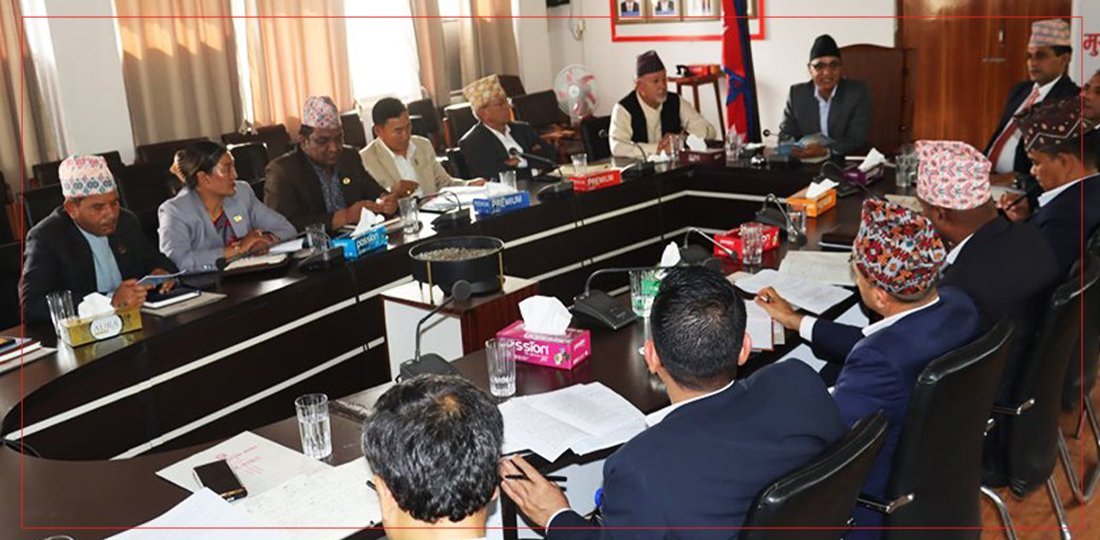
A high-level steering committee for administrative restructuring and reform, led by Minister for Agriculture and Livestock Development Madhusudan Paudel, has initiated the final preparations for these closures. The decision is based on a report prepared by an expert group led by former secretary Bimal Wagle, which was commissioned last Mangsir.
Accordingly, the steering committee has written to all ministries and thematic parliamentary committees to submit their suggestions by the 11th.
Based on these suggestions, the government plans to implement the administrative restructuring before setting the budget ceiling for the upcoming fiscal year.
The government's decision, aimed at cutting administrative costs and eliminating duplication of work, is not without controversy.
Former Joint Secretary Yagyanath Dahal warned that abolishing the directorates could lead to legal and managerial complications. He stated that the dissolution is not merely an administrative decision but a complex legal matter, making a direct abolition inappropriate.
According to Dahal, the Forest Act clearly defines the position and role of the Provincial Forest Director. He noted that the director is designated as the final appellate authority for hearing complaints against decisions made by the Division Forest Office, particularly in disputes such as the revocation of community forests.
He argued that in the forestry sector, which operates with technical and semi-military structures, a lack of a clear chain of command would disrupt administration. He added that while the government's goal of cutting costs is commendable, taking steps without establishing a legal basis could lead to administrative chaos.
'Technical work is not possible from the ministry'
As the government prepares to replace directorates with ministry divisions, employees have argued that this move is impractical. A deputy secretary at the Ministry of Physical Infrastructure Development stated that while the ministry handles policy, tasks such as detailed design of bridges and roads, approval of cost estimates, and complex contract management are purely technical matters. He argued that these tasks cannot be managed by the ministry's administrative structure.
He noted that over the past seven years, the directorate has played a leading role in upgrading over 2,000 kilometers of roads, constructing 170 road bridges, and over 190 suspension bridges. He suggested that the directorate is the appropriate body to introduce modern technologies like information management systems and road asset management for quality control. He emphasized that the directorate is an indispensable body for installing Bailey bridges during emergencies and constructing long-span suspension bridges.
He explained that the directorate, acting as a department-level office under the Ministry of Physical Infrastructure Development, has been active since the inception of the province in line with the federal government's organizational structure. Led by an 11th-level official (Director), the directorate has been responsible for constructing, expanding, maintaining, and regulating roads according to the provincial road master plan, approving cost estimates, tender documents, contract agreements, variation orders, and time extensions, as well as providing technical monitoring and evaluation of projects. The directorate has also served as a knowledge transfer hub and provided technical solutions for project implementation.
The directorate is also positioned to work on public-private partnership and hybrid annuity models for road development, and could collaborate with universities to establish a provincial technical staff college for research.
Fear of legal and quasi-judicial crisis in the forestry sector
Similarly, a deputy secretary at the Ministry of Forest and Environment stated that the abolition of the Forest Directorate would lead to legal complications. He noted that the Federal and Provincial Forest Acts of 2076 grant the directorate not only administrative but also quasi-judicial powers.
Since the law stipulates that decisions made by the director are final regarding appeals against the revocation of community or religious forests by the Divisional Forest Officer, the abolition of the directorate would leave no body to hear public grievances. He mentioned that the directorate has been responsible for the performance evaluation and close monitoring of 22 budget implementation units and 1,015 employees.
He stated that the directorate is empowered to investigate and make decisions similar to a court in matters of land acquisition. Given that the forest service is a technical and semi-military structure, he argued that the directorate is essential to maintain the hierarchy and chain of command.
According to him, the directorate's primary responsibility is to technically review and approve or recommend strategic plans, herbal pocket areas, and partnership forests to the ministry. He added that the director has the authority to approve the auction of forest products worth over 2.5 million rupees, conduct initial environmental examinations, and monitor industrial pollution in accordance with provincial environmental laws.
This specific news has been automatically translated by AI. As a result, there may be some inaccuracies or language errors.