Irrigation Shortages Lead to Decline in Spring Paddy Cultivation in Kanchanpur

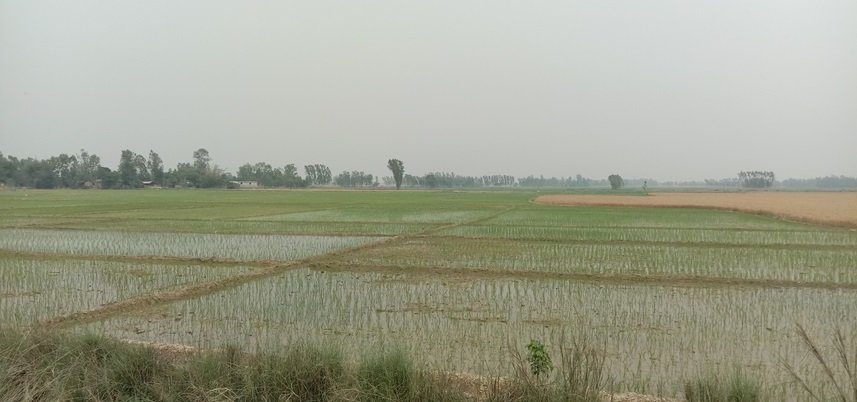
Kanchanpur. The number of farmers cultivating spring paddy (Chaite Dhan) is declining. According to data from the Agriculture Knowledge Center and the Prime Minister Agriculture Modernization Project office in Kanchanpur, the number of farmers planting spring paddy is decreasing every year.
Assistant Crop Development Officer at the Agriculture Knowledge Center, Dharma Bahadur Saud, stated that while spring paddy was cultivated on 400 hectares in the district a few years ago, it is now limited to only 150 hectares.
“We provide farmers with various agricultural tools and facilities, including boring for irrigation,” he said. “Spring paddy requires significant irrigation, and the lack of such facilities here is causing the decline in cultivation.” He noted that although the center provides boring facilities at a 50 percent subsidy, it has not been sufficient for adequate irrigation.
The Agriculture Knowledge Center has been supporting farmers with seeds, fertilizers, irrigation, and plowing equipment under the spring paddy promotion program. “Even though spring paddy yields more than other varieties, cultivation has decreased due to the lack of irrigation,” he said. “Farmers receive support from our technicians.” Local farmers complain that despite the higher yield of spring paddy, they are unable to cultivate it because the Mahakali Irrigation Canal does not provide regular water supply.
“Compared to other paddy, spring paddy production is higher, but it requires a lot of water,” said local farmer Tirtha Rana. “Water in the Mahakali canal is not regular, and boring water is not sufficient for spring paddy.” In Beldadi, which once had the highest spring paddy cultivation in Kanchanpur, farming has now ceased. Farmers say they have stopped planting spring paddy as fields are left fallow due to irrigation issues. Dinesh Chaudhary mentioned that irrigation shortages make farming difficult. “Spring paddy needs sufficient water, and water does not come into the Mahakali canal at that time,” he said.
The Prime Minister Agriculture Modernization Project Paddy Zone office also reported that paddy cultivation in Kanchanpur has not met its targets.
Kanchanpur has a total of 161,741 hectares of cultivable land. Of this, 59,602 hectares, or 36 percent, is under cultivation. Irrigation facilities are available on only 29 percent of this area. Paddy is cultivated on 48,600 hectares in Kanchanpur.
Currently, irrigation facilities are available on 11,600 hectares in Kanchanpur through the first and second phases of the Mahakali Irrigation Project. The first phase, which began in Bikram Sambat 2042 and was completed in 048, provides irrigation to 4,800 hectares, while the second phase, completed in 052, covers 6,800 hectares. Irrigation from these two phases serves Bhimdutta, Bedkot Municipality, and Beldadi Rural Municipality.
This specific news has been automatically translated by AI. As a result, there may be some inaccuracies or language errors.