Bagmati Province Government Moves to Streamline Administration and Reduce Ministries


Hetauda. The Bagmati Province government has accelerated the process of 'Provincial Administrative Restructuring' to reduce administrative structures and enhance operational efficiency. The government has initiated this management work with the goal of finalizing the administrative framework before the budget formulation for the upcoming fiscal year (2083/084).
The provincial government has moved forward with administrative restructuring to cut public expenditure, manage development budget spending, and ensure quality service delivery to citizens along with good governance.
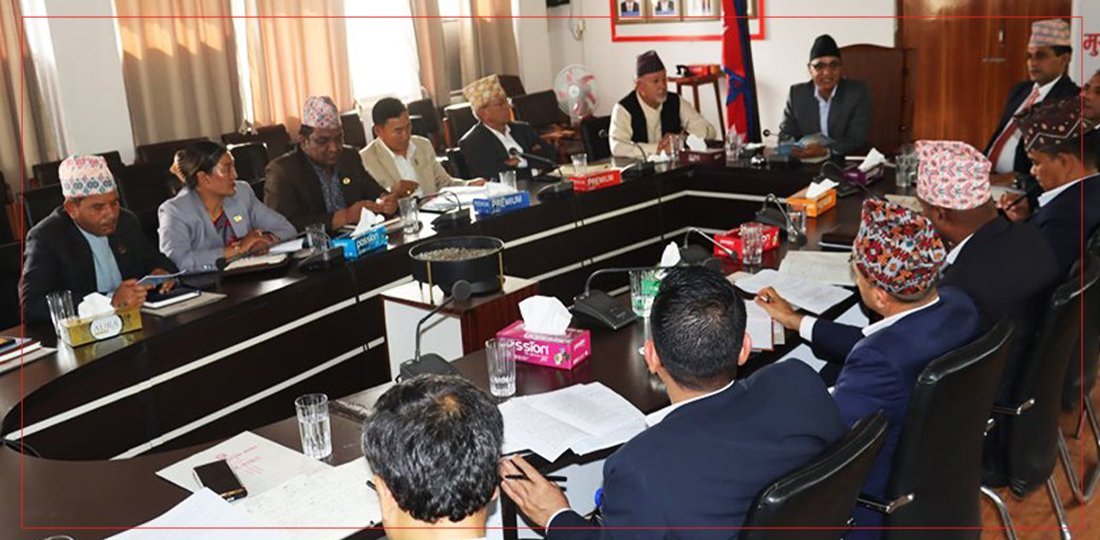
A high-level steering committee, formed by the provincial cabinet under the coordination of Minister for Agriculture and Livestock Development Madhusudan Paudel, has intensified the work of structure creation and management.
Minister Paudel stated that work is underway to finalize the report of the expert committee under the steering committee. According to him, there is a plan to finalize the report provided by the expert committee based on suggestions from provincial ministries and parliamentary committees.
Minister Paudel mentioned that the government, preparing for administrative restructuring, has written to all ministries and thematic committees of the Provincial Assembly to send necessary suggestions within 15 days.
According to Minister Paudel, the government will take a final decision on restructuring after receiving suggestions by Baisakh 7. He noted that since the departmental responsibilities of the ministries proposed by the study committee may be changed as needed, formal suggestions have been requested from stakeholders.
Preparation to reduce from 14 ministries to 8
The current government led by Chief Minister Indra Bahadur Baniya is working to reduce the existing 14 ministries to 8. For this, a consensus on reducing the number of ministries was reached during a discussion held a few days ago between the major ruling coalition partners, the Nepali Congress and the CPN (UML).
The expert team led by former secretary Bimal Wagle, in a report submitted on Falgun 27, pointed out that only 8 ministries, including the Office of the Chief Minister, are necessary. Based on this report, the government has also proposed cutting 701 staff positions for administrative cost reduction and a leaner administration.
According to the government's plan, out of the 7 directorates in the province, only the Agriculture Development Directorate and the Health Directorate will be retained, while 5 directorates will be abolished. The expert team also suggests removing various boards and unnecessary structures in the province.
The expert committee has suggested removing the current Ministry of Internal Affairs and Law, Ministry of Water Supply, Energy and Irrigation, Ministry of Labour, Employment and Transport, Ministry of Industry, Commerce, Land and Administration, Ministry of Culture and Tourism, Ministry of Youth and Sports, and the Ministry of Health.
According to the committee's suggestion, 8 ministries have been proposed by incorporating the responsibilities of those ministries into others.
As per the expert team's proposal, the Office of the Chief Minister and Council of Ministers, Ministry of Economic Affairs and Planning, Ministry of Industry, Culture, Tourism and Transport, Ministry of Agriculture, Livestock, Land Management and Cooperatives, Ministry of Physical Infrastructure Development, Ministry of Forests and Environment, Ministry of Urban and Local Development, and Ministry of Health and Social Development are to be maintained.
According to government spokesperson and Minister for Economic Affairs Prabhat Tamang, since there is a consensus among the ruling coalition parties on changing the number of ministries and administrative structures, the restructuring work will be completed based on technical suggestions received within the next 15 days.
Previously, on Chaitra 17, the Nepali Congress parliamentary party meeting had also decided to cut ministries and subordinate bodies.
This specific news has been automatically translated by AI. As a result, there may be some inaccuracies or language errors.