Gen-Z Movement Leader Rakshya Bam Reflects on Protests and Quest for Justice

Surkhet. A massive protest took place in Nepal on Bhadra 23 and the following day. On the 23rd, during the protest held in the name of Gen-Z, 22 students were killed while still in their school uniforms. As a result, the protest on the 24th became even more violent and aggressive. Not only were government offices across the country damaged, causing billions in losses, but another 54 people also lost their lives unnecessarily.
How did the movement, primarily focused on Gen-Z issues and demands, turn into destruction? Why did the state reach a brutal point where it had to open fire on school children? Regarding this, Gen-Z movement leader Rakshya Bam says – it was stated that the protest on Bhadra 23 would be peaceful, but she remains unanswered as to why such a situation occurred.
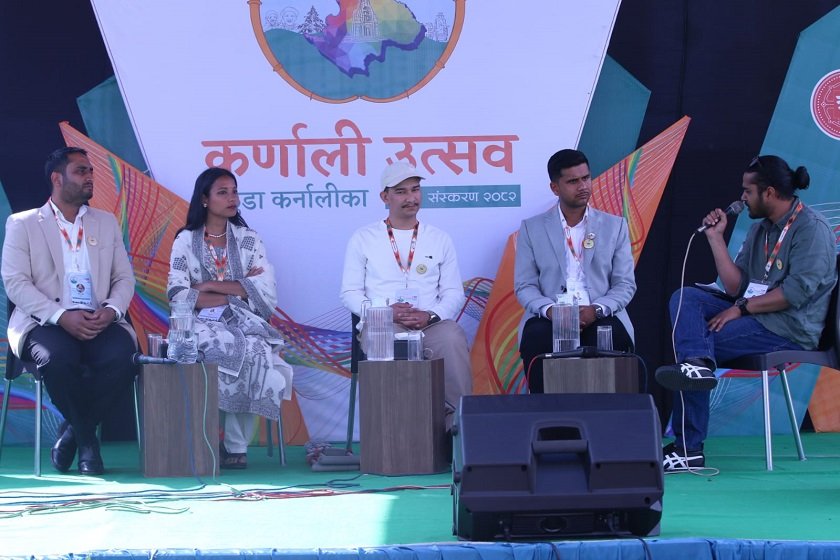
Speaking at the 'Gen-Z: From Street to Parliament' session of the Karnali Festival held in Birendranagar, Surkhet on Saturday, Bam stated that they are still demanding an investigation into the destruction that occurred on Bhadra 24.
'We raised our voices demanding the public release of the Karki Commission report, believing that its release would mean we had received justice,' she said, 'It was leaked, but the government did not make it public.'
However, she mentioned that the recommendation for action against the then Prime Minister and Home Minister based on that report gave her a sense of receiving some justice.
'We felt that we had conducted a peaceful protest, but how did it turn towards destruction,' she added, 'We had gone into the protest saying we would not even break a flower.' However, she stated that they have been demanding the release of the Karki Commission report to find out how it became violent.
'We still want the destruction of the 24th to be clarified,' she continued, 'We want to know the reality of the second day.' She expressed that the matter should be studied. Bam stated that society has already punished the then Prime Minister, Home Minister, and old political parties as part of the Gen-Z movement's agenda.
'Justice is both legal and social; legally, the then PM and Home Minister were arrested, the case went to court, and they were released,' Bam added, 'This is the rule of law. It is a legal process.' She said that the main point of the Gen-Z movement was change, which the public has already chosen through the election by opting for a new generation.
However, Bam says that until the general public can feel the sense of change and good governance, the issues of the Gen-Z movement will not take concrete shape.
Bam also stated that she will always continue to keep a watch from the streets.
Regarding the current government, she said, 'When various accusations are leveled against the Gen-Z generation, I get curious. There is also an accusation that this generation will also engage in corruption and mismanagement; I think corruption and mismanagement are not about age. It must be about mindset and thought.'
Manish Khanal, a member of the Rastriya Swatantra Party (RSP), said that they joined the movement precisely because there should be good governance. 'We jumped into the movement because we believed that transformation along with generational change was necessary,' he said, 'That happened, and now we will work on the issues of good governance.'
He stated that the RSP has worked to provide stability to a country that was in instability.
Another youth, Dhiraj Joshi, said that one should consider the operation of the government and service delivery by looking at the entire country, not just the government or the streets. 'Protests happen, governments are formed, but how one should work on issues of national security and integrity is important,' he said.
Prakash Bohora, who was injured in the Gen-Z movement, said that the movement has yet to receive justice.
Clarifying further about his shoes, which became an icon of the movement, he said, 'Our objective was against the corruption, nepotism, and mismanagement in the country.' He expressed hope that the current two-thirds majority government of the RSP was formed because that blood would receive justice.
Bohora expressed his sadness over the release of the then Prime Minister Oli and Home Minister Lekhak, who suppressed the Gen-Z movement.
'They killed us with the barrel of a gun, but I don't know how the judiciary decided and under which section they were released,' he said, 'We were told to go home while still in the hospital. That is happening wrongly.' He also stated that looking at the current situation, purification is necessary within the judiciary itself.
This specific news has been automatically translated by AI. As a result, there may be some inaccuracies or language errors.