Artemis II astronauts return safely to Earth after historic lunar mission

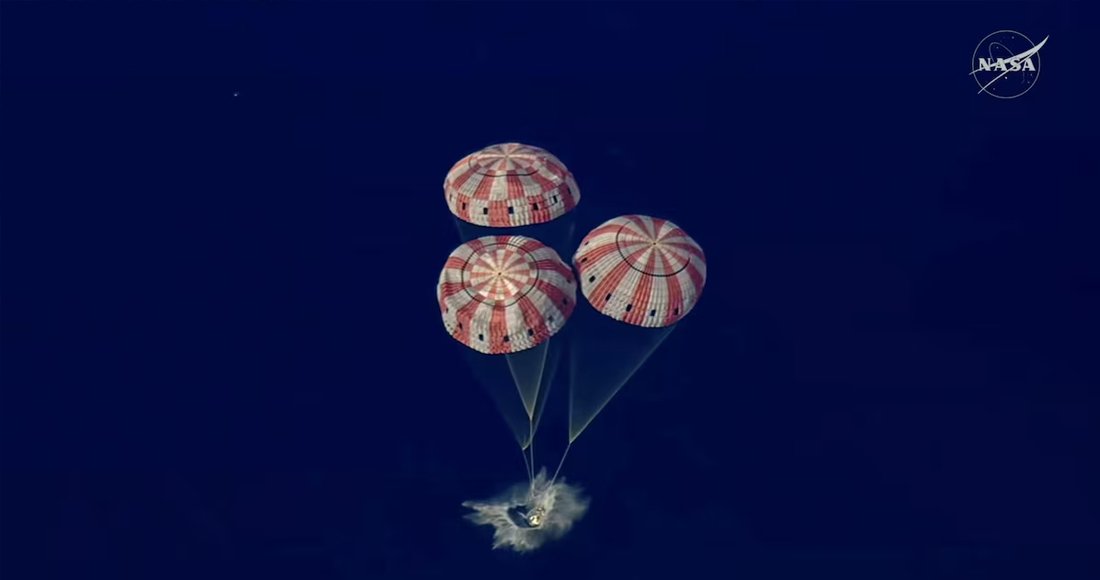
Washington. After a 10-day space journey orbiting the Moon, the four astronauts of the Artemis II mission have returned safely to Earth. Their Orion capsule splashed down in the Pacific Ocean on Friday.
This was the first historic mission in over half a century to carry humans near the Moon and return them safely to Earth. NASA's gumdrop-shaped Orion capsule, named Integrity, descended into the ocean off the southern coast of California with the help of parachutes after 5 PM local time.
The final 13 minutes of re-entry into Earth's atmosphere were highly challenging and dangerous. During this phase, the capsule's external temperature reached up to 2,760 degrees Celsius.

Due to the plasma generated by extreme heat and air pressure, radio contact with the astronauts was completely lost for several minutes. However, once contact was re-established, the capsule's parachutes were seen deploying, slowing the craft to approximately 25 kilometers per hour for a safe splashdown.
Launched on April 1 from Kennedy Space Center in Florida aboard NASA's massive Space Launch System (SLS) rocket, the mission covered a total distance of 1,117,515 kilometers. The crew included American astronauts Reid Wiseman (50), Victor Glover (49), Christina Koch (47), and Canadian astronaut Jeremy Hansen (50).
This journey set several historic records. Glover became the first Black person to reach the vicinity of the Moon, Koch the first woman, and Hansen the first non-American citizen. They traveled over 406,771 kilometers from Earth, breaking the distance record set by the Apollo 13 mission in 1970.

Following the successful uncrewed test of the Orion capsule in 2022, this was the first crewed test flight. Its primary objective was to lay the foundation for NASA's long-term plan to land astronauts on the lunar surface by 2028 and extend human exploration to Mars in the future.
Much like the space race between the US and the Soviet Union during the Cold War, the US aims to outpace China in the space race through the Artemis program. This successful landing has validated the heat shield of the Lockheed Martin-built Orion spacecraft.
Addressing issues observed in the previous flight, NASA engineers modified the re-entry trajectory. Furthermore, the mission proved that the SLS rocket, developed by Boeing and Northrop Grumman over more than a decade, is fully ready and capable of safely transporting humans into space.
Following the splashdown, teams from NASA and the US Navy recovered the four astronauts from the floating capsule and transported them to a nearby ship for initial medical evaluations.
This specific news has been automatically translated by AI. As a result, there may be some inaccuracies or language errors.