RSP Dismisses Minister Deepak Kumar Sah Amid Internal Power Struggles
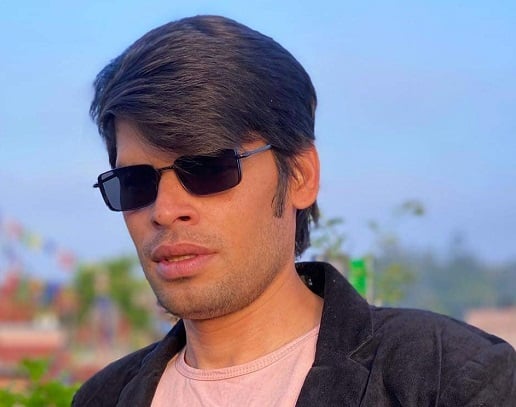

Kathmandu. The Rastriya Swatantra Party (RSP) has dramatically recalled Minister of Labour, Employment and Social Security, Deepak Kumar Sah. The party's Central Disciplinary Commission concluded that Minister Sah abused his position by facilitating the appointment of his wife to the long-inactive Health Insurance Board. Following the commission's recommendation, the RSP advised Prime Minister Balendra (Balen) Shah to remove him from his ministerial post.
Immediately following the party's recommendation, Prime Minister Shah dismissed Minister Sah on Thursday. In the same development, the RSP has recommended that the Prime Minister issue a warning to Minister of Health and Population, Nisha Mehta.
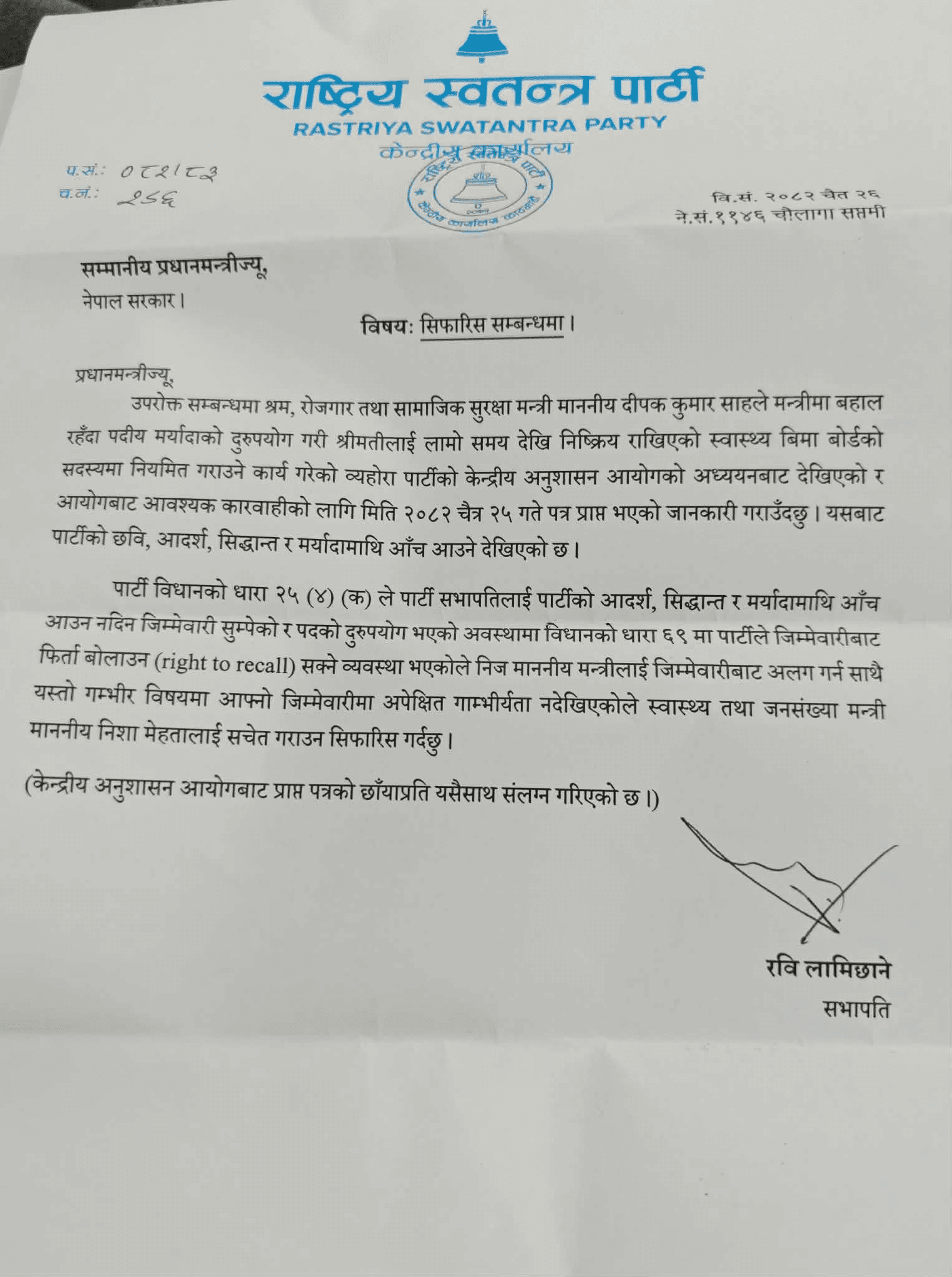
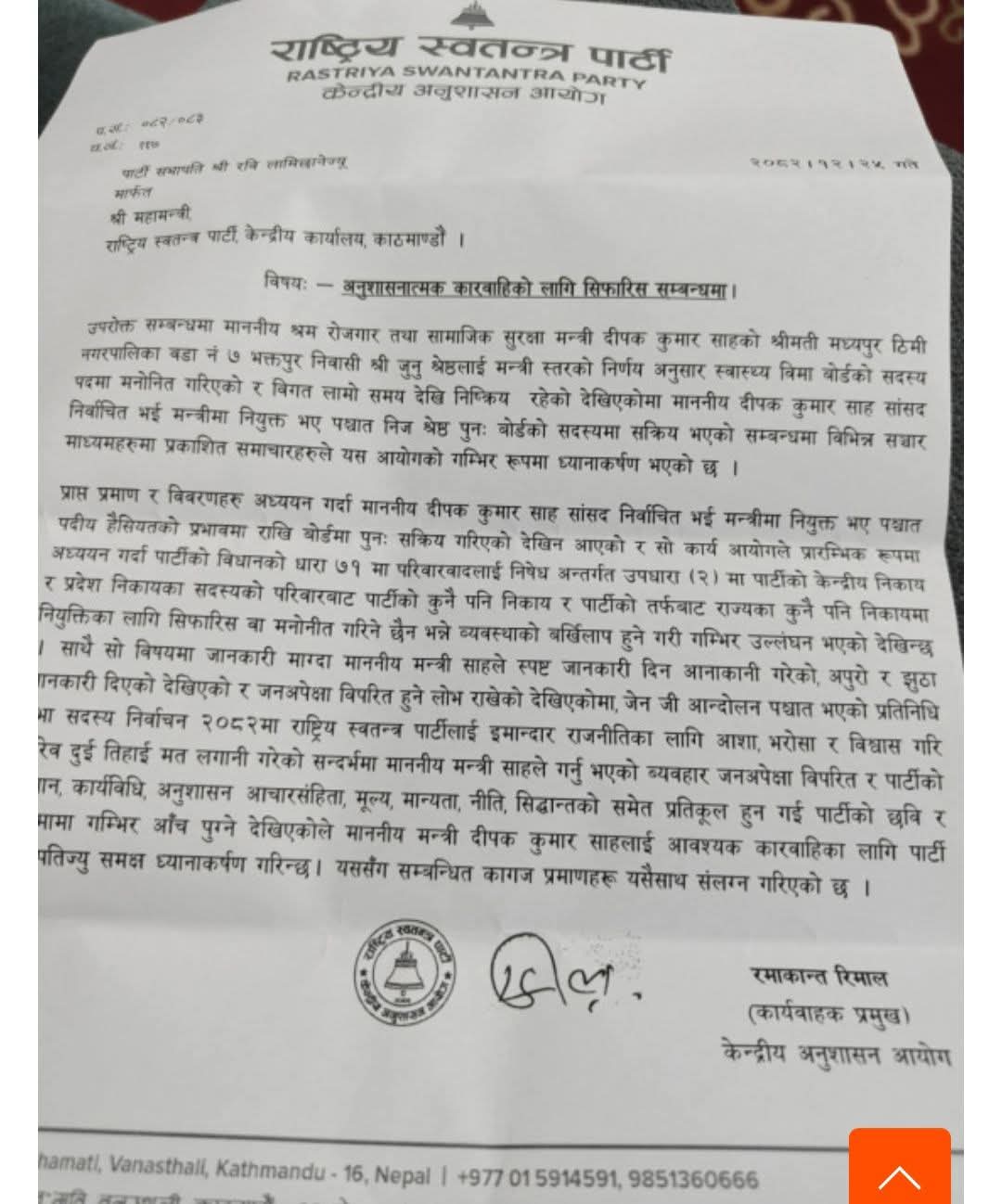
The Disciplinary Commission discussed Minister Sah's case during its meeting on Chaitra 25. The commission recommended action under Article 71(2) of the party statute after preliminary investigations revealed that Sah had abused his position to activate his wife, Junu Shrestha, as a member of the Insurance Board. Questions have been raised within the party after Chairman Rabi recommended Sah's dismissal to the Prime Minister without convening the party's secretariat or central committee meeting upon receiving the commission's letter.
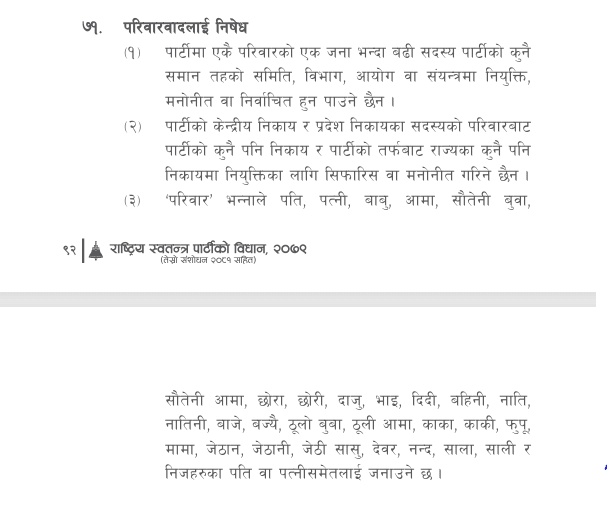
Article 71, Sub-section 2 of the statute stipulates that family members of party central and provincial body members cannot be recommended or nominated for any position in the party or state bodies on behalf of the party.
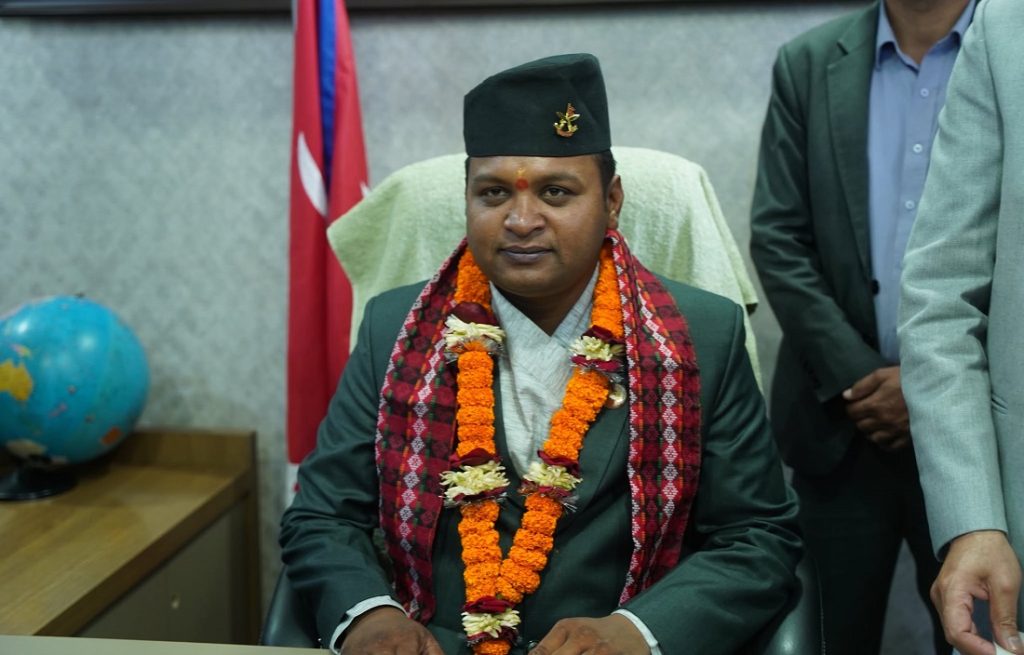
Leaders are surprised as to how Sah, who was not visible since the party's inception, secured a ticket, increased his access to top leaders, and became a minister despite the presence of many qualified and capable lawmakers. A founding leader of the party stated that the leadership failed to pay attention when making Sah a minister, who had won the election based on the wave in favor of the RSP and Balen Shah.
'We have been saying that we choose the knowledgeable. We don't even know who he is. Who gave him the ticket? Who brought him into the party, there is no information,' the leader told Ratopati. 'It is fine that he won in the rush because of the atmosphere in favor of the RSP this time, but on what basis was he made a minister? In which committee of the party was it discussed? Where was it discussed when he was dismissed now? There is no information.'
The leader expressed that if the leadership prioritizes opportunists like Sah while sidelining capable individuals who have worked honestly since the party's inception, there will be no difference between new and old parties.
Acting Chief of the Disciplinary Commission, Ramakant Rimal, clarified that the commission only has the authority to recommend action based on complaints received, while the Central Committee holds the power to decide whether to implement the action or not.
'It is the commission's job to investigate received complaints and recommend action to the party. The Central Committee decides whether to take action or not,' Rimal said.
Sah was elected from Mahottari-2 in the House of Representatives election held on Falgun 21. He became the Labour Minister on Chaitra 13 and was dismissed within 13 days. Following her husband's dismissal, Sah's wife, Junu Shrestha, expressed her dissatisfaction via social media. In a Facebook live, Shrestha objected to linking every woman's progress to men. She questioned, 'Is it good governance to remove someone from office without explanation?'

'There is a lot of talk about good governance outside right now. If linking a qualified woman to her husband and dismissing her without any legal process and explanation is good governance, then I think we all need to re-read what good governance means,' she said.
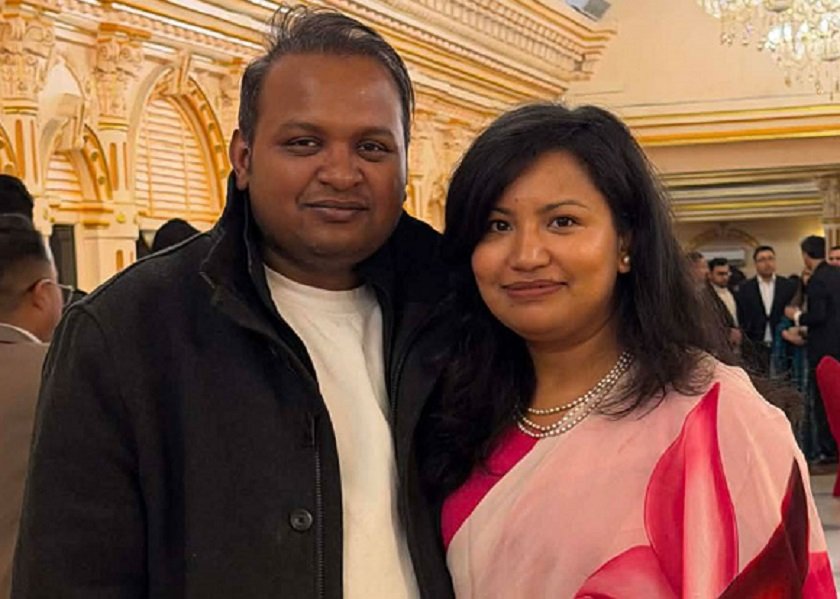
Sah has also complained about being removed from office without being given a chance to explain. Sah is considered close to Prime Minister Balen. He was also accused of fraud by promising to help pass the MBBS examination. The police filed a case against Sah in the Kathmandu District Court on Kartik 3, 2073. The court acquitted him on Mangsir 16, 2073, stating that the claims in the fraud case were insufficient. Questions have also been raised about Sah's educational qualifications.
In the previous election, Dr. Dhaka Kumar Shrestha, who was a proportional representative MP, was dismissed after an audio clip surfaced in which he asked for a two-lakh bribe from medical businessman Durga Prasai.
Joint General Secretary Bipin Kumar Acharya clarified that the promises made to the public during the election are the party's official stance. He stated that whether any individual's appointment or performance was in accordance with the party's rules, statutes, and methods would be discussed in the secretariat meeting.
'The promises made to the public during the election are the party's official stance. There is no compromise on that. Everyone must follow the party's rules, statutes, and methods,' Acharya said, 'If information is received that the performance or appointment process was not in accordance with the rules, it will be discussed in the party meeting. We have included the right to recall in the statute specifically to ensure there are no errors in the appointment process.'
- Balen's influence in minister selection
Some view Minister Sah's dismissal as a power struggle between Chairman Rabi and Prime Minister Balen within the RSP. Before the election, a 7-point agreement was reached between Rabi and Balen on Poush 13. Point number 4 of the agreement mentioned that Rabi would remain the party chairman and Balen would be the candidate for the future Prime Minister.

Although there was a clear basis for the RSP to become a large party, RSP leaders could not internally assess that they would get votes close to a two-thirds majority. With the final election results, leaders including Chairman Rabi, Vice-Chairman Dol Prasad Aryal, General Secretary Kabindra Burlakoti, and Secretariat member Hari Dhakal expressed ignorance about the alleged agreement to make Balen the Prime Minister. Arguments also grew that Balen could not become Prime Minister due to the issue of selecting the parliamentary party leader under Article 66 of the statute.
However, dispelling all these doubts, the RSP called a meeting of the Central Committee and the Parliamentary Party on Chaitra 12. The joint meeting unanimously approved Rabi's proposal to make Balen the party leader. On Chaitra 13, the President appointed Balen as Prime Minister under Article 76(1) of the Constitution.
But the chairman did not bring a proposal on who to make ministers in the joint party meeting. After questions were raised about the leadership's working style, Chairman Rabi requested trust in the leadership regarding the selection of ministers. He committed to selecting based on individual qualifications, ability, subject expertise, inclusivity, and geography.
Although it was claimed that there was no power-sharing in the selection of cabinet members, another leader said that 7 members each were included from the two groups. According to that leader, to balance power, Rabi wanted to make DP the Home Minister. Prime Minister Balen wanted to make Sunil Lamsal the Home Minister. After an agreement could not be reached on both DP and Sunil, Balen-close Sudhan Gurung became the Home Minister.
From the Rabi faction, Dr. Swarnim Wagle, Shishir Khanal, Birajbhakta Shrestha, Pratibha Rawal, Sobita Gautam, Nisha Mehta, and Gita Chaudhary became ministers. From the Balen faction, Sudhan Gurung, Sunil Lamsal, Khadgaraj Poudel, Sasmita Pokharel, Dr. Bikram Timissina, Dr. Deepak Sah, and Sita Badi became ministers.
Vice-Chairman DP, who had an effective role since the party's inception, was made the Speaker. Balen did not attend the parliamentary party meeting called on Chaitra 19 to decide on making DP the candidate for the Speaker post.
Just on Friday, two ministers were appointed to the government. Among the two newly appointed ministers, one each is from Rabi and Balen's side. Ramji Yadav, appointed as Minister of Labour, Employment and Social Security, is considered close to Chairman Rabi, while Gauri Yadav, appointed as Minister of Industry, Commerce and Supplies, is close to Prime Minister Balen.
- Differences over Deputy Speaker
According to the Constitution, the Speaker and Deputy Speaker cannot be from the same party and gender. Within the RSP, which holds the decisive power in selecting the Deputy Speaker, there was a disagreement between Rabi and Balen on which party to support.
In the meeting held on Chaitra 26, an agreement could not be reached as Rabi stood in favor of RPP and Balen in favor of the Labour Culture Party. As they would be members of the Constitutional Council, the opposition Congress, UML, and Nepali Communist Party also claimed the Deputy Speaker post. According to the Parliament Secretariat's schedule, the time for nomination registration was from 11 am to 2 pm on Thursday. RPP parliamentary party leader Gyanendra Bahadur Shahi, citing Chairman Rabi, had proportional MP Saraswati Lama register the nomination.
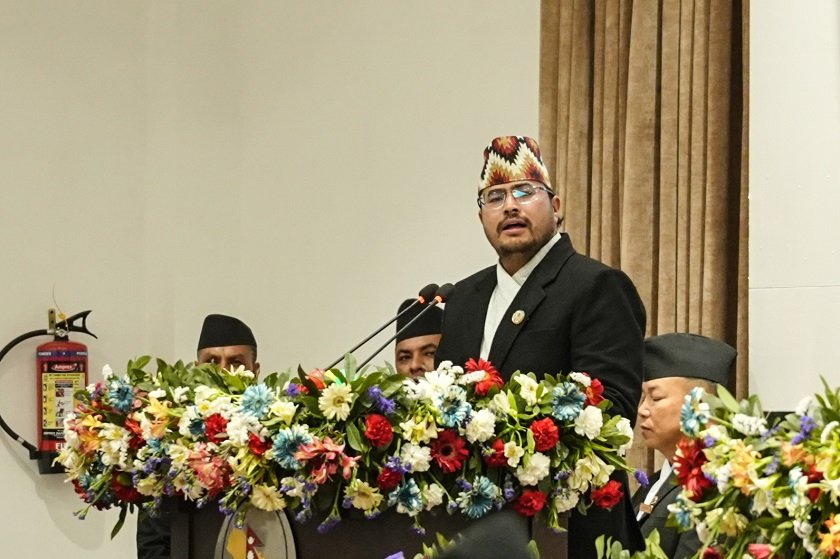
On the other hand, the opposition Congress, UML, and NCP said they would support Labour Culture Party MP Ruby Kumari Thakur. Top leaders were engaged in discussions at the parliamentary party office in Singha Durbar on whom to support for Deputy Speaker. Eventually, the RSP reached the conclusion to support Thakur, the candidate of the Labour Culture Party. The parliamentary party meeting held on Friday decided to support the Labour Culture Party's candidate for Deputy Speaker.
RSP spokesperson Manish Jha has insisted that there was no discussion regarding supporting the RPP. Speaking to journalists at Singha Durbar, he refuted Shahi's claim. 'On what basis is he saying this, who was he talking to, I am not aware of that. That also needs proof, who was he talking to,' he counter-questioned.
Similarly, after dissatisfaction grew regarding the order of precedence of members in the cabinet, Prime Minister Balen changed the order of precedence on Chaitra 24. There is also talk that Rabi and Balen disagreed on the issue of the government tightening entry for lawyers at Singha Durbar.
- Bitter reality of the past
Since the establishment of democracy in 2007, no government has been able to work for a full term. It appears that internal contradictions within parties are primarily responsible for political instability. In the 75 years since democracy, 58 governments have been formed.
The government fell in 2009 due to the power struggle between Matrika Prasad Koirala and BP Koirala within the then Nepali Congress. In 2014, one can read in political history that an undeclared power struggle took place between Subarna Shamsher and BP within the Congress. Subarna transferred leadership to BP by calling a special general convention in 2014. However, old Congress leader Omkar Prasad Shrestha said that the special general convention was held with the calculation that a clear majority could be brought in the election after putting BP forward as the Prime Minister.
In the first general election held in 2015, the Congress brought a two-thirds majority. However, in 2017, King Mahendra deposed the BP government and banned political parties.
After the restoration of democracy in 2046, the Congress brought a majority in the elections held in 2048 and 2056. But as the power struggle between top leaders within the party intensified, the single-majority government fell before completing its term.
In 2074, within the Nepal Communist Party formed by the merger of the then CPN-UML and CPN-Maoist Centre, the power struggle between the two chairmen KP Oli and Prachanda led to the fall of the majority government and the division of the party. Gen-Z youth, frustrated by all these events, rebelled in Bhadra. Embracing that spirit of rebellion, the RSP, which entered the election, brought an unprecedented majority.
Keeping in mind the history that even a single-majority government could not last the full term due to power struggles within parties and bitterness between the ruling party and the government, the RSP faces the challenge of keeping the Balen-led government for the full term. However, it remains to be seen whether the power struggle between Rabi and Balen will escalate or if coordination will be maintained between the party and the government to fulfill the people's expectations.
This specific news has been automatically translated by AI. As a result, there may be some inaccuracies or language errors.