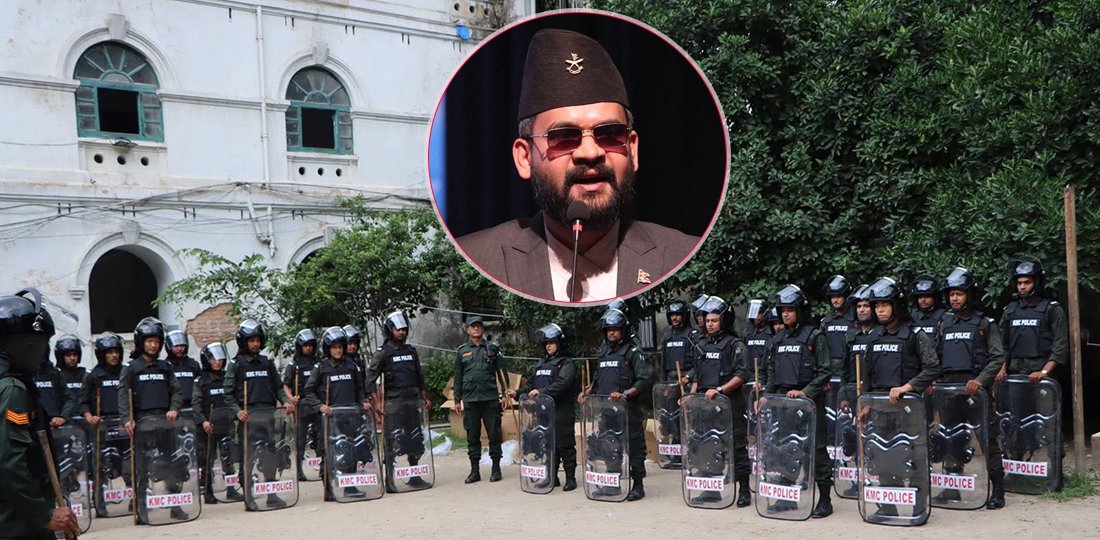
Political Tensions Flare in First House of Representatives Meeting Over Gen-Z Protests


Kathmandu. In the first meeting of the House of Representatives formed following the elections on Falgun 21, lawmakers engaged in heated exchanges regarding the Gen-Z protests that occurred on Bhadra 23 and 24. During the inaugural session, one representative from each political party and an independent lawmaker delivered congratulatory remarks.
Following the elections, the Rastriya Swatantra Party emerged as the largest party with 182 seats, followed by the Nepali Congress with 38 seats, CPN-UML with 25 seats, and the Nepal Communist Party with 17 seats. The Labour Culture Party secured 5th place with 7 seats, while the Rastriya Prajatantra Party placed 6th with 5 seats. Former minister and scientist Mahabir Pun serves as an independent lawmaker. During the remarks, which were allocated based on seat count, party leaders traded barbs over the Gen-Z movement.
Rastriya Swatantra Party Chairman and MP Rabi Lamichhane spoke briefly and sarcastically about the Gen-Z movement during his address. He focused solely on the need for justice for the mother of a martyr who lost their life during the protests. Lamichhane stated, ‘I want to inform you that the wrong practices of the past, such as amending laws and issuing ordinances to save one's own people and frame opponents, will be corrected immediately. The first right to justice belongs to the martyr's mother, and this cannot be called revenge.’

The CPN-UML had expressed objections as soon as the meeting began regarding the potential arrest of UML Chairman KP Sharma Oli and Congress leader Ramesh Lekhak, who were Prime Minister and Home Minister, respectively, during the Gen-Z protests. Lamichhane's remarks were a direct response to this.
Following Lamichhane, main opposition Nepali Congress MP Bhishmaraj Aangdembe argued that it is necessary to analyze the events of both Bhadra 23 and 24 individually. ‘Some see the events of the 23rd but ignore the 24th, while others see the destruction of the 24th but ignore the repression of the 23rd! This trend is completely wrong,’ Aangdembe said. ‘The government-formed inquiry commission investigated the events of the 23rd and recommended action, but claimed it did not have time to investigate the 24th. What kind of method is this? It is hard to believe that the repeated extensions and the claim of insufficient time were not intentional by the members of the commission.’

Congress MP Aangdembe also demanded that the government make the report of the Gauri Bahadur Karki-led inquiry commission public. ‘I want to draw the attention of the new Prime Minister—should the government itself make the inquiry commission's report public, or should the government also read it in the Gorkhapatra?’ he asked. ‘I urge the government to present itself thoughtfully, respecting the law and due process.’
He also drew the government's attention to the burning of physical structures, including the Parliament building and Singha Durbar. ‘Why was the Parliament building reduced to ashes? Why was Singha Durbar burned? Why were so many physical structures destroyed? I want to draw the government's attention through the Speaker,’ Congress MP Aangdembe said.
Aangdembe stated that the Congress remains clear on the principle that the guilty should not escape and the innocent should not be framed. ‘The Congress has long held the belief that “no guilty person should escape, and no innocent person should be framed.” We remain clear and firm on this belief today,’ he said.
UML parliamentary party leader Ram Bahadur Thapa ‘Badal’ demanded answers from the government regarding the purpose and intent behind the destruction on Bhadra 24. Badal stated that the reasons behind the burning of Singha Durbar, the President's residence, and the Parliament building must be uncovered.
‘Why was Singha Durbar burned? Why was the Parliament building burned?’ Badal questioned. ‘For what purpose is a cycle of repression and state terror being unleashed nationwide today?’
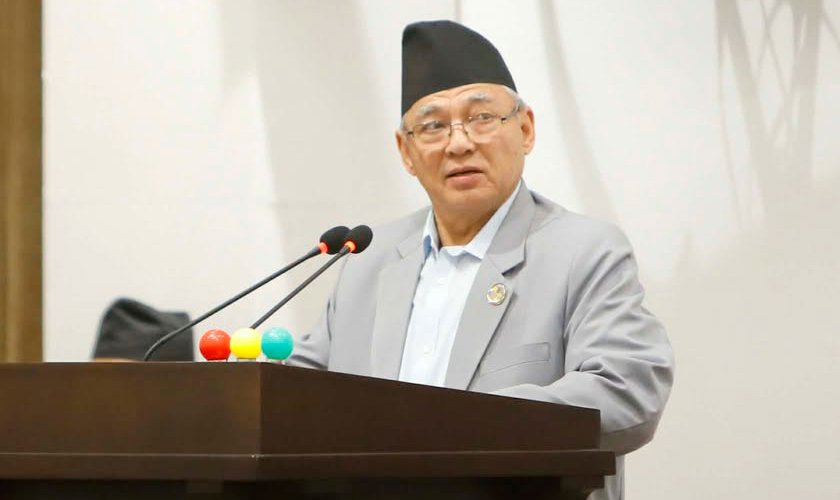
He also accused external forces of working to secure the “magical victory” of the Rastriya Swatantra Party. He alleged that the army and various visible and invisible forces played a decisive role in the party's election success.
Badal alleged that the army, bureaucracy, the government led by Sushila Karki, the Karki Commission, and institutions like the Bar-Bar Foundation played a decisive role in the RSP's victory in the Falgun 21 elections.
‘Countless facts clarify who played a decisive role in this magical victory, including invisible forces, TOB, AI, algorithms, Goebbels-style media trials that established heroes of nationalism, democracy, republicanism, federalism, peace, and prosperity as notorious villains and murderers,’ Badal said. ‘They turned villains who burned the country and erased our national identity into great heroes.’
Badal claimed that the Rastriya Swatantra Party achieved a miraculous victory through invisible forces, TOB, algorithms, and media trials.
Nepal Communist Party MP Barshaman Pun stated that they accept the questions raised by the youth on Bhadra 23 and 24. ‘It was a rebellion on the streets, saying that this type of development, this speed, and this level of governance were not enough,’ Pun said in the meeting. ‘We accepted that and went to the elections, and a mandate has come from the elections. We all accept that mandate.’

Labour Culture Party Chairman Harka Raj Rai (Harka Sampang) stated that a high-level investigation into the Gen-Z movement and the arson must be conducted. ‘A high-level committee must be formed to investigate the act of bringing children onto the streets in school uniforms in the name of the Gen-Z movement, inciting peaceful protests into violence, and burning the country's supreme bodies, including Singha Durbar and the Parliament building, on Bhadra 23 and 24,’ Harka Sampang demanded in the House.

Rastriya Prajatantra Party's Gyan Bahadur Shahi and independent MP Mahabir Pun, who also delivered congratulatory remarks, did not raise any issues regarding the events of Bhadra 23 and 24.
This specific news has been automatically translated by AI. As a result, there may be some inaccuracies or language errors.