Behind the Scenes of Budget Formulation: Chronic Projects and Administrative Failures in Koshi Province

Biratnagar. It has been over 5 years since the provincial government began construction of the Koshi Refreshment Center in Koshi Rural Municipality, Sunsari. A detailed project report was prepared for the center, which is being built on 22 bighas of land, at a cost of 4.706 million rupees.
The project was planned to be executed in two phases. According to the provincial government's plan, 577.8 million rupees were allocated for the first phase and 1.5055 billion rupees for the second. However, the first phase remains incomplete to this day.
The provincial government is not only moving forward with the process of handing over this project to the private sector, claiming the province cannot complete it, but is also preparing to change the 'variation'. Following a complaint filed with the Commission for the Investigation of Abuse of Authority (CIAA) regarding this matter, the provincial government is now in a state of confusion over how to proceed.
The construction of the road from Ghinaghat (Pushpalal Chowk) to Virat Chowk in Morang, which the Koshi provincial government started with great fanfare as its pride project, is another example of mismanagement. Since the day he became Chief Minister, Hikmat Kumar Karki had repeatedly expressed his desire to inaugurate this road with officials. Due to insufficient budget allocation for this road in the two budgets presented during his tenure, the pace of work has been sluggish.
With only 10 million rupees allocated for this road in the current fiscal year, despite a requirement of 150 million rupees, it appears that Chief Minister Karki's dream of inaugurating the road will not be fulfilled this fiscal year either.
_a2vAPBo4Kn.jpg)

The agreement for this road construction was signed on 2076 Ashar 29. Even after nearly 5 years since the contract expired, progress is limited to 85 percent. This road was contracted for 686.6 million rupees.
Data on multi-year projects provided by the Ministry of Economic Affairs and Planning of the province shows a massive pile of stalled projects across the province. Hundreds of multi-year projects worth billions of rupees announced in sectors including roads, bridges, drinking water, irrigation, urban development, and hospital construction are currently in limbo.
Projects started 5 to 7 years ago (around fiscal years 2075/76 and 2076/77) have not reached even 25 percent progress despite repeated extensions. Some projects worth tens of millions are missing from the ministry's own records. Some projects have zero progress, yet the government continues to allocate budgets to such abandoned and untraceable schemes.
- Billions in liabilities due to past weaknesses
The largest share of infrastructure development is occupied by roads and bridges. According to the data, there are 68 multi-year projects in operation in the province, including 51 roads and 17 bridges, with a total contract value exceeding 2.38 billion rupees. Most of these projects have become 'chronic' and stalled.
The Mechi Highway section (Bagadagi-Haldibari) in Jhapa, costing 334 million rupees, was contracted in 2078 and was supposed to be completed in 2080. Its progress is only 25 percent. The progress of the Kankai Lakdigadhi road, costing 209.5 million rupees, is only 35 percent even after the deadline passed in 2080. Construction work on the 639.2 million rupee Bhojpur-Dingla road (Tritale section) has barely reached 22 percent completion.
The situation with bridge construction is similar. The bridge over the Dudhkoshi River connecting Udayapur and Bhojpur was contracted in 2077 for 212.3 million rupees, but progress is only 20 percent. The deadline for the bridge over the Tamor River connecting Panchthar and Terhathum passed in 2078, yet progress is only 65 percent. This bridge was contracted for 223.7 million rupees.
In terms of urban development and building construction, hospital buildings that provide direct benefits to the public have been abandoned for years, while the government is pouring budget into unproductive areas like welcome gates and view towers.
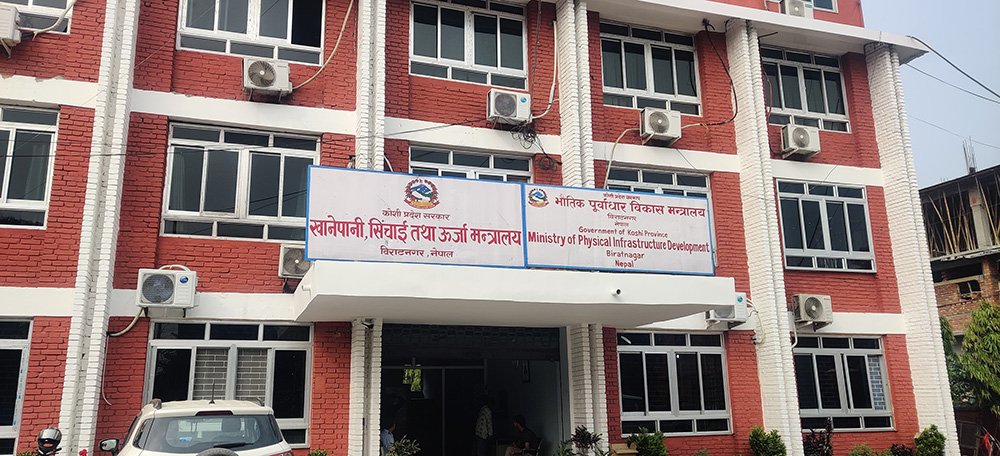
The construction progress of hospitals, which are directly linked to the health of citizens, is also disappointing. The progress of the 300 million rupee Madan Bhandari Hospital and Trauma Center project is only 25 percent. Only 70 million rupees have been spent so far on this project under special grants. The construction progress of the Taplejung Hospital building, costing approximately 240.8 million rupees, is only 20 percent.
The data on drinking water projects, considered a basic necessity, is similar. Some drinking water projects are not even in the institutional memory and record system of the provincial government.
The source for the Lumphabung, Nawamidanda Lifting Drinking Water Project in Panchthar was secured on 2076 Baisakh 15. The ministry itself does not know the status of this project, which has an estimated cost of about 300 million rupees. The ministry's own official records state: 'Project not found in the received details.'
It is a sample of negligence that a project for which a budget of 300 million rupees was secured about 5 years ago is 'missing' not only from the field but also from the ministry's documents. For this same project, the provincial government has allocated 1.8 million rupees for the fiscal year 2082/083.
Furthermore, out of 16 listed projects, 12 have neither had contracts signed nor any work started. Projects like the Jhiljhile Drinking Water (190 million cost) and Thekkitola Drinking Water in Jhapa have been without contracts despite receiving source assurance in 2079.
In an agricultural country, the state of irrigation projects is even more dire. There are 34 irrigation projects listed, but most have not even started, and some are not even in the ministry's records.
The Chisang River Control and Lohandra River Control projects in Morang received multi-year source consent in 2076, but their progress is zero and there is no record.
The Rumjatar Lifting Irrigation Project, with an estimated cost of 1.8143 billion rupees, is one of the largest irrigation projects in the province. Its progress is only 10 percent.
Old projects have not been contracted. Work is stalled, yet in the current fiscal year alone, the ministry has added 11 new irrigation projects to the multi-year list.
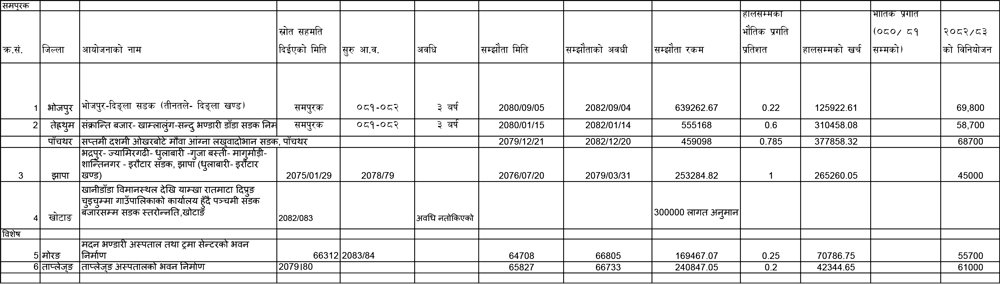
The data on supplementary and special grant projects is equally chaotic. The physical progress of the Bhadrapur-Jyamirigadhi-Dhulabari via Irautar road (Jhapa) project, which was contracted in 2076 and whose deadline expired in 2079 Ashar, is shown as 100 percent. In this road, which had a contract amount of 253.2 million rupees, 265.2 million rupees—more than the contract amount—has already been spent. Instead of closing the project, which is 100 percent complete and has been paid more than the contract amount, the provincial government has re-allocated 45 million rupees for this same project. Why and for whom were 45 million rupees allocated for a completed project? This is a matter that needs investigation.
The Ministry of Economic Affairs of the Koshi provincial government has stated that the liability for such abandoned and messy projects is still over 2.061 billion rupees. 'We have estimated the multi-year liability at 2.061 billion rupees for now. This cost may increase further when the variation is changed,' said Sushil Bastola, spokesperson and under-secretary of the Ministry of Economic Affairs.
However, Principal Secretary of the province, Rajendra Kumar Paudel, says they do not have exact details yet and that it is verbal information. 'We have been saying verbally that even now, if we look at multi-year projects, there is a liability of around 2 billion rupees. There are questions about how to fulfill that liability and how to take on new projects,' said Paudel.
- Mismanagement in budget formulation and implementation
Former Chief Minister of Koshi Province, Kedar Karki, admits that there is extreme mismanagement in the provincial government's budget formulation and implementation. He believes that the tendency to scatter the budget and the increasing financial liability of multi-year contracts are ruining the province's development.
'Budget is not something to be scattered; it is something to be allocated based on necessity, but currently, the tendency to distribute and scatter the budget is dominant,' he said.
Karki had adopted a policy in the budget brought during his tenure not to include projects under 2.5 million rupees in the provincial plan and to focus on large infrastructure, but subsequent budgets trampled on all those methods and procedures.
'We brought a budget saying the province would not look at projects under 2.5 million, but later it was completely ruined. The concept of a project bank was also ignored,' he said.
Currently, the liability for multi-year road and other physical infrastructure projects in Koshi Province has reached over 2 billion rupees. Karki explained this as the main reason for the province's economic crisis.
Former Chief Minister Karki termed the fact that some projects started since 2075/076 are still not completed and budget headings are constantly being changed as serious negligence. 'Those who take money for multi-year projects and do not work should be treated as having misused the government treasury. In some places, problems have been created by not allocating sufficient budget even while work is ongoing,' he said, 'If MPs only look for small projects in their own wards and villages, what is the point of the provincial government? Local levels are there for small projects.'
Karki argues that the province should think about how to change the overall structure of the province and how to make the province strong. But he said that personal interest is seen more in the allocation now.
Karki argues that there must be strong willpower in the leadership to improve this mismanagement seen in budget allocation. He said such problems arise when the leadership makes compromises just to save their position.
'The Chief Minister must have courage. If there is no strength in the leadership and only compromises are made, the budget will be mocked,' said Karki, 'Instead of small projects done in the name of elections, sufficient budget should be put into completing multi-year projects that have already started.'
Additionally, he demands that contractors who take advances after winning contracts and flee without doing work should be brought under strict legal action.
According to Karki, instead of allocating sufficient budget to complete multi-year projects that have already started, the tendency of leaders and MPs to scatter the budget on new and small projects targeted at their personal interests or electoral constituencies has led to the accumulation of liabilities for old projects.
He believes that in some cases, even when work is ongoing, the government's failure to allocate the necessary funds causes projects to drag on, which only increases the economic burden (liability) on the province.
Karki claimed that the government allocating budget to wrong priorities, politicians carrying personal interests, and contractors not doing work are the main factors behind the increase in multi-year liabilities.
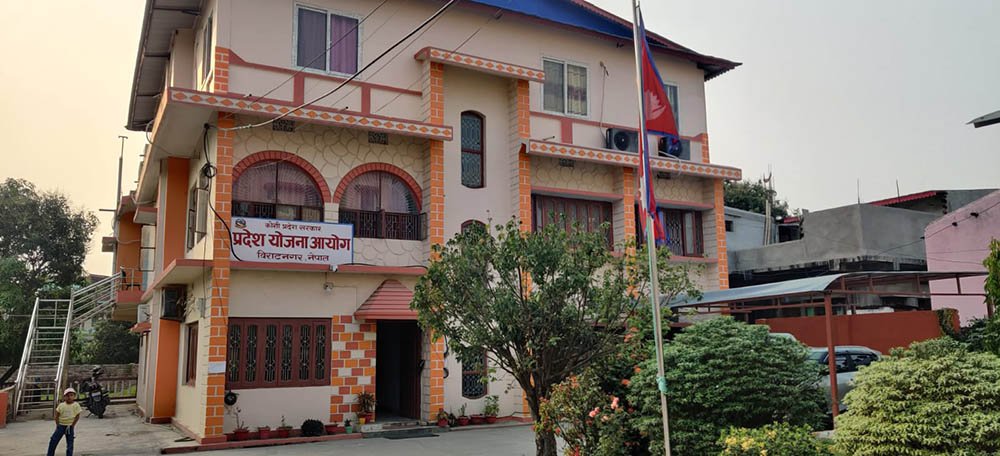
- Those who make laws are indifferent to following them
The Koshi Province Planning Commission is training MPs to include projects only from within the project bank for the upcoming fiscal year's budget and project selection. However, the MPs who make policies and laws in the provincial assembly openly raise questions, saying this system cannot be implemented immediately.
Deputy leader of the UML parliamentary party, Tilkumar Menyangbo, indirectly says that the project bank cannot be implemented now. 'What happens to the projects included in the project bank? Do we have to enter everything again?' he said, 'How possible would it be to bring a budget by including only projects that are in the project bank and above 2.5 million?'
UML MP Ramdev Yadav raised questions about the criteria of 150 million to 300 million for multi-year projects set for the project bank and the lack of DPR. 'We don't even have a DPR. On what basis has the project bank recommended projects so far?' said Yadav, 'Now you are talking about land, saying the process is not complete; if you do this, projects won't even fall in our areas.'
Similarly, UML MP Hombahadur Thapa expressed anger, saying that small but essential projects for the people have been ignored. 'If drinking water reaches a village ward with 2.4 million, shouldn't the province give it? If irrigation is completed with 2 million, shouldn't that be given?' Objecting to the fact that there is no budget to make a DPR but the project bank asks for a DPR, Thapa said, 'We MPs have nothing, only the names of projects, and we understand the problems of the people. But we don't have money to do a DPR, no budget, no preparation.'
He asked what happens to others if only those whose projects are good and processes are complete get them when requesting projects.
NCP MP Vidya Chamling also expressed dissatisfaction with the Planning Commission's process and criteria. 'The necessary documents must be clearly stated. How much investment should be made? How many projects should each honorable member bring?' she said, 'If you bring 25 projects, two fall, so should we become toys in the eyes of the public or not?'
MP Khinu Langwa Limbu also expressed anger. 'Last year we spent two-three months entering projects, now do we have to go looking for them again? Are you saying to adapt them to this system or bring new ones?' she said.
Chief Minister Hikmat Kumar Karki clarified that the project bank is just a technology. 'Preparations will be made to finish budget entry by Jestha 15. This time, I feel like we shouldn't go as if we have to do everything by stressing our heads too much,' he said.

Chief Minister Karki also said that the provincial government has become unaware of some past projects. 'The minister changed, the secretary changed, everything went. Our institutional memory just becomes weak. Because of that, we will do those things as sequential. Buildings being built, bridges being built, for which the Physical Infrastructure Minister is currently calculating the cost, we are preparing to do some of them this time.'
Principal Secretary Paudel recalls that the Authority (CIAA) used to call MPs themselves when projects were placed haphazardly in the past. 'There was a lot of political pressure from honorable ministers to MPs to enter all P-1 projects at the center. In the end, that system is in a state of failure now,' he said, 'After that, it is a concept brought to go to the project bank so that it can be seen and monitored.'
Paudel revealed that the Authority asks questions when the project bank is not implemented. 'We are still being asked about one or two projects not being included in the project bank. I have also found that some honorable members have been called for statements based on the projects they chose,' he said.
Therefore, Paudel clarified that it will be easier for provincial assembly members when choosing projects, selecting them, and following their methods and procedures.
This specific news has been automatically translated by AI. As a result, there may be some inaccuracies or language errors.

_tg2iDz0Uv6.jpg)