Government Moves to Seize Bank Funds Dormant for Over a Decade, Citing Governance Reforms


Kathmandu. The government has announced plans to bring bank funds that have remained inactive for more than 10 years into the state treasury. This provision is included as the 78th point in the '100 Agendas for Governance Reform' approved by the first cabinet meeting after the formation of the new government, stipulating that the process must be completed within 90 days to transfer these funds.
The agenda states: 'To effectively utilize the state's dormant resources, details of bank and financial institution accounts inactive for 10 years or more shall be collected, and amounts unclaimed by the rightful owners shall be brought into the state treasury after completing legal procedures, and other sources shall be identified and managed within 90 days.'
Government officials state that the timeline for enacting the necessary legal provisions and procedures for this point has been set for three months, and the process has already begun.
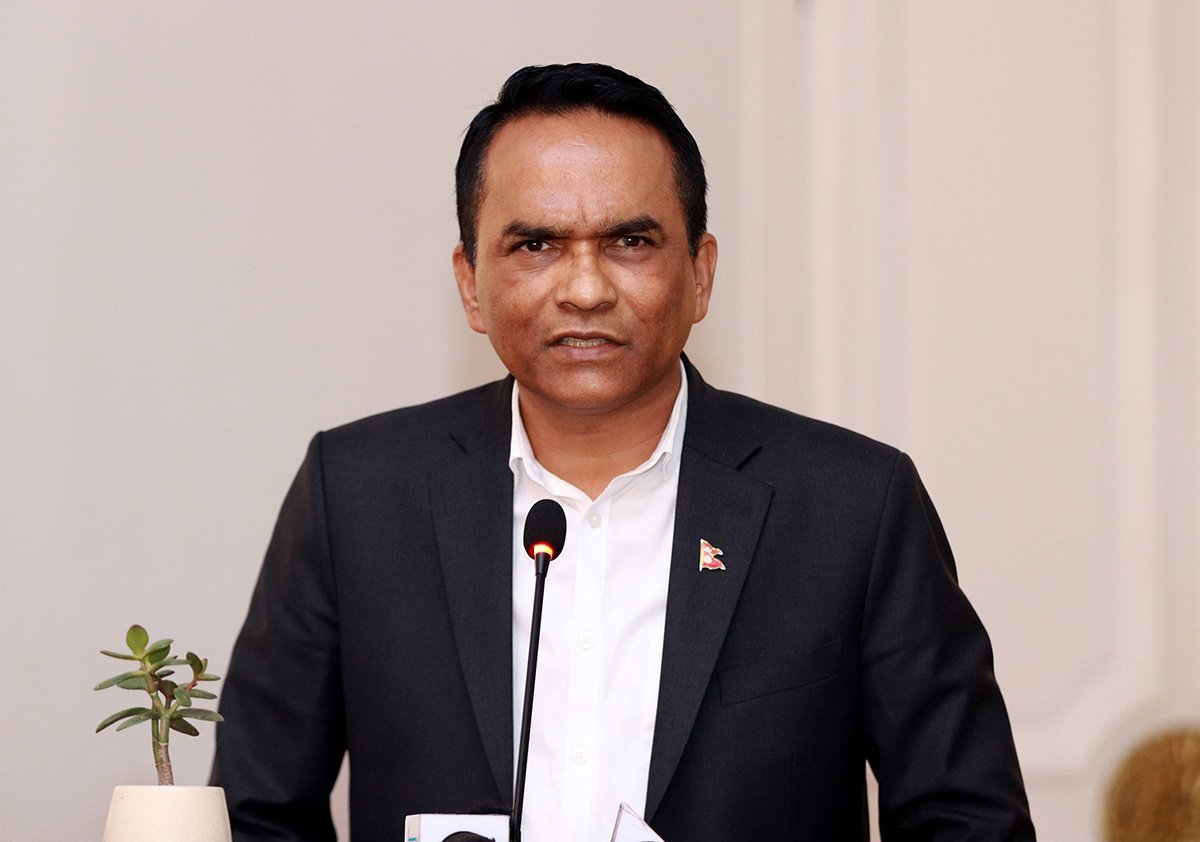
Finance Ministry Spokesperson Tanka Prasad Pandey stated that the Ministry of Finance has already started implementing the matters under its responsibility for the execution of the agenda, and discussions and correspondence processes have advanced for the tasks to be carried out by subordinate bodies.
Furthermore, Finance Minister Dr. Swarnim Wagle and Nepal Rastra Bank Governor Dr. Bishwa Poudel held a discussion on Sunday. The Ministry of Finance reported that the discussion focused on the implementation of the agenda item concerning the responsibility of the Nepal Rastra Bank.
This move by the government regarding the mobilization of dormant funds is not new. Currently, provisions exist to bring funds, ranging from share dividends to bank account balances, into the government treasury and spend them in designated sectors.
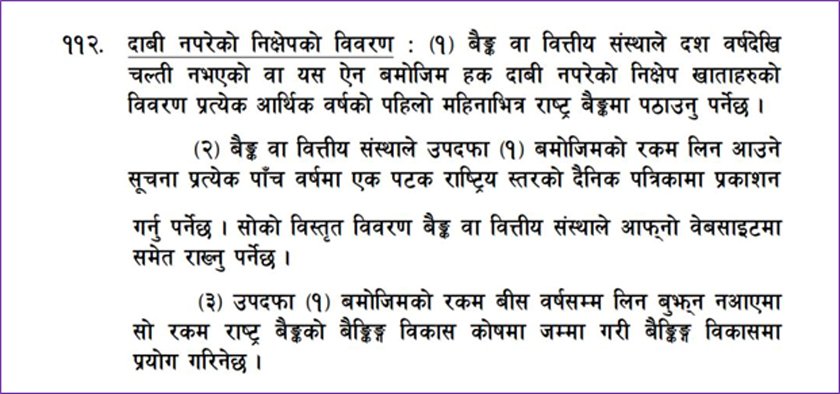
Section 112(1) of the Banks and Financial Institutions Act, 2073, provides for the Banking Development Fund. This section mandates that details of bank accounts inactive for 10 years must be sent to the central bank annually, notices must be published every 5 years to claim such amounts, and if unclaimed after 20 years, the funds are deposited into the Nepal Rastra Bank's Banking Development Fund for use.
Section 112 of the Banks and Financial Institutions Act
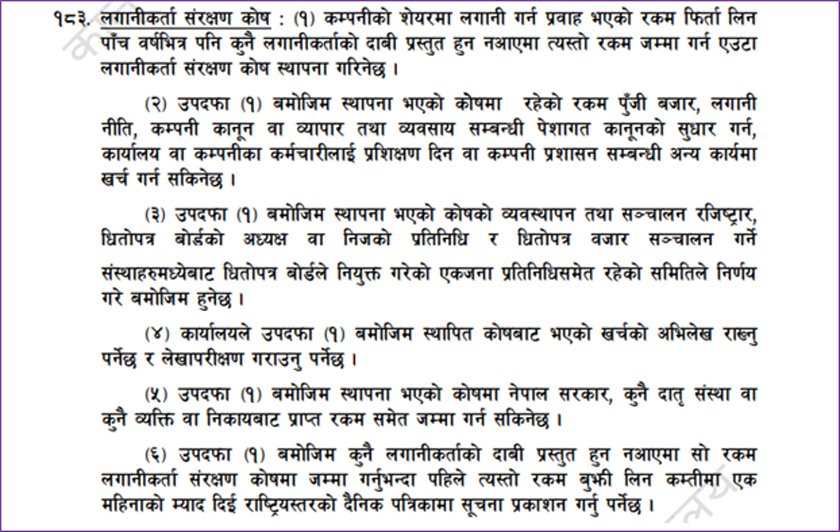
A similar arrangement exists for investments in companies. Section 183 of the Company Act, 2063, mandates that amounts uncollected for five years must be deposited into the Investor Protection Fund. This fund is designated for use in improving company-related laws, training employees, or for company administration.
Section 183 of the Company Act
However, Senior Advocate Resham Regmi, an expert in banking law, notes that there is a guarantee for the refund of amounts once sent to the Banking Development Fund, even if a claim is made later.
'The provision is to send the amount from the inactive account to the Banking Development Fund, but if a claim is made later, the amount is returned from the Fund,' Regmi stated. 'There is no possibility of depositors' money being lost.'
Currently, although the government seeks to bring 10-year dormant funds directly into the state treasury for expenditure, the specific agenda point does not clearly state whether such funds will be returned if claimed later. Nepal Rastra Bank officials indicate that this will only become clear once the law is enacted.
However, Senior Advocate Regmi asserts that the government cannot bring the funds under its control by completely eliminating the possibility of return. He argues that the government cannot seize property simply because it has been dormant for a long time, as the right to property is guaranteed by the Constitution.
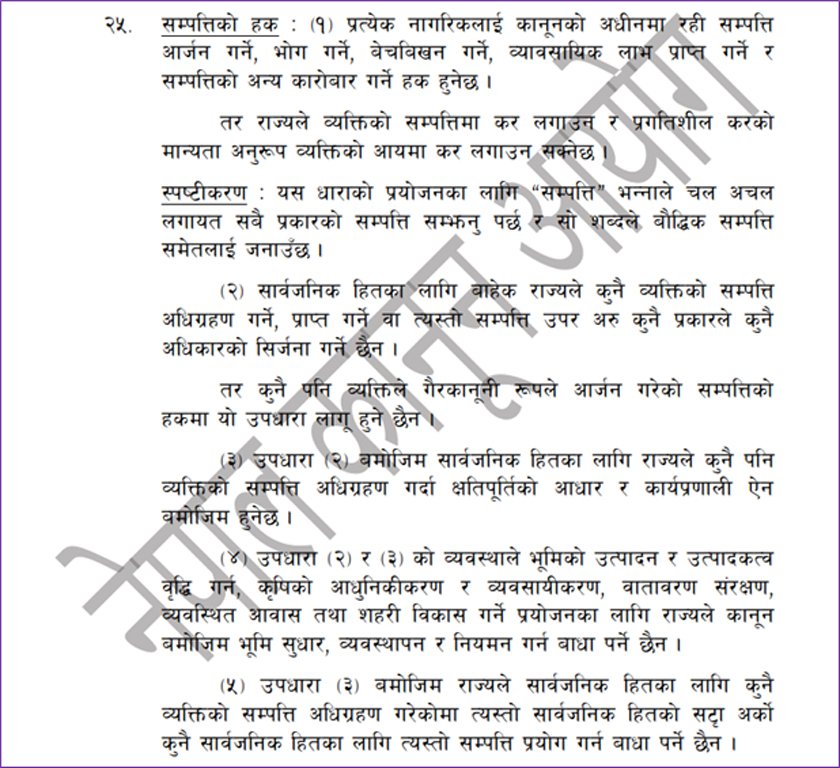
'Article 25 of the Constitution deals with the right to property, which grants citizens the right to accumulate property, except for illegally acquired assets,' Regmi explained. 'While progressive tax can be imposed on property, property cannot be confiscated just because it has been inactive for a long time. The government can state that it will use the funds temporarily, with the condition that they will be returned upon demand.'
Article 25 of the Nepal Constitution
- What is the process?
Currently, the prevailing law in BAFIA allows only funds older than 20 years to be brought into the Banking Development Fund; this needs to be reduced to 10 years and arranged to be brought into the state treasury. Experts suggest that this requires an amendment to the Act itself.
For this, the central bank prepares the necessary draft for the legal amendment and sends it to the Ministry of Finance. The Ministry, with the consent of the Ministry of Law, sends the bill to the Cabinet.
Once the proposal is approved by the Cabinet, it is registered in Parliament as the BAFIA Amendment Bill. Such funds can only be brought into the state treasury after being passed by both houses of Parliament and authenticated by the President. Stakeholders suggest that completing all these tasks within three months will be challenging.
Moreover, the government is not precluded from deciding to transfer funds from various other funds to the state treasury. In the past, during budget formulation, the Ministry of Finance has made provisions in the budget to transfer money held in the funds of various regulatory bodies to the government treasury when facing resource shortages.
However, experts maintain that reducing the current 20-year provision to 10 years necessitates a legal amendment.
This specific news has been automatically translated by AI. As a result, there may be some inaccuracies or language errors.

_cvUCBlwFTZ.jpg)