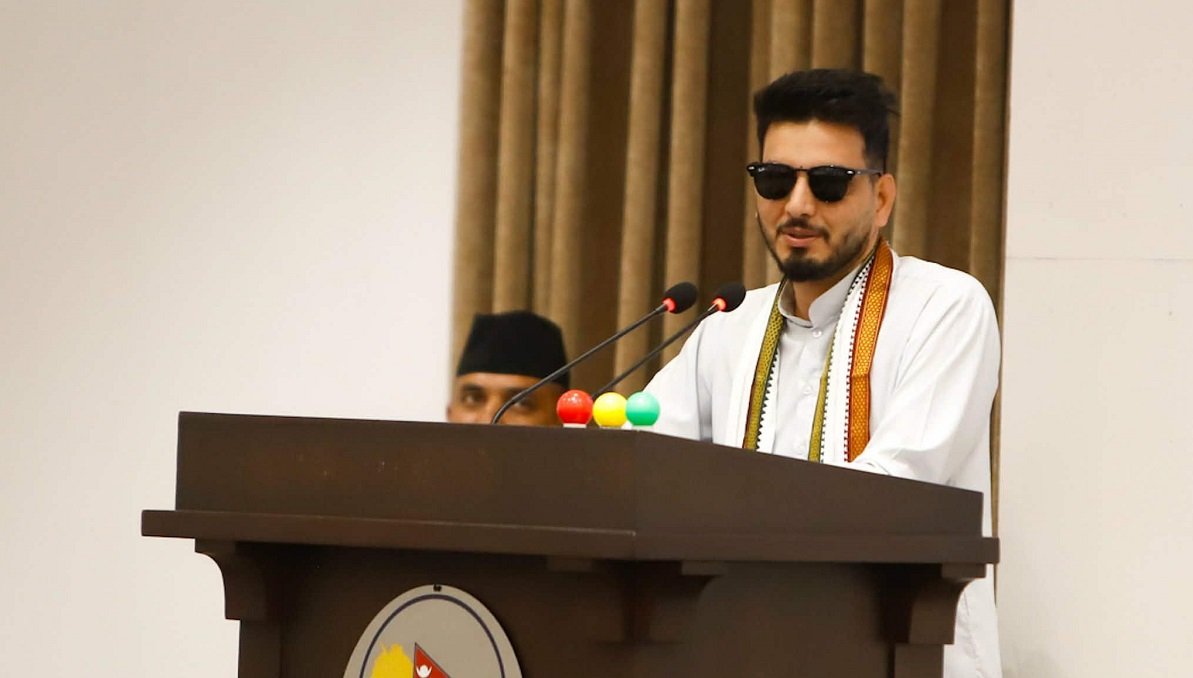
Army Commander Details Events During Protests at President's Residence, Citing Decision Not to Fire on Crowd


Kathmandu. Brigadier General Manoj Vaidya, a security commander, has revealed detailed accounts of the vandalism and arson that occurred at the President's Office, Shital Niwas, during the recent mass protests. While testifying before the inquiry commission, he clarified that the army refrained from opening fire to prevent massive casualties and to prioritize the President's security.
According to Vaidya, demonstrators began gathering in various locations starting at 11:00 AM on Bhadra 24, 2082. A contingent of 224 Nepali Army personnel was deployed for security at Shital Niwas, supported by only a small squad of 9 Nepal Police officers for coordination.
The President discussed the situation twice, at 12:30 PM and 2:00 PM. Although she expressed a desire to remain at Shital Niwas until the last moment, the security risk escalated significantly after 3:00 PM when an angry mob numbering in the thousands advanced towards Shital Niwas from the direction of Baluwatar.
- President Evacuated After 15-Minute Interval
According to the report obtained courtesy of Janastha Weekly, it became clear that the protesters' target was Shital Niwas itself. Consequently, at 3:15 PM, the President and her family were moved to a secure location with the assistance of the ADC team and the Special Security Directorate. Just five minutes later, at 3:20 PM, protesters attempted to breach the premises through Gate Numbers 1 and 2. Although the army initially blocked the gates, Vaidya stated that a large crowd entered the compound by climbing over the low, old wall adjacent to Gate Number 1.
- Reason for Not Firing and Extent of Damage
“Since firing weapons at the enraged crowd risked massive human casualties, firearms were not discharged,” Brigadier General Vaidya stated in his testimony. After the army's attempts at de-escalation failed, the crowd began vandalism and arson, with the fire spreading extensively around 4:00 PM. Due to the rapid spread of the fire across old structures, carpets, and curtains, damage occurred to the eastern and northern sections of Shital Niwas and the pre-fabricated houses. However, the army claimed success in fully securing the southern office area, vehicles, and the main presidential residence building by forming a cordon.
He asserted that no army weapons were lost and that security procedures were followed according to the chain of command. His conclusion was that due to the residential nature of the area, using aerial fire or tear gas posed a risk of serious accidents, leading the military contingent to withdraw and focus on protecting the main building. He recommended that in the future, the perimeter walls and security structures of such high-profile offices should be multi-layered, and the role of the Nepal Police and Armed Police Force in controlling unarmed crowds should be made more systematic.
This specific news has been automatically translated by AI. As a result, there may be some inaccuracies or language errors.

_iL3K2wYemS.jpg)