Astronomers Discover One of the Universe's Oldest and Rarest Stars in Its Original Galaxy


Chile. Astronomers have discovered one of the oldest and rarest stars in the universe. This ancient star was found inside a small galaxy (dwarf galaxy) called 'Pictor Two', over 10 billion years old, in an image captured by the 'Dark Energy Camera' mounted on the Victor M. Blanco Telescope in Chile.
Scientists have classified this star, named 'Pictu-503', as a 'Population Two' or second-generation star. Because it formed in the early stages of the universe's origin, it contains extremely low amounts of heavy elements like iron.
Compared to our Sun, this star has 40,000 times less iron. However, despite the lack of iron, the star has an unexpectedly high amount of carbon. According to researchers, the ratio of carbon to iron in this star is 1,500 times higher than in the Sun.
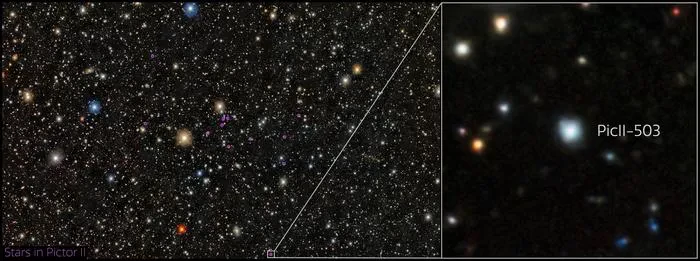
Astronomers consider this star an important link for 'stellar archaeology'—the study of ancient stars. Most old stars have moved far from their birthplace, making it difficult to study their origins. However, since 'Pictu-503' remains within its original galaxy, it is easier for scientists to test their theories.
The composition of this star supports the scientific hypothesis that during the violent 'supernova' explosion at the end of a star's life, lighter elements like carbon are ejected much farther than other elements. It appears that this very process caused carbon to spread throughout the universe, eventually establishing itself as a key basis for life on Earth.
This discovery is believed to help solve the mystery of how the elements necessary for life formed and spread in the universe.
This specific news has been automatically translated by AI. As a result, there may be some inaccuracies or language errors.