Nepali Congress Faces Setback After Special General Convention Amid Leadership Tensions
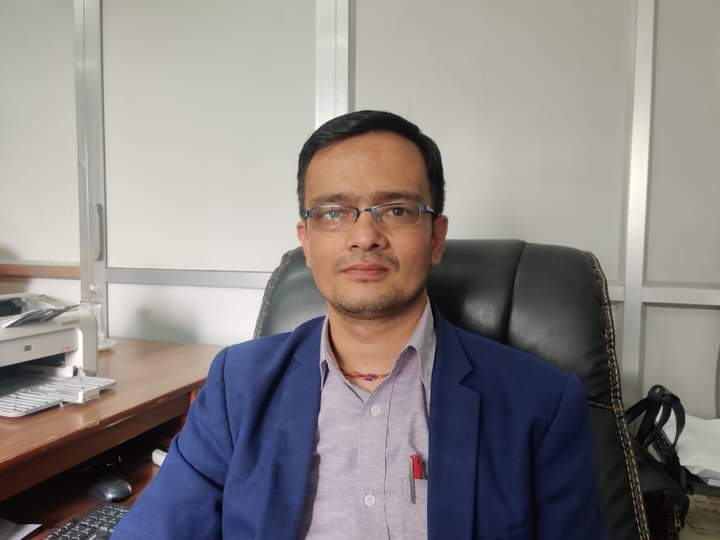

Kathmandu. Following the agitation on Bhadra 23 and 24, the then General Secretary of the Nepali Congress, Gagan Thapa, had stated, “The citizens are seeking good governance, they are seeking a change in leadership. The party cannot go into the general elections with the same president. The party must go into the House of Representatives elections after changing the leadership, either through a regular general convention or, if not possible, through a special general convention.”
This issue sparked widespread debate within the Congress. Sher Bahadur Deuba, elected as President in the 14th General Convention, and his closest competitor, Dr. Shekhar Koirala, stated that there was no possibility of holding a regular or special general convention as the election date had already been announced. However, Thapa and the then another General Secretary Bishwa Prakash Sharma continued to push their stance of demanding a regular convention if possible, or a special convention, ignoring the statements of Deuba and Koirala.
A central working committee meeting of the Congress was held on Ashoj 28. President Deuba, who was seriously injured in an assault at his residence in Budhanilkantha on Bhadra 24 during the agitation, handed over the responsibility of acting president to Vice President Purna Bahadur Khadka at the beginning of the meeting.
The day after Khadka took charge, on Ashoj 29, a petition demanding a special general convention, led by Thapa and Sharma, was submitted with the signatures of 2,488 general convention representatives. The Congress statute stipulates that the central working committee must call a special general convention within 90 days if demanded by 40 percent of the general convention representatives, providing a reason.
_fea29IJA1T.jpg)
However, when the central working committee did not call the convention, a special general convention was organized under the leadership of Thapa and Sharma from Poush 27 to 30 at Bhrikutimandap in Kathmandu. This special general convention was not accepted by the Deuba and Dr. Koirala factions. A writ filed by the Deuba and Koirala factions, claiming the special general convention was illegal, is currently sub-judice in the Supreme Court, with a hearing scheduled for Falgun 27.
A new working committee was elected at the special general convention under the presidency of Thapa, with Sharma elected as Vice President.
During the special general convention, Thapa had said, “Even if Deuba takes five steps during the election campaign, the party's and the candidate's votes will decrease.” Hearing this, Deuba neither became a candidate in the election nor campaigned. He did not even go to his home district Dadeldhura to cast his vote. He is currently in Singapore for treatment.
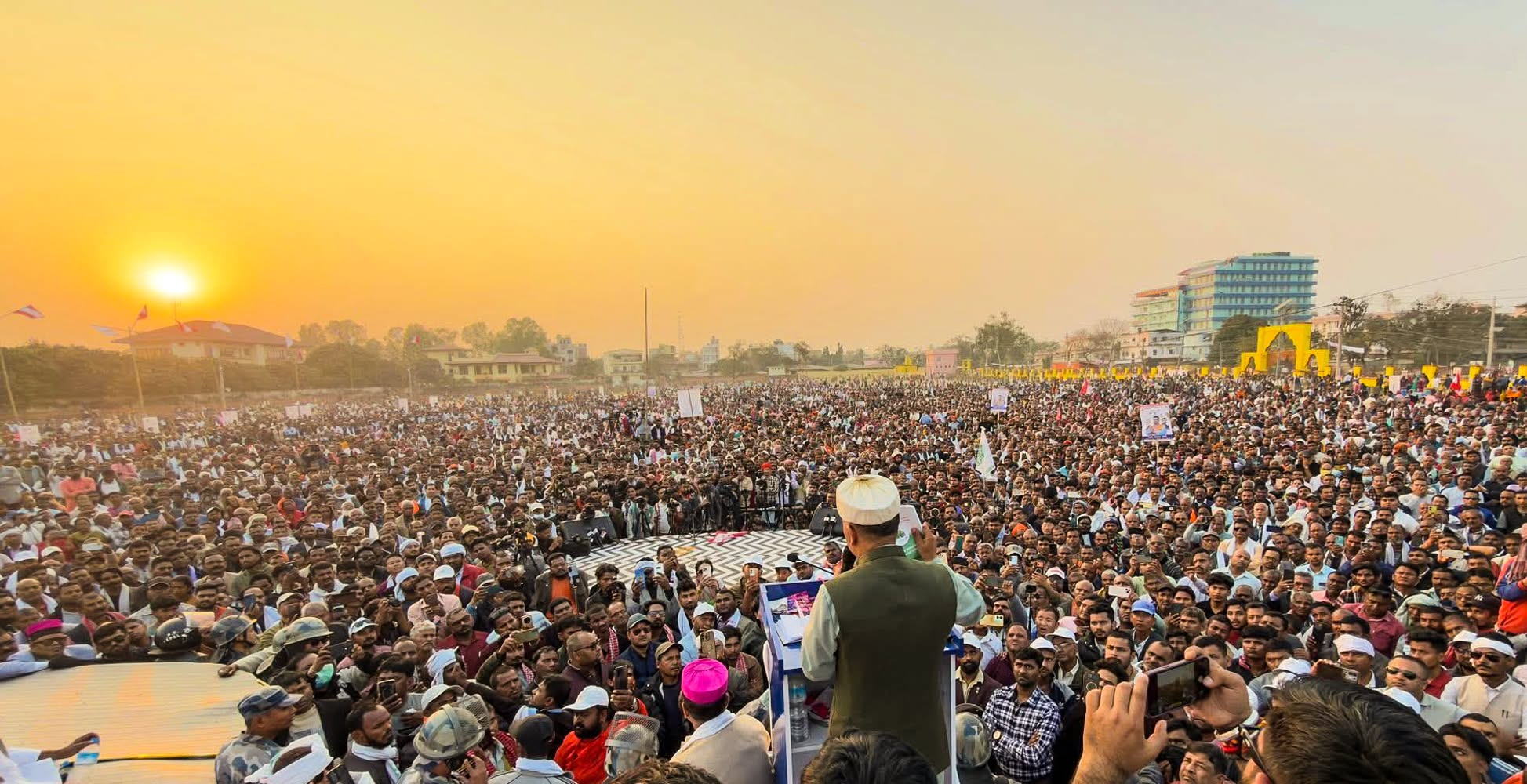
President Thapa and Vice President Sharma had been stating that the Congress, with its changed policies and leadership, would bring a boom in the elections. Thapa had even coined the slogan “This time, 100 plus” during the election campaign.
However, the candidates fielded by the Congress, which went into the elections after changing policies and leadership through the special general convention, failed to win. Out of the 57 seats won by Congress in the direct elections of the 2079 elections, only 17 candidates have been elected directly. Congress does not show a lead in the remaining counting locations.
Viewed this way, it can be said that the public did not trust the Congress, which went into the elections after changing policy and leadership through a special general convention following the agitation. Congress suffered a major blow in this election where the Rastriya Swatantra Party saw a surge.
In the 2079 elections, Congress became the largest party with 88 seats, winning 57 seats in direct elections and 32 in proportional representation, but it has now shrunk to second place by a large margin.
_fCrbyGks3O.jpg)
Thapa, elected President from the special general convention, was defeated by Dr. Amresh Kumar Singh in Sarlahi-4. Following the defeat, Vice President Bishwa Prakash Sharma, who was also the coordinator of the election mobilization committee, issued a video message stating that the election result was not favorable for the party. He said, “The election result was not favorable for Congress. This was not unexpected or unforeseen. We will hold a central working committee meeting soon to review it. Although policy and leadership were changed through the special general convention, the short time of about 50 days before the election meant that the new message could not be effectively conveyed to the voters, which also affected the election results.”
Congress Spokesperson Devraj Chalise reacted by saying the party was hit by a tsunami. “When a wave comes, something remains, but a tsunami came. We were caught in its grip,” Spokesperson Chalise told Ratopati.
Sharma also claimed in his video message that internal weaknesses and external circumstances contributed to the party's defeat.
Mainly, the leadership that came from the special general convention before the election did not pay attention to the old establishment. When the new leadership did not pay attention, the old leaders did not feel the need to follow them. Former President Deuba, former acting President Purna Bahadur Khadka, leaders Prakash Man Singh, Dr. Shashank Koirala, and Dr. Arju Rana Deuba did not participate in campaigning.
Even though new leadership emerged from the special general convention, a large faction of the party remained with Deuba and Dr. Koirala. That faction remained silent without engaging in the election, which appears to have impacted Congress candidates.
A few days before the election, Party Spokesperson Chalise told Ratopati, “We are finding it difficult to unite within the party more than outside. If we can unite within the party, we will win a good number of seats.” The current results show that they failed to unite the party.
_CyINKWRtCk.jpg)
A leader from the Deuba faction says this situation arose because the new leadership neglected the old leaders who had a public mandate. That leader told Ratopati, “It is the leadership's responsibility to unite other leaders who have a public mandate. They could not unite them. That affected the election.”
Congress had faced such unexpected results in previous elections as well. In the 2015 election, Congress won 75 out of 108 seats in the House of Representatives, and after the success of the people's movement, it secured a majority with 110 seats out of 205 in the second House of Representatives held in 2048 BS. In the mid-term election held in 2051 BS, Congress came second, winning only 83 seats, while in the 2056 election, Congress obtained a majority, securing 111 seats.
In the first Constituent Assembly election held in 2064 BS, Congress again faced an unexpected defeat. Out of 601 seats in the House of Representatives and the Constituent Assembly, Congress was limited to second place, winning 110 seats combining direct and proportional representation. In the second Constituent Assembly election of 2070 BS, Congress became the first party again, securing 196 votes combining direct and proportional representation.
In the House of Representatives election held in 2074 BS, Congress secured only 63 seats out of 275. Congress, which won 88 seats and became first in the 2079 election, has now shrunk to second place again.
This specific news has been automatically translated by AI. As a result, there may be some inaccuracies or language errors.



_beJFbtmC3W.jpg)