Leaders of Five National Parties Defeated in 2082 House of Representatives Election


Kathmandu. The chairpersons of five political parties that achieved national party status in the House of Representatives election held on Mangsir 4, 2079, have been defeated in the 2082 House of Representatives election. Not only did the chairpersons of these parties lose in the election held last Thursday, but only a limited number of candidates fielded by their parties have secured victories.
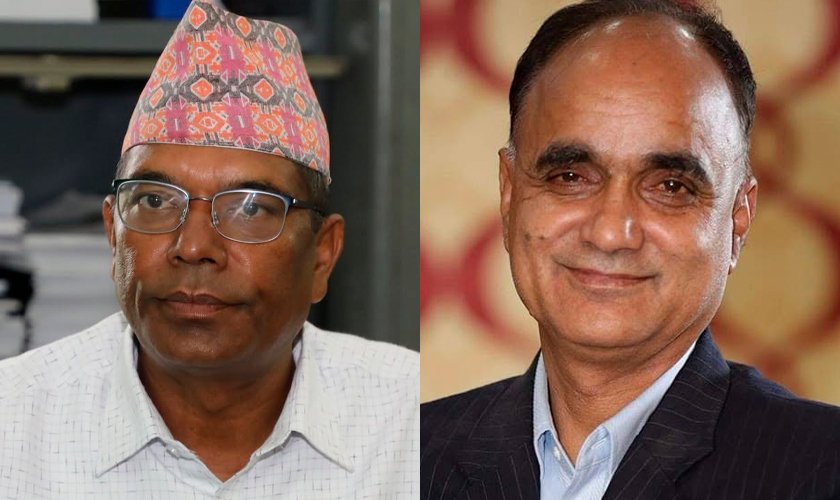
Gagan Thapa, President of the Nepali Congress which became the largest party in the 2079 election, KP Sharma Oli, Chairman of CPN-UML which became the second largest party, Rajendra Lingden, Chairman of the Rastriya Prajatantra Party (RPP) which became a national party, Upendra Yadav, Chairman of the Janata Samajbadi Party Nepal, and Dr. CK Raut, Chairman of the Janamat Party, were defeated in the recent election.
Seven parties had achieved national party status in the 2079 election. Only Rabi Lamichhane, Chairman of the Rastriya Swatantra Party (RSP) which became a national party, and Pushpa Kamal Dahal 'Prachanda', coordinator of the then CPN (Maoist Centre) now the Communist Party of Nepal, have been elected in this election. Results show that the chairpersons of all other parties have faced defeat.
Congress President Thapa was defeated in Sarlahi-4 by RSP candidate Dr. Amresh Kumar Singh. Dr. Singh was elected securing 35,688 votes, while Congress President Thapa, the closest competitor, managed only 22,831 votes.
CPN-UML Chairman KP Sharma Oli, who contested from Jhapa-5, was defeated by a wide margin by RSP senior leader Balendra Shah. Shah was elected with 68,348 votes, while Oli secured only 18,734 votes.
RPP Chairman Lingden contested from Jhapa-3. He was defeated by RSP candidate Prakash Pathak by a margin of double the votes. Pathak was elected with 38,674 votes, while the closest competitor Lingden secured only 17,294 votes.
Janata Samajbadi Party Nepal Chairman Yadav contested from Saptari-3. He was defeated by RSP candidate Amarkant Chaudhary by more than double the votes. Chaudhary was elected with 29,943 votes, while the closest competitor Yadav secured only 13,435 votes.
Janamat Party Chairman Dr. Raut contested from Saptari-2. In that constituency where results are yet to be finalized, Dr. Raut is in third place. RSP candidate Ramji Ram is in the lead with 22,111 votes. He is being followed by Janata Samajbadi Party, Nepal candidate Umeshkumar Yadav with 10,549 votes. Dr. Raut is in third place with 7,983 votes. As the vote counting is in its final stages, it seems unlikely that Raut will cover the 14,000 vote gap.
It is now certain that the Janata Samajbadi Party Nepal and the Janamat Party, which became national parties in the last election, will not have representation in the House of Representatives this time. A party gains national party status if it wins at least 1 seat in the direct election and secures 3% of the valid votes cast in the proportional representation category. To secure seats in proportional representation, a party must win at least 1 seat in the direct election. However, both parties have not won any seats yet. In the vote counting nearing its end, candidates from both parties are not leading anywhere.
In the last election, the Congress became the first party by securing 89 seats, with 57 seats from direct elections and 32 from proportional representation. CPN-UML became the second party with 78 seats, securing 45 in direct elections and 33 in proportional representation.
The then CPN (Maoist Centre) became the third party with 32 seats, securing 18 in direct elections and 12 in proportional representation. RSP became the fourth party by securing 9 seats in direct elections and 11 in proportional representation. Besides these, the Janata Samajbadi Party Nepal, RPP, and Janamat Party became national parties because they won seats in direct elections and secured 3% of the votes in proportional representation.
This specific news has been automatically translated by AI. As a result, there may be some inaccuracies or language errors.