Bhaktapur Celebrates Holi with Unique Traditional Rituals Marking Spring's Arrival

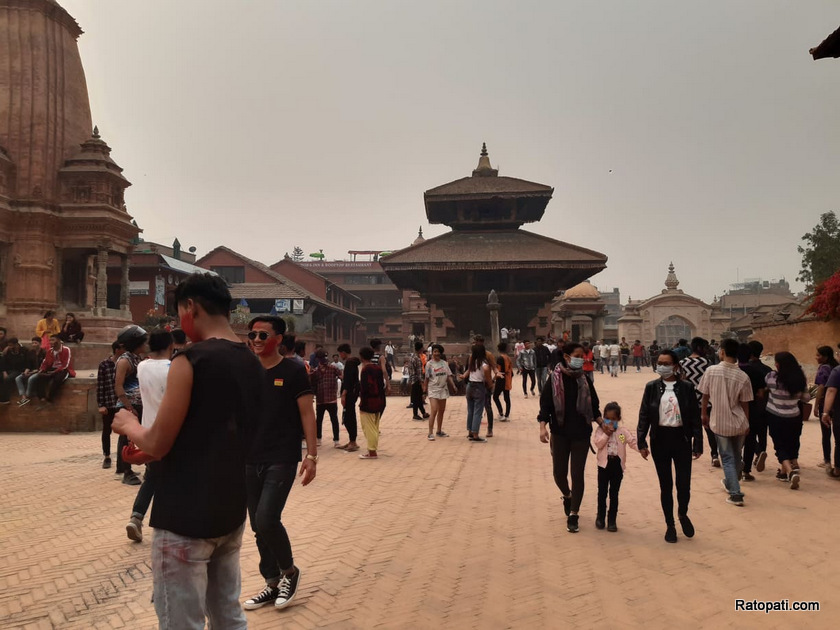
Bhaktapur. With the arrival of the spring season, the festival of colors, Fagu Purnima, is being celebrated with great fervor in Bhaktapur today. This festival, celebrated by exchanging colors in joyous celebration of victory, is observed in Bhaktapur in a distinctly traditional style.
Fagu, known as the festival of open-hearted singing and dancing, a festival of reconciliation, a time to lose oneself in ecstasy, and a festival to color the body and mind, is specially celebrated in Bhaktapur by singing sexually suggestive songs and local Dhimay Baja Khala, Bansuri Baja Khala, and Daafa Bhajan Khala groups visiting the Bhimsen Temple (Bideshi Bhimsen) at Adarsha, eating Samaybaji, and applying Abir (colored powder) to each other.
The start of the Fagu festival in Bhaktapur is different from elsewhere. The Fagu festival is considered to have begun in Bhaktapur on the eighth day of the bright half of Falgun when a colorful flag is hoisted at the Gaddi Baithak in Basantapur. However, to signify the start of Fagu in Bhaktapur, a wooden phallus symbolizing the male genitalia and a cloth yoni symbolizing the female genitalia are displayed in a posture of union at a platform in the Tachpal Bhimsen Temple in Dattatreya.
From that very day, the singers of the Bhimsen Guthi at that platform sing sexually suggestive songs like ‘Bhimsen deya lajja khang lawaanla! Bisyuwane mwaayak so jhaayla!’ meaning ‘Did Bhimsen's phallus become envious! Did you come to see what you shouldn't miss!’, entertaining passersby.
The wooden phallus symbolizing the male genitalia and the cloth yoni symbolizing the female genitalia, displayed in a posture of union at the Tachpal Bhimsen Temple platform, are interpreted as the union of Bhimsen and Draupadi from the Dwapara Yuga. Although at first glance it appears obscene, cultural experts explain that at a time when there were no mass media, this was a way of teaching the art of procreation by naming it the union of deities. They suggest that sexual education was imparted in the guise of the union of Bhimsen and Draupadi so that everyone could understand the method of physical relations without it appearing as vulgar or loose instruction.
The Fagu festival is particularly regarded by the Newar community as a festival focused on sexuality and women. The traditional folk tunes and music of Fagu are related to sexuality.
Cultural experts state that with the arrival of spring, when saplings sprout on trees, greenery appears everywhere, and flowers begin to bloom, a kind of wave is created in people's minds and brains, leading to the mind being attracted towards sexuality.
Cultural expert Harisharan Rajopadhyay stated that the tradition of sexually suggestive songs during Fagu has come into practice because the arrival of spring awakens lust in people along with new sprouts on trees and plants. Rajopadhyay said, “Valley residents engaged in agriculture become somewhat free with the arrival of spring, and people are attracted to entertainment in their leisure time. Since entertainment options were limited at that time, the tradition of searching for beautiful young women developed, leading to Fagu being filled with more sexually suggestive music.”
Although some try to portray this festival as obscene because of the sexually suggestive songs and music during Fagu, Rajopadhyay stated that Fagu should be viewed as a purely vibrant cultural festival.
Cultural expert Dhaulbhadel mentioned that the Fagu festival conveys the message of ending existing discrimination, stating that since children, youth, and people of all castes and creeds are colored with the colors of Fagu and everyone exchanges the colors of happiness, this festival is also an inclusive one.
Similarly, another cultural expert and historian, Purushottam Lochan Shrestha, stated that since ancient times, as society developed as male-dominated, the tendency to view women as symbols of sexuality and as means to fulfill male sexual desires developed, which is why songs and music targeting women resonate during Fagu.
He mentioned that since the Fagu festival is traditionally considered a day of love, the tradition of singing songs filled with sexual and romantic sentiments prevails during Fagu. On the day of Fagu Purnima, young men go to the courtyard of the girl they like and propose love through songs targeting women. If the girl accepts the proposal, she allows them to apply Abir to her cheeks, and if she does not like them, the young men console themselves by sprinkling Abir from a distance.
Shrestha further stated that the display of the wooden phallus, a symbol of Bhimsen's phallus, along with the hoisting of the Chir in Tachpal tole, Bhaktapur, confirms that Fagu is a woman-centric festival. On the day of Fagu Purnima, the Fagu festival in Bhaktapur is formally concluded after the Bhimsen's phallus is taken to the Brahmayani River, washed, and returned to the Tachpal Bhimsen Temple.
There is a belief that washing the Bhimsen's phallus in the Brahmayani River results in the birth of a son. Based on this belief, there is a competition among those who wish to carry the phallus. Especially from Basanta Panchami until Holi, it is the season for weddings. It appears that through culture, education is being imparted to newlyweds during this period to awaken sexual excitement and teach them the method of intercourse and the importance of keeping their genitals clean.
Professor Dr. Shrestha stated that because the current youth generation fails to understand the significance of the Fagu festival, which has been celebrated for ages, it is beginning to appear as a social aberration. He noted that the Fagu festival, which is celebrated with great joy by applying colorful powders to each other without any barriers of age, gender, or relationship, turning the environment colorful, has been transformed into a festival of fear due to the reckless activities carried out by the younger generation.
On the evening of Falgun Shukla Purnima, there is a tradition of taking Krishna in a palanquin inside the Taleju of Bhaktapur, worshipping with 16 types of bread, cotton, rose flowers, and perfume, and then parading around the city. At that time, there is a tradition of sprinkling balls of Abir soaked in oil on the deities in every locality and taking them to the Dattatreya Temple in the evening.
This specific news has been automatically translated by AI. As a result, there may be some inaccuracies or language errors.