Far-West Voters Prioritize Local Employment Over Grand Promises Ahead of Elections
Dhangadhi. The House of Representatives election is approaching. Candidates are distributing dreams. In public electoral debates, they are presenting a list of what they can do for infrastructure and social sector development.
However, voters are getting tired of candidates coming with similar promises before every election. Those who have been listening to the empty assurances of leaders have not been able to trust them.
Ratopati spoke with voters from various districts of the Far-West targeting the election. Many have asked them not to show big dreams and plans, but rather to provide employment in the villages.
Radha BK from Lamki Chuha Municipality-5, Kailali, has not been moved by the big dreams of the candidates. “Our children have gone abroad now. We want employment in the village,” she said.
Bhumeshwari Mahara of Bedkot Municipality, Kanchanpur, has a similar complaint. “Leaders come, with big plans, saying they will build roads, do this and that,” she says, “First of all, we need a basis to live here, we need employment.”
Manmaya Luhar from Dhangadhi Sub-Metropolitan City-15, Kailali, also demands employment. Her 17-year-old son left his studies at a young age and went to Bengaluru, India.
“At an age when my son should have a school bag on his shoulder, he is carrying loads. Leaders say they will build the country. For whom is the country being built? My son had to go to India because he couldn't find employment in the country, I don't need anything else, I need employment in the country,” she also said.
Due to the lack of employment in the Far-West, children are left without guardians at home. Manisha BK, 11 years old, from Lamki Chuha Municipality, studies in Grade 4. Both her parents work as laborers in India. She lives with her grandparents.
“It has been four years since my parents went to India,” Manisha said, “I miss my parents a lot. They say they will come when we talk on the phone, but they don't come.” Manisha dreams of earning a lot of money when she grows up and stopping her parents from going to India.
10-year-old Bimala BK, who studies at the same school, also has parents in India.
Bimala’s aunt, Sudha BK, explained that her parents had to go to India because staying at home was not enough to cover expenses. “There is no work in our own country. There is no environment here to do anything if we stay. Our hearth won't burn here if we don't go to someone else's country. The first thing we need is employment,” she said.
Dharma BK from Lamki has a clear stance for this election.
“We need employment. I will not vote for those who win the election and never look back. I will vote only for those who guarantee employment,” she said.
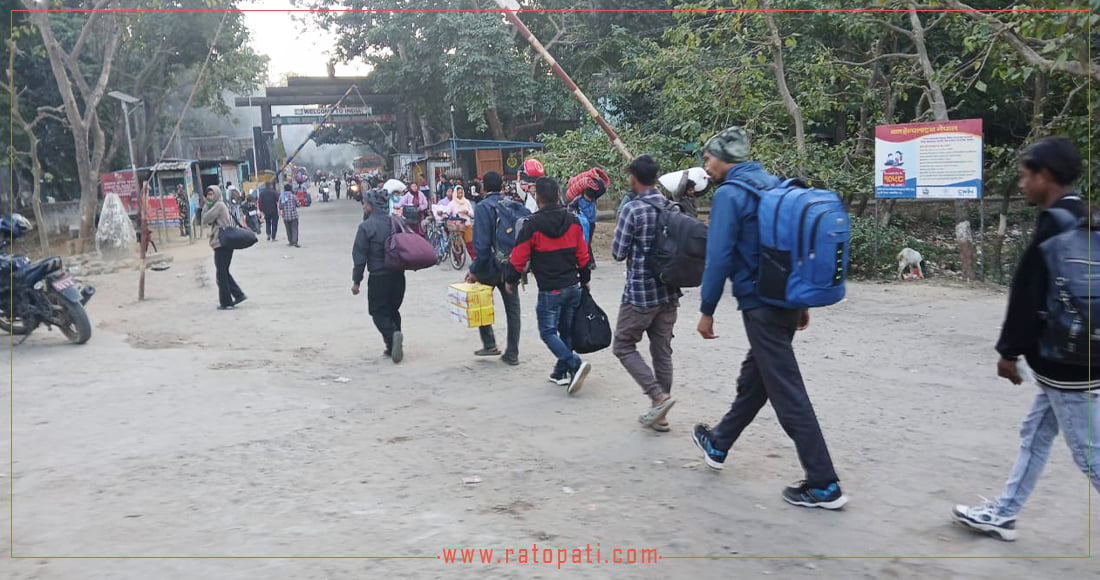
For people in the Far-West, Indian cities are closer than Kathmandu. The market is there, treatment is there, and work is also found there. People here travel in search of work from nearby Uttarakhand to Kalapahar, Ratnagiri, New Delhi, Mumbai, and even Bangalore.
The government does not have exact statistics on how many people go to India annually. However, an estimated five to six lakh people from the Far-West sweat it out in India. This trend has been going on for years, and there is no sign of it stopping.
During the COVID-19 period, Dinesh Thapa from Bajura was eating rice from a plastic bowl after returning through the Gauriphanta border. He had been hungry for two days after returning after two years. At that time, he had said, “If I could get some work in Bajura, why would I go, enduring this much hardship? I don't want to return and go again.”
Puran Khatri from Dhangadhi Sub-Metropolitan City-2 used to work in a shoe factory in Mumbai as a security guard. He had also returned.
“Now I will do poultry farming, I will do something in the country,” he had said. Dharmaraj Upadhyay from Bajhang had also shared his plan to raise goats in the village after leaving his sanitation job in Delhi.
Recently, it is not just the line of people going to India; the number of people going to the Gulf countries and other nations via Tribhuvan International Airport after reaching Kathmandu from Dhangadhi is also increasing. Some go to Japan, Korea. Some go to Dubai, Malaysia. Students form a large portion of those going abroad.
At that time, Jhabat Bohora, the then Minister for Economic Affairs and Planning of the Provincial Government, while presenting a budget of 33 billion, had said, “This budget will create employment. Those returning from India will be engaged in agriculture and enterprise.”
But four years later, instead of improvement, the situation is even more painful. Even now, many people are going to India through the Trinagar Customs checkpoint in Kailali, Gaddachauki checkpoint in Kanchanpur, Jhulaghat in Baitadi, and Khalanga checkpoint in Darchula in the Far-West. Many go to India for work through these open borders.
Recently, it is not just the line of people going to India; the number of people going to the Gulf countries and other nations via Tribhuvan International Airport after reaching Kathmandu from Dhangadhi is also increasing. Some go to Japan, Korea. Some go to Dubai, Malaysia. Students form a large portion of those going abroad.
Sanam Rana from Dhangadhi says that the departure of youth abroad at a tender age, leaving their villages and families, affects the entire country. She is also preparing to go abroad. Despite holding a Master's degree, she has not yet found a basis to stay in the country. While preparing for the Public Service Commission exam and tutoring at home, she emphasizes that the government formed after the election on Falgun 21st must provide employment.
The hope and promises shown by the Far-West Provincial Government during the Corona period remained just promises. Trilochana Bhatta, who became the Chief Minister of the Far-West after winning the election from Doti on the then Maoist ticket, himself had worked as a watchman in India and had stated that after coming to leadership, he would end the need to go to India.
The talk of self-employment funds promised by the Provincial Government remained confined to paper. The process for collateral-free loans became more complicated. Agricultural grants fell into the laps of party cadres rather than genuine farmers. As a result, the youth who returned to the villages saw no future here.
But in his five-year tenure, the Provincial Government failed to provide any basis for the people of the Far-West to stay in the country. The second term of the Provincial Government is currently underway. Locals complain that the Sudurpaschim government led by the current Chief Minister, Kamal Shah of the Nepali Congress, has also done nothing to arrange employment that would allow people to stay in the country.
Many of those who returned during the Corona period saying, “I will not go to India anymore,” were forced to go back to India.
The analysis of economist Daman Chalane remains equally relevant today. He had said back then, “No one has made any prior preparation or plan to keep the annual migrants in their own country. Therefore, the large population returning from India will be forced to remain unemployed.”
The situation is the same even now. The talk of self-employment funds promised by the Provincial Government remained confined to paper. The process for collateral-free loans became more complicated. Agricultural grants fell into the laps of party cadres rather than genuine farmers. As a result, the youth who returned to the villages saw no future here.
As the election on Falgun 21 approaches, party leaders have entered the villages again. This time, however, voters are aware. This time they want change. When we asked voters about the election, most said they wanted to change their vote.
This specific news has been automatically translated by AI. As a result, there may be some inaccuracies or language errors.