Nepal Explores Alternative Starting Point for Kathmandu-Terai Expressway Amid Land Dispute Stalemate

_hdzzD6T0Uu.jpg)
Kathmandu. The government is exploring an alternative for the starting point of the Kathmandu-Terai-Madhes Expressway (Fast Track), a national pride project, after failing to resolve a land dispute at the original entry point. Following an unresolved land acquisition dispute in Khokana spanning eight and a half years, preparations are underway to establish Pharsidole as the alternative starting point in Lalitpur.
Based on a feasibility study conducted by Pulchowk Engineering College, it appears feasible to make Pharsidole the alternative starting point. The Nepal Army has stated that preparations are being made to fix the Fast Track's starting point at Pharsidole. By establishing the starting point 3.3 kilometers away from Khokana, it is expected that the land dispute, which has been lingering for decades, will find a resolution.
According to Nepal Army Spokesperson and Brigadier General Rajaram Basnet, the Army is preparing to move forward with further processes based on the latest discussions and directives received at the Prime Minister's Office. However, he stated that the work on preparing the Detailed Project Report (DPR) will only commence after receiving formal and clear directives from the Council of Ministers or the relevant bodies.
"The study regarding the alternative to Khokana was conducted by Pulchowk Engineering College about two years ago," Spokesperson Basnet said. "That study showed various alternatives, and discussions are ongoing regarding Pharsidole based on that study."
Although it is understood that a policy-level decision has been made, the Army is still awaiting the official letter. Spokesperson Basnet stated, "We will start the new DPR process only after receiving clear instructions from the ministry and the policy level. Field work has not started yet."
The dispute over the Fast Track's starting point arose because local residents have been protesting for a long time, demanding the preservation of Khokana's cultural and archaeological significance. Establishing Pharsidole as the starting point is expected to resolve this dispute. The Army states that the study report is currently with the ministry, and the new starting point of the expressway will be determined based on the decision made there.
On Magh 3, a team led by then-Prime Minister Sushila Karki, along with Minister for Physical Infrastructure and Transport Madhav Chawlagain, Secretary Keshav Kumar Sharma, and Chief of Army Staff Ashok Raj Sigdel, conducted an on-site inspection of the expressway under construction. At that time, it was concluded that the dispute in the Khokana section was halting the progress of the entire project, increasing pressure to opt for an alternative.
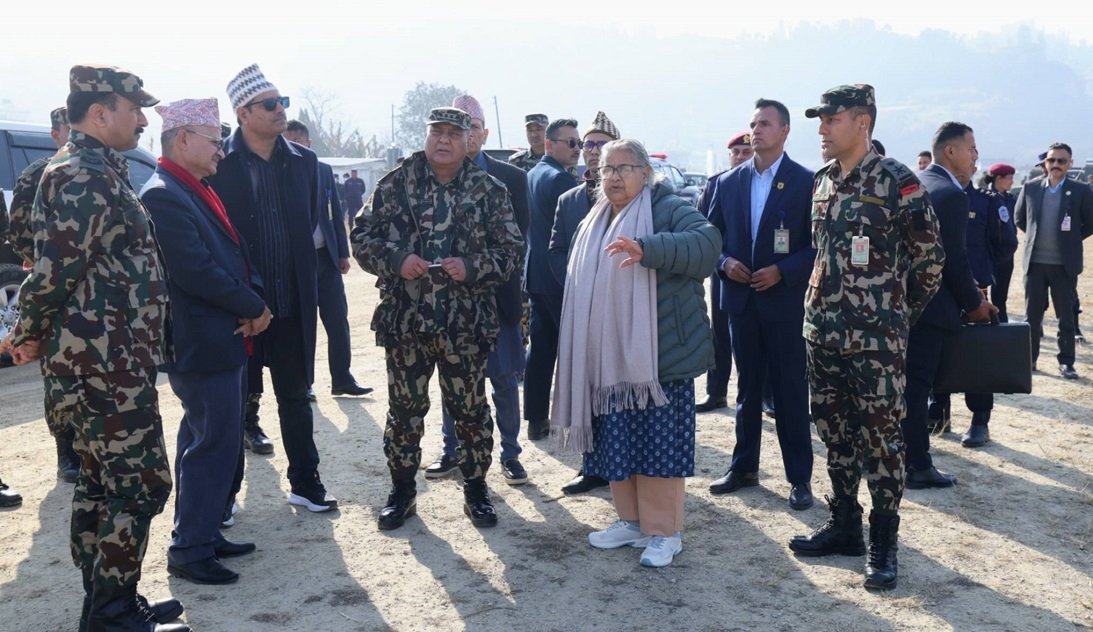
Local residents had been protesting for a long time, demanding the preservation of Khokana's cultural, religious, and archaeological identity, which caused the land acquisition process for the Khokana-Dukuchhap section, falling under Package Number 11, to nearly halt. Due to this dispute, a concrete decision regarding the expressway's starting point and traffic management could not be made even after eight and a half years.
The overall physical progress of the project does not yet appear satisfactory. The government entrusted the responsibility to the Nepal Army on Shrawan 27, 2074 BS, with a target to complete the construction within four years. However, due to repeated deadline extensions and technical complications, the overall physical progress reached only 45.15 percent by the end of Poush. According to data up to the end of Poush in the current fiscal year 2082/83, the financial progress is limited to 45.33 percent.
Compared to the same period last year, the physical progress this year has increased by only 7.55 percent, raising significant doubts about the project being completed on schedule. The government recently set a second revised deadline to complete the project by the end of Chaitra 2083 BS, but given the snail's pace of construction, meeting the target appears very difficult.
The land acquisition processes are still pending for the tunnel sections and slope stabilization in Makwanpur, not just in Khokana. However, the Army has stated that land acquisition has been completed and construction is proceeding rapidly for the section of the expressway from 24.8 kilometers to 70.97 kilometers.
The cost burden is increasing because the project is not being completed on time. The estimated cost for this project, which was initially projected to be completed at 1 Kharba 75 Arab 19 Crore Rupees, has already reached 2 Kharba 11 Arab 93 Crore Rupees due to the revised deadline and inflation. This 20.95 percent increase in cost has added further burden to the national treasury. So far, 82 Arab 97 Crore Rupees has been spent on the project. If policy decisions are delayed further and construction work does not gain momentum, this cost is certain to rise. Experts argue that the government's failure, particularly in the Khokana section, has made the project expensive and slow.
The land acquisition processes are still pending for the tunnel sections and slope stabilization in Makwanpur, not just in Khokana. However, the Army has stated that land acquisition has been completed and construction is proceeding rapidly for the section of the expressway from 24.8 kilometers to 70.97 kilometers.
_gG0c5cAQpZ.jpg)
Some encouraging progress has been seen in the construction of the tunnels, which are the main attractions of the project. Among the seven tunnels, the 'breakthrough' has been achieved in the Dhodre and Lendanda tunnels, which is a significant success for the project. Excavation for the Mahadevtar tunnel is 64 percent complete on the right side and 74 percent on the left side. However, work on tunnels such as Chandram Bhir, Devichaur, Sishoutar, and Mauri Bhir is still in the preliminary stages. Similarly, out of the 89 bridges included in the project, the contract management for 85 bridges has been finalized, and the foundation construction for 54 bridges and the superstructure construction for 34 bridges have been completed. The completion of 13 special bridges, some reaching 82 meters in height, also demonstrates the development of Nepali technical capability.
The future of this strategic project, which connects Kathmandu to the Terai region via a shorter route, now depends on the new DPR for Pharsidole and the firm decision of the government. The Army's recent readiness to move the project forward by setting aside the Khokana dispute or using an alternative route has generated some hope. However, if administrative hassles related to land acquisition, deforestation, and compensation distribution are not addressed in time, the deadline of Chaitra 2083 BS will also become just another paper target.
This specific news has been automatically translated by AI. As a result, there may be some inaccuracies or language errors.
_cvUCBlwFTZ.jpg)