
Major Nepali Parties Outline Constitutional Amendments in Election Manifestos, Revealing Disagreements
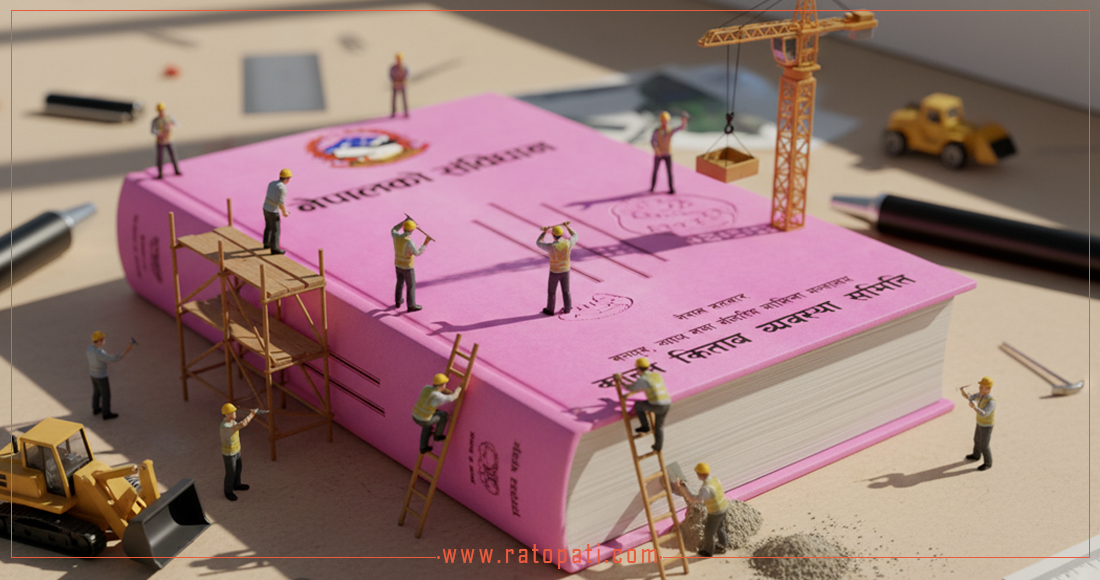
Kathmandu. The four major political parties have stated that the parliament formed after the House of Representatives election scheduled for February 21 will amend the constitution. All four parties have mentioned constitutional amendment in their manifestos for the election. However, differences of opinion are apparent among them regarding the specific issues for amendment.
The major parties, Nepali Congress, CPN-UML, CPN (Maoist Centre), and Rastriya Swatantra Party (RSP), have raised issues such as the form of governance and constitutional amendment in their manifestos. However, there are significant differences in the issues they have raised.
They have mentioned issues ranging from changing the form of federalism and inclusion to restructuring the state by changing the electoral system.
Issues Mentioned by Parties for Constitutional Amendment
Nepali Congress
In its manifesto, titled 'Pratigyapatra' (Pledge Letter), the Congress has mentioned that constitutional amendment is indispensable to fulfill the commitments made by the party. 'To fulfill the commitments made in our pledge letter, some new clauses will need to be added to the constitution, and some parts require time-appropriate revision,' the pledge letter states, 'We have already prepared a list after serious homework on which provisions of the constitution have obstructed performance, caused governance anomalies, and how they can be improved.'
The Congress has also mentioned preparing a 'framework' for amendment through discussions among the political parties represented in the House of Representatives immediately after the election. Congress stated that broad national consensus and active participation from everyone are necessary for constitutional amendment.
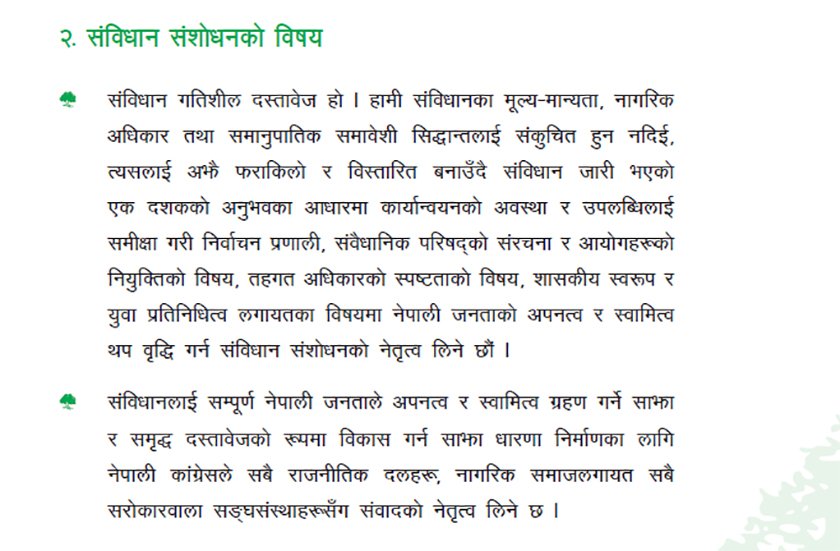
'As soon as the parliament begins, an inter-party cooperation structure will be formed for collaboration among the parties within it, and Congress will lead it,' the Congress pledge letter states, 'Through that structure, by maintaining a minimum understanding, and through that committee, we will quickly finalize the issues of constitutional amendment in dialogue and consensus with many other political parties outside the parliament, civil society, and all stakeholders, which will make the implementation of our pledges possible.'
Congress has also mentioned reforming the electoral system. The pledge letter mentions making legal and constitutional arrangements for political stability by reviewing the electoral system to further strengthen, make fair, and broaden the proportional and inclusive electoral system.
CPN-UML
In its manifesto, UML stated that it would further refine the constitution based on national consensus, making it vibrant and functional for practical implementation.
'The constitution is currently suppressed, violated, dormant, and burned by riots and arson,' UML wrote in its manifesto, 'We declare that we will bring this constitution of the Nepali people to life and functional in practice by further refining it based on national consensus.'
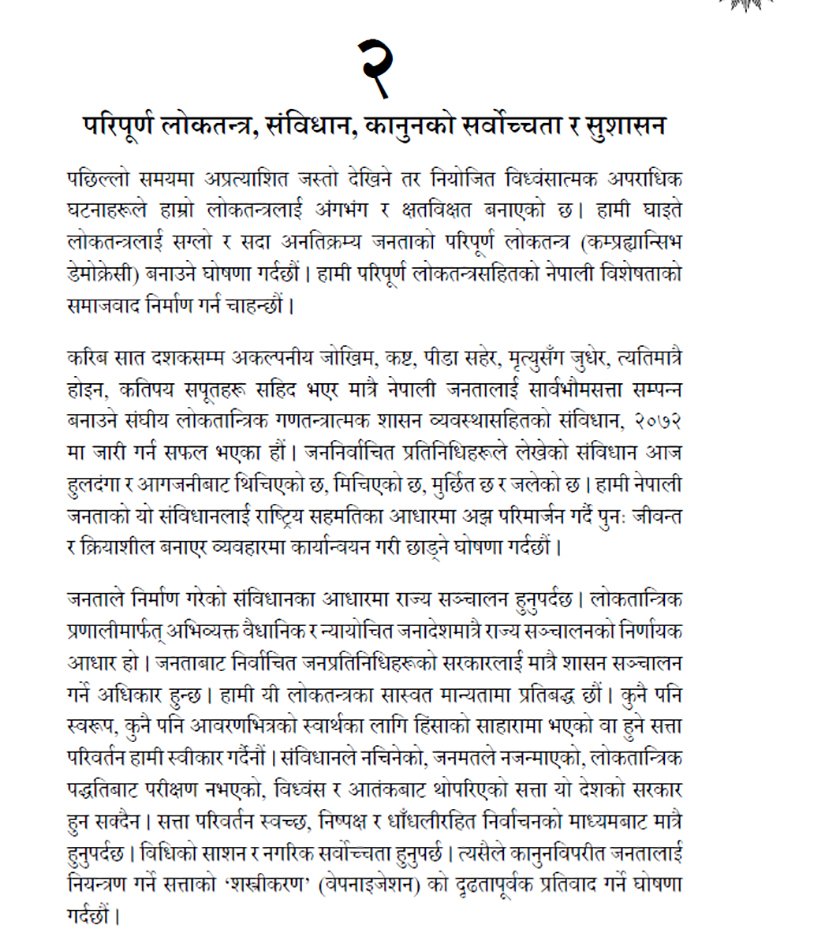
UML also stated that it would take the initiative to build national consensus among political parties. 'We accept the existence of political parties, believe in dialogue and cooperation, and reject so-called populism, extremism, exclusion, and authoritarianism,' UML wrote in its manifesto.
CPN (Maoist Centre)
The CPN (Maoist Centre) has stated that the constitution should be amended as directed by the constitution itself. Its manifesto mentions that the constitution was created by a popularly elected constituent assembly and documents the rights achieved by the Nepali people through many types of sacrificial struggles.
'No one has the right to abolish the constitution. However, it is not an immutable document. Necessary revisions can and should be made to solve the problems that arise during its implementation,' the CPN (Maoist Centre) wrote in its manifesto, 'But it is our firm belief that the process must be as directed by the constitution itself. We are firmly determined to amend various aspects, including the form of governance and the electoral system, based on the conclusions drawn from a serious review and reconsideration of the constitution's implementation.'
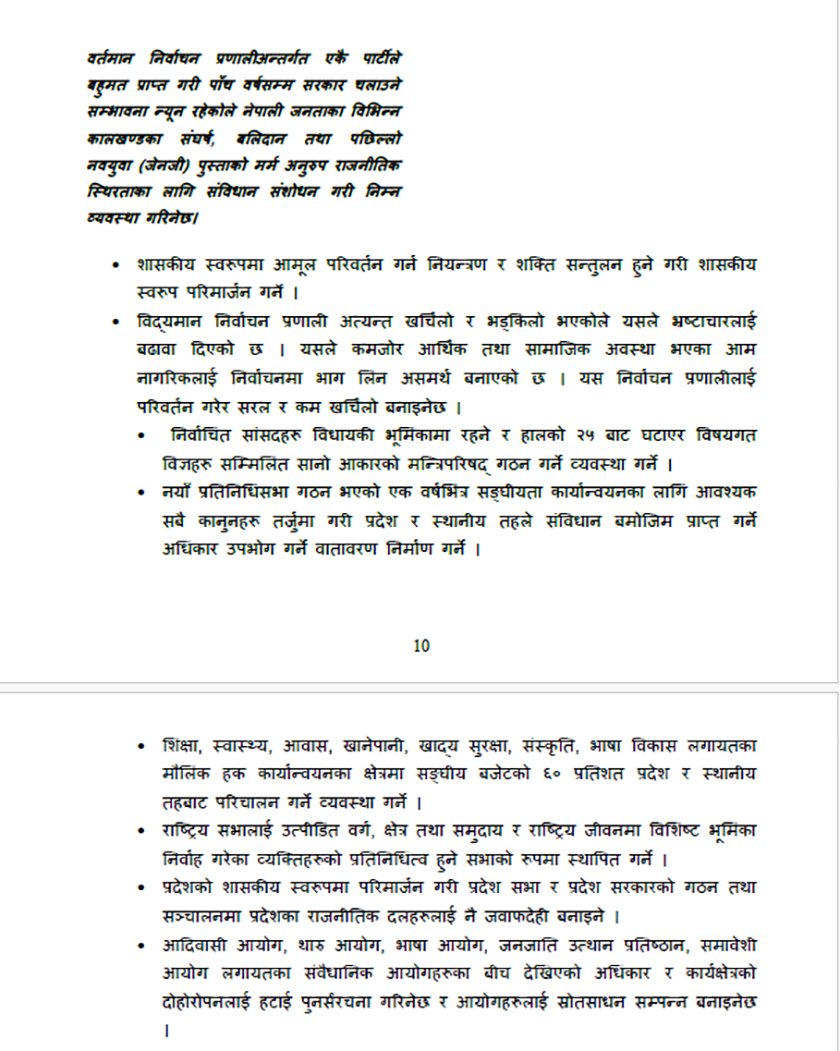
The CPN (Maoist Centre) mentioned that under the current electoral system, the possibility of a single party gaining a majority and running the government for five years is low, and stated that amending the constitution could lead to a single party gaining a majority. 'The existing electoral system is extremely expensive and extravagant, which promotes corruption. It makes it impossible for ordinary citizens with weak economic and social conditions to participate in elections. This electoral system will be changed to be simpler and less expensive,' the CPN (Maoist Centre) wrote in its manifesto.
Rastriya Swatantra Party
The Rastriya Swatantra Party (RSP) stated in its manifesto that it would amend the constitution to establish a directly elected executive and a fully proportional parliament.
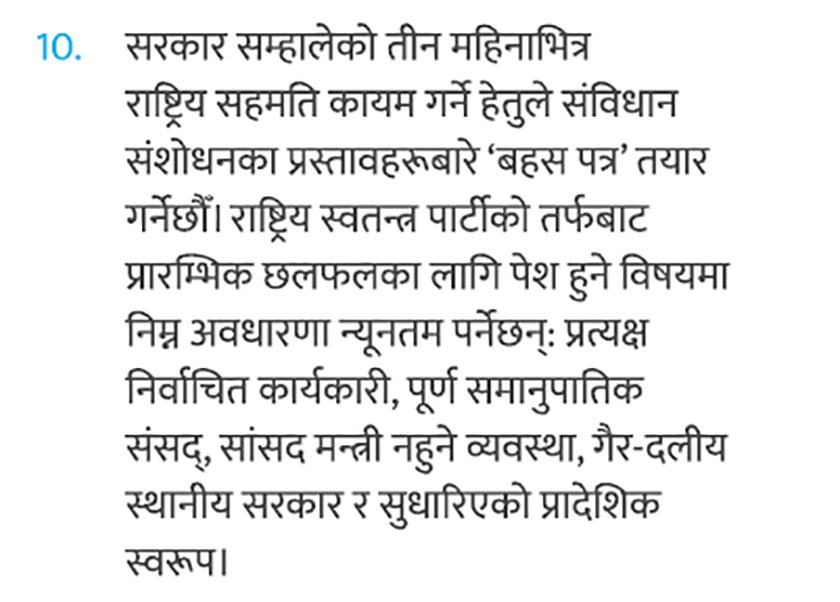
'Within three months of taking office, we will prepare a discussion paper on proposals for constitutional amendment with the aim of achieving national consensus,' the RSP wrote in its manifesto, titled 'Wachapatra' (Promise Letter), 'The following concepts will minimally be included in the issues presented for initial discussion from the side of the Rastriya Swatantra Party: directly elected executive, fully proportional parliament, a provision where MPs cannot be ministers, non-partisan local government, and an improved provincial structure.'
Amendment Issues Do Not Align
The constitutional amendment issues raised by the four parties do not align with each other. Apart from the issue of changing the electoral system mentioned by Congress and the CPN (Maoist Centre), different issues are seen for constitutional amendment. Since a two-thirds majority in parliament is required for constitutional amendment, the possibility of amendment appears low when parties raise different issues for amendment.
Constitutional Amendment Agendas of Other Parties
- Rastriya Prajatantra Party
The Rastriya Prajatantra Party (RPP) has prioritized the issue of the monarchy in its resolution proposal regarding constitutional amendment. Its resolution paper mentions comprehensive change and reform in the current expensive and unstable electoral system. Furthermore, the RPP manifesto mentions abolishing the provincial structure and establishing a two-tier governance structure with the federal and local levels. The promise letter also mentions establishing a Vedic Sanatan Dharma-based Hindu nation with full religious freedom and non-partisan local levels.
- Janata Samajbadi Party Nepal
The Janata Samajbadi Party Nepal (JSP Nepal) has prioritized the issue of constitutional amendment in point number 3 of its manifesto. Accusing the three major parties at the time of the constitution's promulgation in 2072 BS—Congress, UML, and CPN (Maoist Centre)—of issuing the constitution based on a majority, JSP has emphasized the issue of amending the constitution with identity.
JSP Nepal has called for rewriting or extensively amending the current constitution, calling it 'incomplete.' It has raised the issue of a directly elected executive presidential system in the form of governance and stated that federalism based on national identity and restructuring of provinces should occur. It mentioned forming a high-level constitutional review commission to strengthen constitutional bodies by forming a Janlokpal body, ensuring the rights, interests, and identity of oppressed communities, ending gender discrimination in citizenship, and clarifying the interpretation of secularism, and amending the constitution based on the suggestions of that commission.
- Ujyalo Nepal Party
The Ujyalo Nepal Party has mentioned in its manifesto the right to good governance through constitutional amendment, reducing the number of parliamentarians, reducing the number of ministries, directly elected chief ministers, and making local elections non-partisan. It also mentioned reducing the number of House of Representatives members from 275 to 209 and Provincial Assembly members from 550 to 330. The Ujyalo Nepal manifesto mentions 15 ministries at the federal level and 5 to 7 ministries at the provincial level, and not having state ministers and assistant ministers in the cabinet.
The issue of making local level elections non-partisan, where only independent candidates compete, to develop a culture of achieving common consensus, is also mentioned in the Ujyalo Nepal Party's manifesto. It stated that arrangements would be made for voting from districts and abroad, and a 'No-Vote' option would also be provided.
This specific news has been automatically translated by AI. As a result, there may be some inaccuracies or language errors.

_D4v4Yqko03.jpg)


_hXuKAenRlA.jpg)
_cvUCBlwFTZ.jpg)