Krishna Shah, Commander of Notorious 'Dullu Rebellion' Against Maoists During Civil War, Passes Away at 76


Surkhet. Krishna Shah, the commander of the 'Dullu Rebellion' that took place during the 10-year armed conflict initiated by the then CPN (Maoist), has passed away. Her son, Bhupal Vikram Shah, confirmed that she died on Monday at the age of 76.
Bhupal Vikram stated that his aunt passed away from asthma at her home near Patangini in Dullu Municipality-7. The 'Dullu Rebellion' against the Maoists during the Maoist war is a very famous incident. Shah is renowned in Dailekh as a commander of that rebellion.
The 'Dullu Rebellion' incident in 2061 BS was even broadcast by Al Jazeera.
Dullu Rebellion Shook Even the Maoist Headquarters
At the peak of the armed conflict, the Dullu Rebellion against the Maoists sent shockwaves even to the Maoist headquarters. According to Chandra Rawat, a teacher and litterateur from the Dullu area, the 'Dullu Rebellion' occurred as a counter-revolution after Maoist cadres oppressed the local populace.
On Kartik 23, 061 BS, Maoist cadres forcibly made Raju Bajracharya of Dullu-8 the head of the Ward People's Government. They also forced him to wear a combat uniform.
The next day, the army from the district headquarters reached Dullu. Raju, wearing a militia uniform, tried to flee. As he was running downhill from a tea shop, he was shot by the army and collapsed on the spot. The army dug a pit and buried his body.
"Then the army spread fear among the citizens, saying not to dig it up, as there might be a bomb with the corpse," says Prakash Adhikari, a senior journalist from Dailekh knowledgeable about the incident, "After that, no one dared to exhume the body."
The 'Dullu Rebellion' against the Maoists started from that very incident.
The incident gained widespread attention. Locals appealed to the Maoists. The local demand was that the Maoists themselves should exhume the body, as Raju was killed for being forcibly made the head of the People's Government. However, Maoist leaders and cadres were unwilling to excavate the body.
At that time, the Maoists were running a people's government, and Thir Bahadur Karki was the head of the Dullu People's Government.
Four days later, locals and relatives managed to exhume the body, but no bomb was found. While taking it for cremation towards the Paduka river, a group of Maoists tried to stop them and attempted to drape their party flag over the body. The enraged public, furious at the Maoists over the atrocities, turned against the Maoists who were trying to drape the flag over the body that had been rotting in the pit. The sticks carried by the funeral procession were turned against the Maoist leaders.
Maoist leader Nayaram Thapa was injured. The locals chased the Maoist leaders away from there. But then, fear spread further among the locals—"We beat them up, but what if the Maoists attack us now?"
"It was like 'better to go mad than to die,' and amidst fear and terror, the people organized against the atrocities of the Maoists," recalls journalist Adhikari, "How long can we live in fear and terror? It was decided that we must resist."
Initially, the locals decided to patrol day and night to prevent Maoists from entering the village by any means. According to him, the locals planned to play music and gather everyone to chase the Maoists away if they arrived.
In that process, a clash occurred between the police and locals at Kotadanda, where local Bishu Sarkeni initially hit a Maoist leader with a stick. Two Maoist cadres fled after being attacked by women. Adhikari says that the public was very angry with the Maoists for activities like claiming to liberate the proletariat while not allowing ordinary poor people to live peacefully, taking action if food wasn't provided, and preventing last rites.
After that, locals started taking out processions from Kartik 28. The campaign that started in Dullu spread to the then 13 VDCs, and one of the commanders among them was Krishna Shah of Patangini.
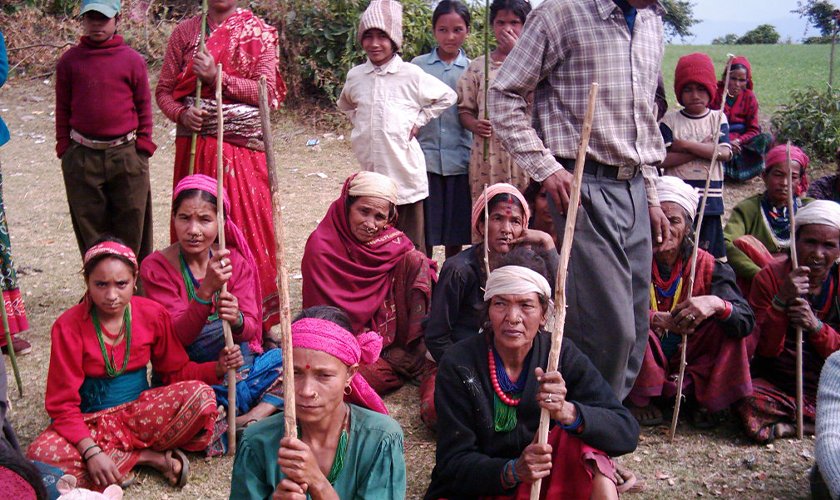
Women emerged as leaders of the rebellion. On Mangsir 2, a massive crowd gathered at Kafalapani in Naulakatwal. The rally was led by Hiranya Dahal of Paduka, Khadga Bahadur Khadka of Gamaudi, and Bina Karki of Dullu. Many men were in India, affected by the war. Only women and children remained in the villages. Most of the angry women and children were seen holding spears and sticks. Maoist cadres murdered Khadga Bahadur Khadka, supported by the UML, accusing him of inciting a rebellion against them by mobilizing women.
Protest rallies were held from Kartik 28 to Mangsir 7. As the public rose against the Maoists, the news of the 'Dullu Rebellion' spread across the country. The state's attention was focused there. According to local Chandra Rawat, this incident of a popular counter-revolution against the Maoists was the first of its kind in Nepal. After 'Al Jazeera' broadcast the report, the 'Dullu Rebellion' gained international attention.
A massive assembly was organized in Patangini on Mangsir 7, led by women and children. Then Home Minister Purna Bahadur Khadka, Local Development Minister Yuvraj Gyawali, and Science and Technology Minister Balaram Ghartimagar announced a 'Special Development Program' worth 3 crore.
Immediately afterward, an Area Police Post and an Army Battalion were stationed. The then Home Minister Khadka had stationed the army in Dullu for the security of the citizens. That was done by displacing local homes. That barracks still exists there today. After the 'Dullu Rebellion,' its impact spread to Naumule in Eastern Dailekh, which was also affected by the war.
Khadga Bahadur Bishwakarma 'Prakanda' (who was a central committee member of the party at that time and is currently a candidate from Kalikot for the Maoists) was attacked by the public in Naumule. He managed to escape and save his life.
Journalist Adhikari says, "The Dullu Rebellion shamed the Maoists. After that incident, the Maoists adopted a softer stance towards the public."
Citing a weakness in leadership, the headquarters demoted Khagendra Sen by 'one step' and appointed Rajkumar Sharma as the Dailekh District In-charge. Sharma, who was previously the Chief Minister of Karnali, recalls saving the Maoist organization in a difficult situation at that time.
The shock of the Dullu Rebellion caused turmoil at the Maoist headquarters. Citing leadership failure, the headquarters took action by implementing a 'one step down' policy. State-level leaders were assigned district responsibilities, district leaders to area responsibilities, and area leaders to village responsibilities. Leaders and cadres across the country apologized to the public. They adopted a policy of mingling with the people.
After the public rose against them, the Maoists changed their war strategy. Adopting a softer approach towards the public, they built infrastructure like the road connecting Dullu to Pipaldhari. Later, the Maoist headquarters sent a 5-member task force under the convenorship of Ekraj Bhandari to investigate the shortcomings committed by the cadres.
Thir Bahadur Karki was removed as the People's Government Chief. All leaders in that area were demoted by one level as a punitive measure.
However, records show that 24 people from Dullu lost their lives during the Maoist war.
Result - Dailekh Remained Weak as a Base Area
According to journalist Adhikari of Dailekh, Maoist leaders became highly criticized due to the Dullu Rebellion and the murder of journalist Dekendra Thapa. Consequently, the Maoists failed to expand in Dailekh. While the Maoists emerged as a strong force in other districts of Karnali (now) after the peace process, they remained weak in Dailekh. This was a result of incidents including the Dullu Rebellion and the murder of journalist Thapa.
In Dailekh, which has two constituencies, the Maoists have never won a House of Representatives election so far.
The area where the 'Dullu Rebellion' took place currently falls under Dailekh-2.
The Maoists have not won any election here, from local to provincial to the House of Representatives. Thir Bahadur Karki, who was the People's Government Chief during the rebellion, contested the Constituent Assembly elections in 064 and 070 BS, but he finished third in both elections.
As the Maoists weakened organizationally and in parliamentary elections, this area became a stronghold for the Congress-UML alliance.
In 074 BS, when the Left Alliance was formed, the Maoists supported UML's Raj Bahadur Buda, and in 079 BS, they supported Congress's Dikpal Kumar Shahi. Currently, Yogendra Bahadur Shahi from the transformed Communist Party of Nepal (CPN) is the candidate. Congress has again fielded Dikpal, while UML has Laxmi Pokhrel, who won the 070 BS election, as the candidate. Organizationally too, Dailekh is the weakest district for the Maoists.
This specific news has been automatically translated by AI. As a result, there may be some inaccuracies or language errors.