Maha Shivaratri Celebrated Across Nepal with Devotion and Festivity

Kathmandu. Today, the major festival of Hindus, Maha Shivaratri, is being celebrated across the country with reverence, devotion, and joy. This festival, observed on the fourteenth day of the dark half of the month of Falgun, is considered a day extremely dear to Lord Shiva.
This festival, celebrated to commemorate the night of Lord Shiva's manifestation according to the Puranas, is described as one of the four major sacred nights: Kalratri, Moharatri, Sukharatri, and Shivaratri. This day is especially considered the day that brings forth religion into the hearts of beings living a sorrowful, difficult life.

On the occasion of Mahashivaratri, devotees traditionally observe fasts while performing puja and archana at Shiva temples. Milk, datura, and bel leaves, considered dear to Lord Shiva, are offered. This day is also recognized as the day of the marriage of Shiva-Parvati and the day Brahma manifested Shiva in the Rudra form.
According to the Shiva Purana, observing a fast and chanting the mantra 'Om Namah Shivaya' on this day is believed to bring happiness and prosperity on Earth and salvation after death. Similarly, the Linga Purana mentions that devotion, meditation, and puja lead to Shiva Loka, while according to the Padma Purana, men or women who fast are believed to be endowed with health and good fortune.
_ngSQ52utMJ.jpg)
The main rituals of Shivaratri are considered to be Nirjal Vrat (fasting without water), overnight vigil, puja in four segments (Prahars), and the Abhishek (bathing) of the Shivling with milk. Water, milk, yogurt, ghee, honey, and bel leaves are offered in each segment. The Shivaratri fast is explained as the best means of Dharma in the Kotirudrasamhita section of the Shiva Mahapurana.
The Shiva Mahapurana's Kotirudrasamhita explains the significance of Shivaratri as follows:
Shivaratrivratadanyannasti nrna shitavaham |
Etat vrat tu sarvesha dharmasadhanamuttamam ||
Nishkayanam sakamanam sarveshamcha nrnam tatha |
Varnanamashramanamcha streevalanancha hare 1 ||
Dasanam dasikanamcha devadeenam tathaiva cha |
Sharirinamcha sarvesham hitametad vratam varam || (Shivapuramana Kotirudrasamhita 38/21-23)
Meaning: There is no fast like Shivaratri that benefits human beings. Through this, people attain Dharma. All types of devotees, whether performing selfless or motivated actions, benefit from this. Brahmins, Kshatriyas, Vaishyas, and Shudras—people of these four Varnas, and those in the four Ashramas of Brahmacharya, Grihastha, Vanaprastha, and Sanyasa, if they observe the Shivaratri fast with devotion, they become capable of achieving their respective goals according to their Varna and Ashrama. This fast should be observed with devotion by men, women, boys, girls, and people of all Varnas. This fast benefits various creatures, humankind, gods, ancestors, and sages.
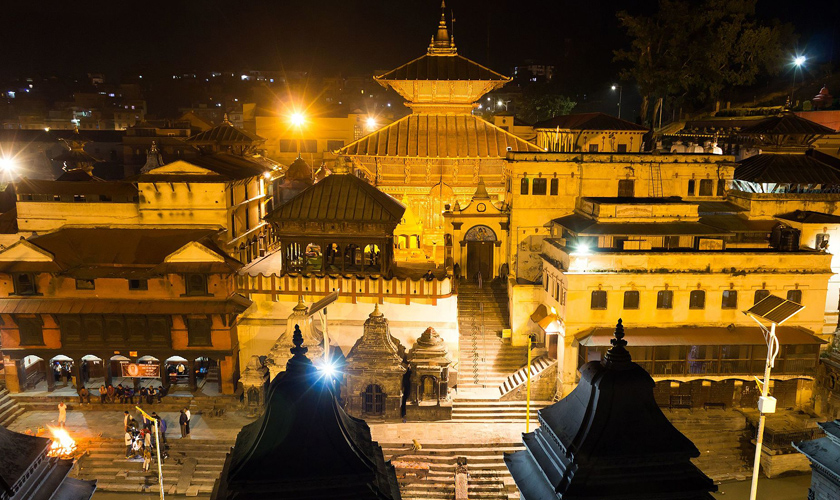
On this occasion, huge crowds of devotees have gathered at Pashupatinath Temple, Doleshwor Mahadev Temple in Bhaktapur, Devghat Dham, Halesi Mahadev Temple in Khotang, and other Shiva temples across the country. A special fair is being held in the Pashupatinath area, with a notable presence of Sadhus and saints from both Nepal and India.
Similarly, large crowds of devotees have also gathered at famous Shiva Dhams in India, including Kashi Vishwanath Temple, Kedarnath Temple, Somnath Temple, and Mahakaleshwar Jyotirlinga.
This specific news has been automatically translated by AI. As a result, there may be some inaccuracies or language errors.