Supreme Court Establishes Precedent Allowing Review of Final Judgments Under Extraordinary Jurisdiction for Grave Errors

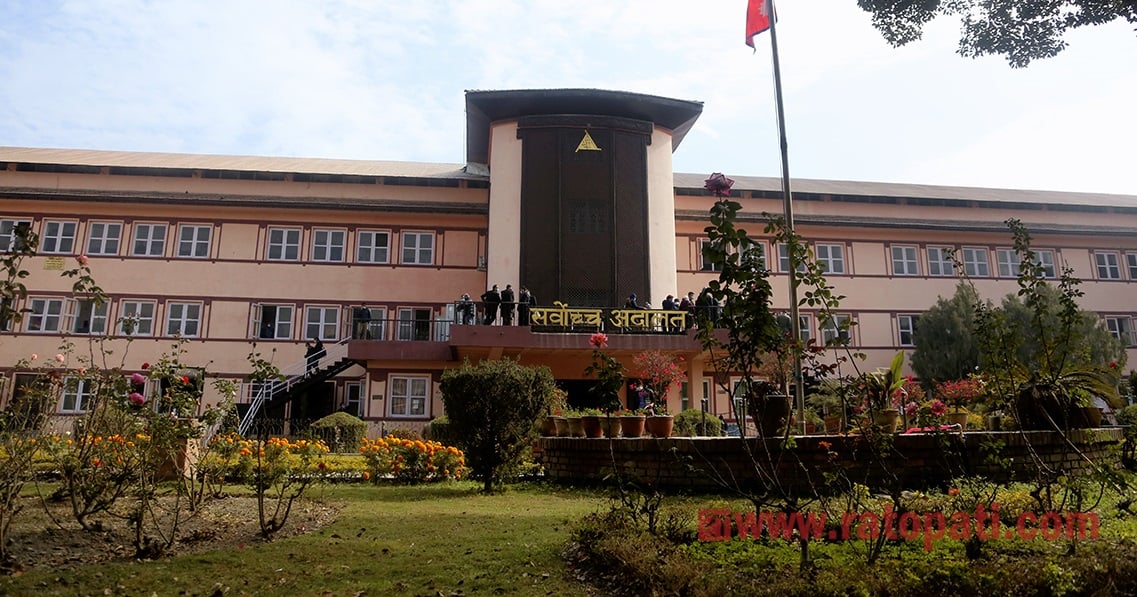
Kathmandu. The Supreme Court has established a precedent allowing for hearings under its 'extraordinary jurisdiction' (writ) even in cases where a final judgment has already been rendered, provided there are grave legal errors or violations of the principles of natural justice.
A full bench comprising Justices Dr. Manojkumar Sharma, Tekprasad Dhungana, and Sunilkumar Pokharel, while hearing the petition of Bekulakshmi Shrestha, discussed the established legal principle of 'Doctrine of Finality' in its order. Generally, after an appeal process or a 'review' process is exhausted in a case, it is considered a 'final judgment,' and that dispute is deemed settled forever. This is known in legal language as the Doctrine of Finality. However, the Supreme Court stated that there are some exceptions to this.
For the resolution of any dispute, the law first provides remedies under ordinary jurisdiction, which typically includes processes such as the court of first instance, appeal, and review/reconsideration.
"Once the right to appeal in a case has been exercised, or after a petition for review has been filed and rejected without merit, the case is considered to have exhausted ordinary remedies and reached finality. A final decision made by the court after the full use of all ordinary remedies provided by law cannot be challenged again using extraordinary jurisdiction. A writ cannot become an alternative remedy when ordinary remedies have been fully exhausted," the Supreme Court's order stated. "Challenging a final judicial decision again through a writ petition goes against judicial discipline and the principle of finality. If the finality of judicial decisions is not accepted, no dispute will ever end, rendering the justice system ineffective. Therefore, the 'Doctrine of Finality of Judgment' is accepted as the backbone of the judicial system."
"It is a general principle that the Doctrine of Finality applies to decisions finalized according to the law," the order stated. "An exceptional situation arises where this Court's extraordinary jurisdiction is invoked if there is a jurisdictional error, gross violation of the principles of natural justice, lack of judicial mind, preconceived notions, arbitrary exercise of discretionary power by state bodies or officials, or a patent error visible on the face of the record, and an effective remedy is not available through the ordinary jurisdiction route."
The Supreme Court concluded that extraordinary jurisdiction can only be exercised in a final decision if there is a jurisdictional error, gross violation of the principles of natural justice, lack of judicial mind, preconceived notions, arbitrary use of discretionary power, or a patent error visible on the face of the record. The court ruled that seeking the remedy of a writ when ordinary remedies have been exhausted, in the absence of any exceptional circumstances, cannot be considered consistent with judicial principles.
"In fact, apart from certain principles developed through court practice, there are no mechanical or formulaic rules regarding the circumstances under which a remedy can be sought through extraordinary jurisdiction," the Supreme Court's order stated. "Generally, the extraordinary jurisdiction of this Court is exercised when there is a jurisdictional error, violation of the principles of natural justice, lack of judicial mind, preconceived notions, arbitrary exercise of discretionary power in decisions made by state bodies or officials, a patent error visible on the face of the record, and the absence of an effective means to correct such an error and obtain a remedy through the ordinary jurisdiction route."
The order mentioned that the constitutional writ jurisdiction can only be invoked if there are concrete grounds showing extraordinary circumstances, such as a serious violation of the principles of natural justice or a clear constitutional or legal error visible from the record, at the very first sight. "The notion that a writ jurisdiction is automatically invoked simply because permission to review the case was not granted cannot be maintained," the Supreme Court's order stated.
Petitioner Bekulakshmi Shrestha was dissatisfied with the decision of the Patan High Court regarding the deduction of tenancy rights (Mohi Lagat Katta) and had filed a petition in the Supreme Court seeking review permission (Nissa). After the Supreme Court denied Nissa (refused to hear the case), the case legally became final. However, claiming that the decision contained serious constitutional and legal errors, Shrestha attempted to file a writ petition (Mandamus/Certiorari). The Supreme Court administration (Registrar) rejected the filing on Bhadra 21, 2080, stating that "a case that has already been finalized cannot be subject to a writ again." Shrestha then filed a petition in the bench against that rejection.
Previously, the Supreme Court administration would refuse to register such petitions, citing procedural deficiencies. However, with this order, the Registrar will no longer be able to stop a petition solely on the basis that the case is 'already finalized.' The court determined that the serious legal question raised in the petition must be tested by the bench itself.
The court ordered that Bekulakshmi Shrestha's writ petition be registered and presented to a division bench according to procedure. This ruling has opened the door for parties who have suffered injustice due to grave errors to file a writ under extraordinary jurisdiction and raise questions even after a final judgment.
This specific news has been automatically translated by AI. As a result, there may be some inaccuracies or language errors.
_fCGHuxt9oR.jpg)