Private Sector Ready to Build Major Projects Like Budhi Gandaki If Government Facilitates, Says IPPAN Chief

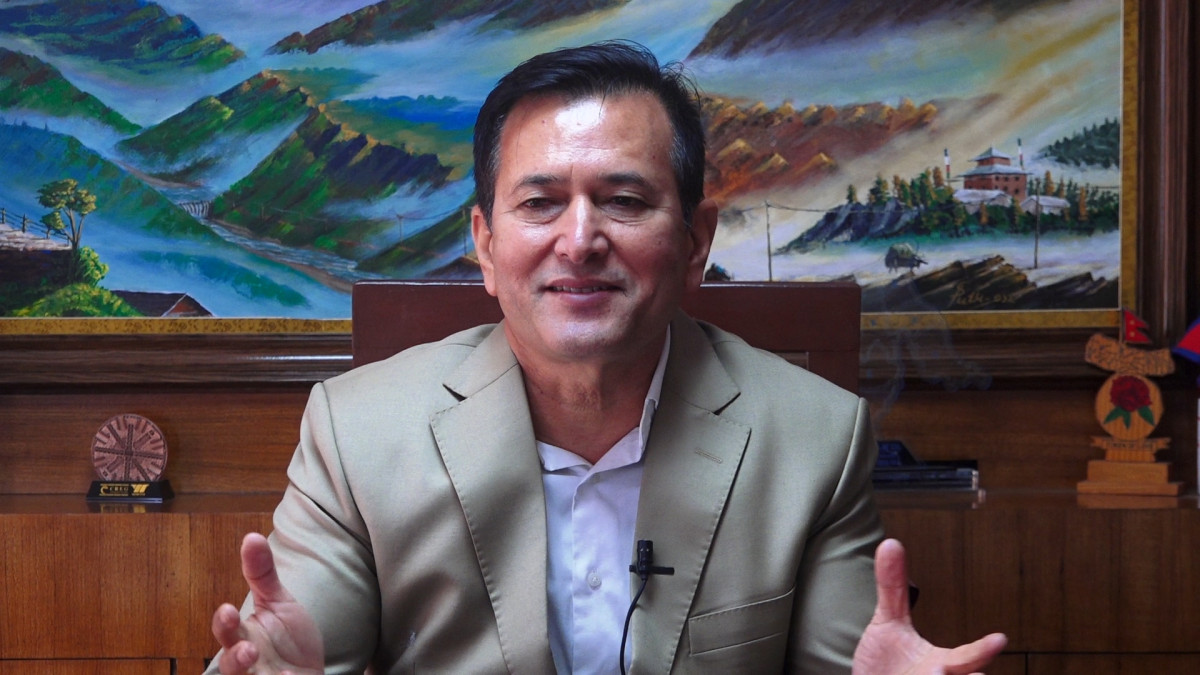
Political parties often use large projects as campaign slogans during elections. One such project that parties have long used as a tool to win elections is the Budhi Gandaki Hydropower Project. Despite being Nepal's largest storage-based multipurpose project, this project has failed to move forward. While parties make it a campaign promise, they neglect it after winning elections, causing Budhi Gandaki and other major projects to be sidelined. Given that this project will impact the economy of not just Dhading and Gorkha but the entire nation, and support employment and all types of business promotion, a signature campaign was recently launched in Dhading to expedite its construction. While major projects are stalled, Nepal's private sector has stated it is fully prepared to construct such large hydropower projects. Ganesh Karki, President of the Independent Power Producers' Association, Nepal (IPPAN), claimed that if the government provides policy facilitation and creates an enabling environment, the private sector can build ambitious projects like Budhi Gandaki. According to Karki, although the Budhi Gandaki project has been discussed for many years, the main factor hindering its progress is political leadership. He stated that political leaders have held such projects hostage by failing to make timely policy decisions even after gaining power. Karki noted that while the Nepali private sector previously built only small projects, they are now constructing large projects up to 500 MW, meaning there is no issue in moving forward with projects including Budhi Gandaki. He added that since shareholders for a single project are reaching nearly 1.5 to 1.6 million, it is now possible for the private sector to build large projects. President Karki said, 'The discussion about Budhi Gandaki has been going on for a very long time. This project should have moved forward much earlier. The private sector used to build small projects first. Now they are building projects up to 500 MW. This is because raising capital has become easier. Nearly 1.5 to 1.6 million people are becoming shareholders in a single project. Even by investing small amounts, the situation has developed where large work can be done. Raising money at the local level in Nepal does not seem to be a major problem. The biggest problem appears to be policy-related. The government brought a plan to produce 28,500 MW of electricity. The private sector is urging policy reforms to build projects. The Nepali private sector will manage to raise the necessary funds for the projects. Looking at the current records, the Nepali private sector is building projects 30-40 percent cheaper than those built by the government. If the government makes timely policy decisions, the cost of projects will decrease significantly. It is not impossible to build storage projects, but the government must facilitate issues like land leasing and forest-related problems. Today, government policies make it impossible to enter the forest. The government must facilitate these matters. The government must also guarantee the purchase of electricity. The PPA [Power Purchase Agreement] is halted. The government must create an environment for Nepali private sector and citizens to invest in the energy sector. If foreign investment truly needs to be brought in, the Nepali private sector can also convince and bring it. The government must create that kind of environment. If there is no working environment for the Nepali private sector here, we cannot even think about bringing external investors.' Furthermore, NPR 168 billion has been collected from the fuel-based infrastructure development tax for the construction of the Budhi Gandaki Hydropower Project. This amount was collected from the fiscal year 2072/73 until Poush 15, 2082/83 BS. Despite this, the state is delaying the project's advancement. The government approved the financial modality for the 1,200 MW Budhi Gandaki storage-based hydropower project, but it is unknown when construction will begin. According to Karki, the private sector has already produced over 3,300 MW from 190 projects totaling 5,700 MW in 26 years, and 958 projects totaling 36,336 MW are under construction. Since an investment of about NPR 13 trillion has already been made for electricity generation, the private sector is ready to build other large projects. The government needs to create an environment for construction. While studies by the Water and Energy Commission indicate a potential capacity of 120,000 MW—48,000 MW from storage projects and over 72,000 MW from run-of-the-river projects—only 4,000 MW has been generated so far. Karki stated that the private sector is seeking clear policy and plans to achieve the targets set by the National Planning Commission's 16th Five-Year Plan (8,500 MW production capacity), the long-term goal by Bikram Sambat 2100 (40,000 MW production), the Energy Development Roadmap-2081 (28,500 MW by 2035 AD), and the Third Nationally Determined Contribution (NDC) (14,000 MW by 2030 and 28,500 MW by 2035). According to him, to achieve these targets, it is necessary to immediately open the Power Purchase Agreement (PPA) and attract domestic and foreign investors with a clear plan. The Government of Nepal should formulate a separate plan for the energy sector to achieve the goal of net-zero emissions by 2045 AD and declare an energy crisis until these goals are met, prioritizing production. Similar to the cement industry, the state should build basic infrastructure to promote every industry and business to increase electricity consumption, and priority and concessions should be given to industries and vehicles that consume more electricity. —News Agency Nepal
This specific news has been automatically translated by AI. As a result, there may be some inaccuracies or language errors.
_iL3K2wYemS.jpg)