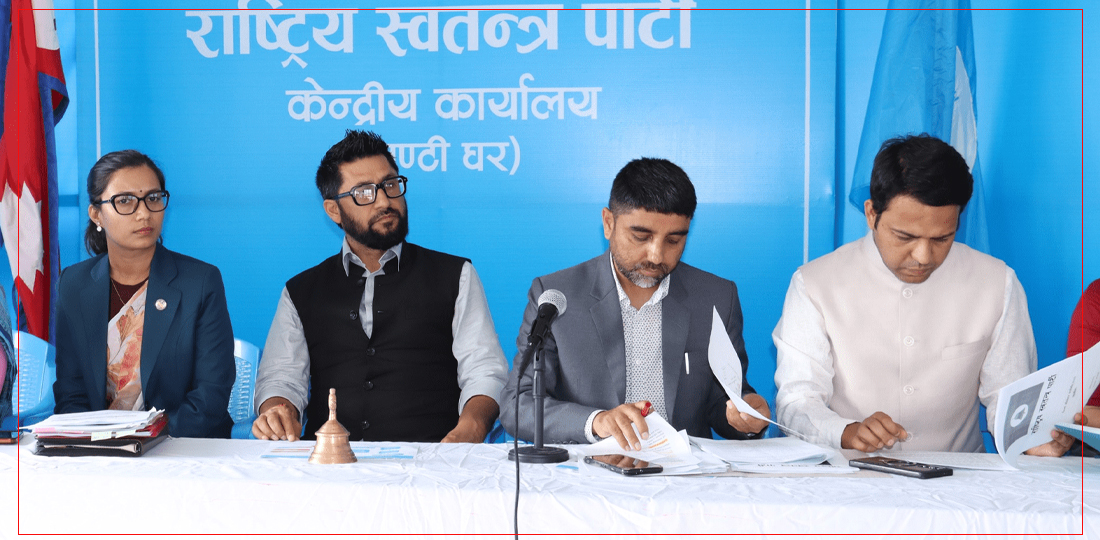
Voters in Makwanpur Demand Governance and Development Agendas as Election Nears

Hetauda. As the House of Representatives election approaches, political parties have launched their campaigns. Candidates, both from established parties and independents, have entered the electoral arena carrying development agendas tailored to the geographical conditions of Makwanpur.
While parties and candidates are actively campaigning, voters in Makwanpur Constituency No. 1 are emphasizing the need for discussions centered on the country's current political situation, good governance, and livelihood issues.
As election fervor increases, voters in the eastern region of Makwanpur express the necessity of seeking concrete agendas for good governance and tangible development from candidates and political parties. Citing past political instability and unsatisfactory performance by elected representatives, they stress the need for leadership capable of bringing about practical change, not just limiting themselves to slogans.
They state that capable leadership and an effective parliamentary role are indispensable for the nation's development and prosperity. They view the recent movement led by the younger generation as a positive pressure against the irregularities and poor governance caused by older political parties. They noted that the search for change and expression of dissatisfaction have been presented through this movement.
However, they critique that while the movement is relevant, it is insufficient for real change due to a lack of concrete agendas. They attribute the growing dissatisfaction with the working style of old parties primarily to widespread corruption and delays in service delivery across the country.
They recall that the role of a House of Representatives member is not limited to the development of their constituency but also includes lawmaking and coordinating between the central, provincial, and local governments. Especially given the geographical remoteness, they emphasized proportional development based on population and geography to resolve the hardships faced by the public in education, health, and transportation.
Bikash Lama, a local youth from Hattisude, Makwanpur, views the Gen Z movement against widespread corruption, irregularities, and poor governance in the country as a positive campaign. According to him, this movement is a result of the irregularities and weak governance brought about by the older political parties.
He stated that for the country's prosperity, elected representatives must focus not only on their constituency but also on policy formulation for the entire nation. He also stressed the need for voters to elect capable leadership that can provide a stable government. He mentioned that the movement, initiated with the aim of good governance and eradicating corruption, has seen some instances of extremism and unpleasant incidents in a few places. He commented that when elected MPs focus only on the race for development in their respective areas, balanced development of the entire country becomes impossible.
He said, "Development has still not reached equally across Nepal. Population and geography must be the main basis when drawing up the blueprint for development." He added, "The selection of capable and competent parties and leaders is essential to establish permanent political stability and a stable government in the country."
Badri Pandey, a local resident of Chhativan Pawas, stated that the movement started by the younger generation amidst widespread poor governance and political instability in the country has emerged as a demand for change. He believes that irregularities have increased because the older generation and traditional parties have failed to maintain good governance, resulting in intense dissatisfaction among the youth.
According to him, MPs must promptly enact necessary laws for the nation and move towards a system of proportional development. He stated that leadership must seriously move forward to resolve the hardships faced by the public due to poor governance and delays in service delivery.
He said, "Minimum basic necessities such as education, health, and physical infrastructure are still not universally accessible. Development works are not progressing as the people expected." He added, "There is also talk about new party candidates these days. However, the policies, principles, and views of those called new have not yet become clear. It is necessary to clearly understand their ideology and agenda in the upcoming elections. It is more reliable to give opportunities to parties or candidates whose policies, methods, and principles appear clear."
Madan Waiba, a local resident of Bakaiya-7 Matokuri, stated that while the youth movement seems relevant, its effectiveness is being questioned. He commented that the issues raised by the movement have not been managed effectively.
According to him, the next parliament must pay special attention to parliamentary proceedings and coordination between different levels of government. He stated that MPs must play a key role in making the parliament organized and effective and keeping the division of work and coordination between the central, provincial, and local governments tight. He believes that the primary responsibility of an elected representative is for the parliament to truly become a forum that voices the people's concerns.
He said, "Although the Gen Z movement appears relevant, its concrete agenda is still not clear. It has created an impression of some change, but it does not seem successful in bringing about the real and concrete change the country seeks." He added, "Due to our difficult geographical structure, people face great hardship in education, health, and transportation. Citizens in remote areas are not receiving basic services and facilities on time because development infrastructure is not easily accessible."
This specific news has been automatically translated by AI. As a result, there may be some inaccuracies or language errors.

_1PHK75GdcC.jpg)