Overview of New Interest Rates for Ashoj Month

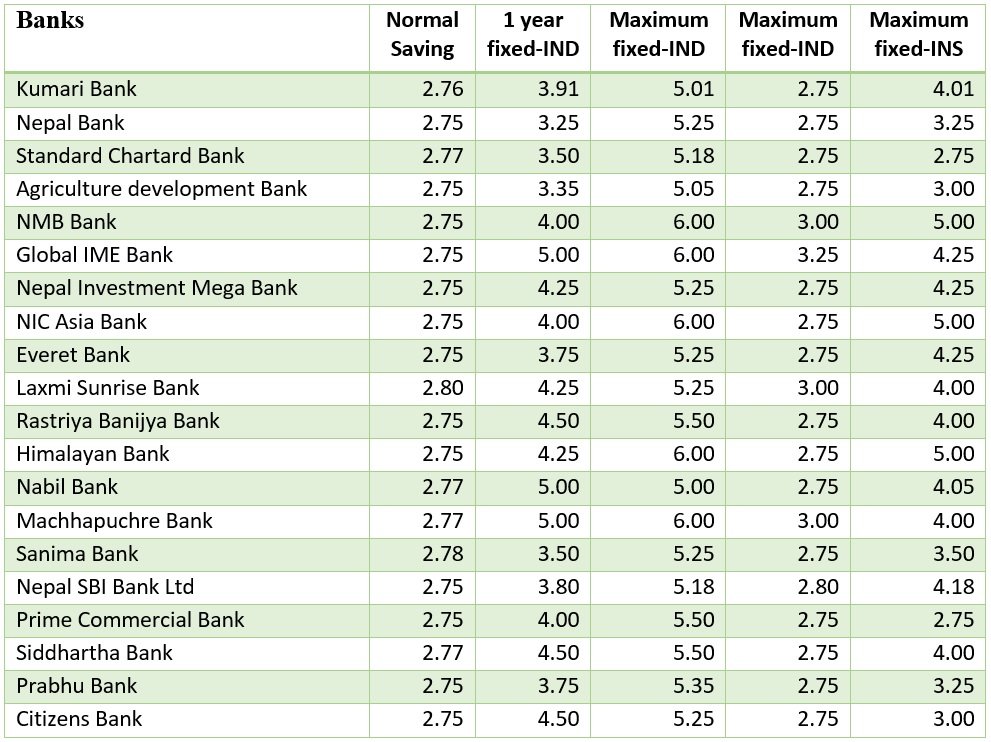
Several banks and financial institutions in Nepal have announced their new interest rates for the month of Ashoj. These rates are set in accordance with the requirement to finalize interest rates before the end of the previous month. Among the 20 commercial banks, nine have made adjustments to their interest rates, while the others have kept them unchanged. The general trend shows that banks are offering varying rates for different types of accounts, with special provisions for remittance accounts and specific deposit schemes.
Interest Rates on Savings and Fixed Deposits
For ordinary savings accounts, the interest rates range from a minimum of 2.75% to a maximum of 2.80%. However, there is a regulation that prevents a difference of more than 2% between various types of savings accounts. Additionally, remittance accounts can have an extra 1% interest point added to the standard rate. Banks have set their rates within this framework for special and remittance accounts.
In the category of fixed deposits, one-year individual fixed deposits offer interest rates from a minimum of 3.25% to a maximum of 5%. For individual fixed deposits, the highest interest rate currently available is up to 6%. Banks have structured their new interest rate charts to provide lower rates for shorter terms and higher rates for longer terms.
Institutional Fixed Deposit Rates
For institutional fixed deposits lasting one year, most banks have set an interest rate of 2.75%. However, Global IME Bank offers the highest rate in this category at 3.25%. Other banks such as NMB, Lakshmi Sunrise, and Machhapuchchhre Bank have set their rates at 3%. For institutional fixed deposits with terms longer than one year, banks are offering higher rates. For example, NMB, NIC Asia, and Himalayan Bank are offering up to 5% interest. In contrast, Standard Chartered Bank offers the lowest rate for institutional fixed deposits, at just 2.75%, regardless of the term length.
Context of Changing Interest Rates
It is important to note that interest rates have been generally decreasing. Over the past year, the average base rate of commercial banks has fallen by 2.13 percentage points, leading to lower loan interest rates. This decline is attributed to reduced deposit interest rates and a surplus of investable funds (liquidity) in banks, alongside sluggish loan demand. For instance, the average base rate dropped from 8.20% to 6.07% over the year. Some banks, like Rastriya Banijya Bank and Standard Chartered, now have base rates below 5%.
Conclusion
In summary, for the month of Ashoj, banks are offering competitive interest rates, with variations based on account type and term length. While savings accounts see modest rates, fixed deposits, especially longer-term ones, offer higher returns. Institutional deposits generally have lower rates, but some banks provide more favorable terms. The overall trend indicates a decline in interest rates due to market liquidity and reduced loan demand.