
Tension at Patale Chhango Again, Public Hearing Held Inside Security Ring in Pokhara
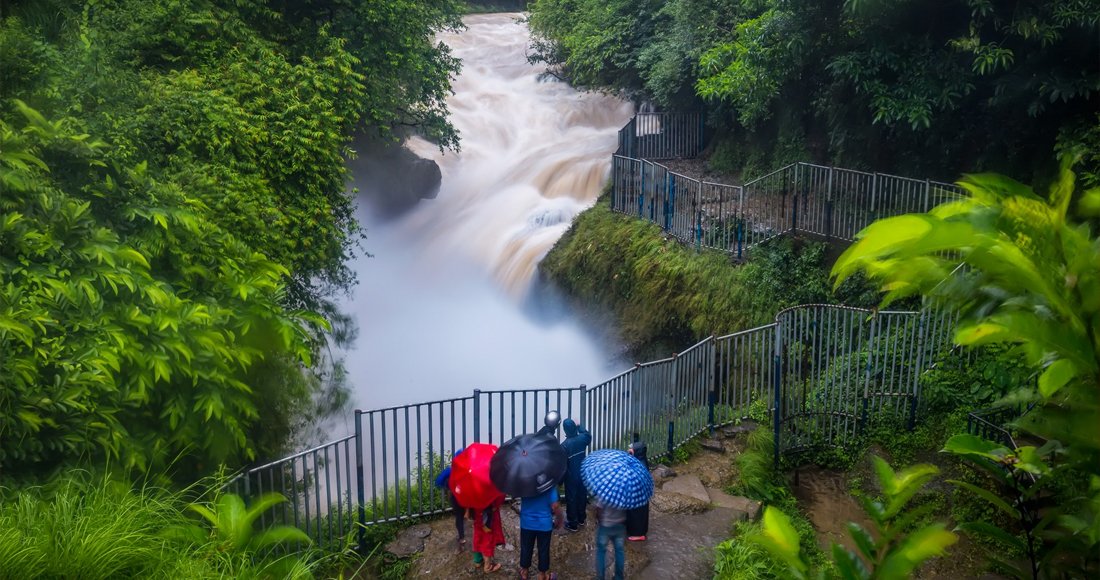
There is renewed tension at Patale Chhango (Patalé Chhāngō), a natural site in Pokhara. The site has been entrusted to a private company, Seti Canyon, for 40 years. The Pokhara Metropolitan City gave this responsibility to the company under a public-private partnership model for its investment and operation.
Some local residents are protesting this decision. They argue that the city has given a long-term contract to a private company, taking only a fixed annual income. This site was previously managed by a local school since 2034 B.S. (1977/78 A.D.). An agreement has now been made for the private sector to use it for the next 40 years.
Legal Challenges and Required Public Hearing
Although the city has already agreed to pay the school 3.02 crore rupees annually, some lawyers filed a case in the high court. They argued that Patale Chhango is a sensitive asset. However, the court dismissed the case. There is now no legal obstacle for the contractor company to move forward.
An Environmental Impact Assessment is mandatory for the project. For this purpose, the company organized a public hearing with local residents present.
A Heavily Guarded Event
A second public hearing was held on Thursday after the first attempt failed. The chairman of Seti Canyon, Karken Kumar Gurung, stated that the second event was organized to make it more inclusive for all locals.
The scene on Thursday was different. Expecting possible disruptions, the city deployed a large number of police officers. The presence of both city and national police was very heavy at the event venue. The Mayor and other public representatives were also present. Despite the risk of disturbance, the program was completed. Chairman Gurung confirmed that the hearing is over and work will proceed once the report is received.
Local Voices of Dissent and Demand for Answers
During the hearing, some locals took control of the microphone to express their dissatisfaction. One local, Yamnath Subedi, questioned the project's standards and their impact. He complained that his property fell under a 200-meter project buffer zone, preventing him from getting a bank loan to finish his house.
He also questioned the need for heavy security, asking why the Mayor needed such a large security ring among his own people. He demanded that the Mayor answer the public's questions, stating that a public hearing is meant to listen to and address people's concerns. Instead, Mayor Dhanraj Acharya left the venue without responding.
Mr. Subedi clarified that they are not against development but are demanding that local rights be ensured. He raised critical questions about the local community's role, access, share in profits, and employment opportunities from the project.
Divided Opinions on the Project
Public representatives and political parties are deeply divided on the project. Some demand the contract be canceled under any circumstance, while others insist it must be implemented.
A Ward Chairman, Devkrishna Parajuli, called the contract non-transparent and a disgrace to the city. He questioned why the city would settle for 2 crore rupees annually when the site could potentially earn 12-15 crore. He also criticized making a 40-year decision that outlasts their five-year elected term.
Conversely, another representative, Motilal Timilsina, argued that canceling the project would send a bad message to investors. He emphasized that Pokhara, as a tourist city, needs more tourist destinations and that this project must be implemented to prove the city is investment-friendly. He clarified that the payment to the city is not a flat 2 crore; the company must also pay 8.5% of ticket sales and spend 1% on corporate social responsibility after operations begin.
The Underlying Issue and Delay
The Metropolitan City had awarded the 40-year contract to Seti Canyon on July 29, 2021. Four years after the agreement was signed, the company has not started any work. The company blames the delay on obstructions from locals. Due to this delay, the estimated project cost has been re-evaluated and has increased from 44 crore to 66 crore rupees.
Some ward chairmen accuse opponents of creating confusion without properly studying the agreement. They suggest that if there are wrong points in the deal, they should be specifically identified. They also expressed concern that the Nepali habit of opposing everything creates problems for investors, whose long-term impact on the city nobody is considering.