
MP Shrestha Registers Dissenting Opinion on Education Bill

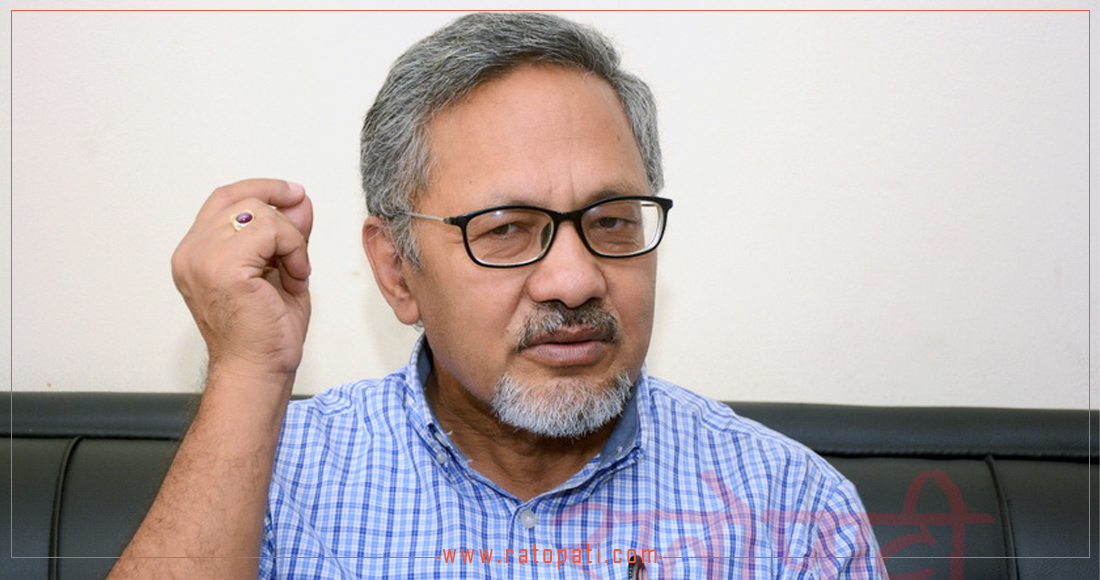
The Education, Health, and Information Technology Committee under the House of Representatives passed the School Education Bill 2080 on Thursday with a dissenting opinion. The main opposition parties, including CPN (Maoist Centre), Rastriya Swatantra Party (RASWPA), and Rastriya Prajatantra Party (RPP), registered their differing views. On behalf of RASWPA, former Minister for Education, Science, and Technology, MP Sumana Shrestha, registered a dissenting opinion on three specific points.
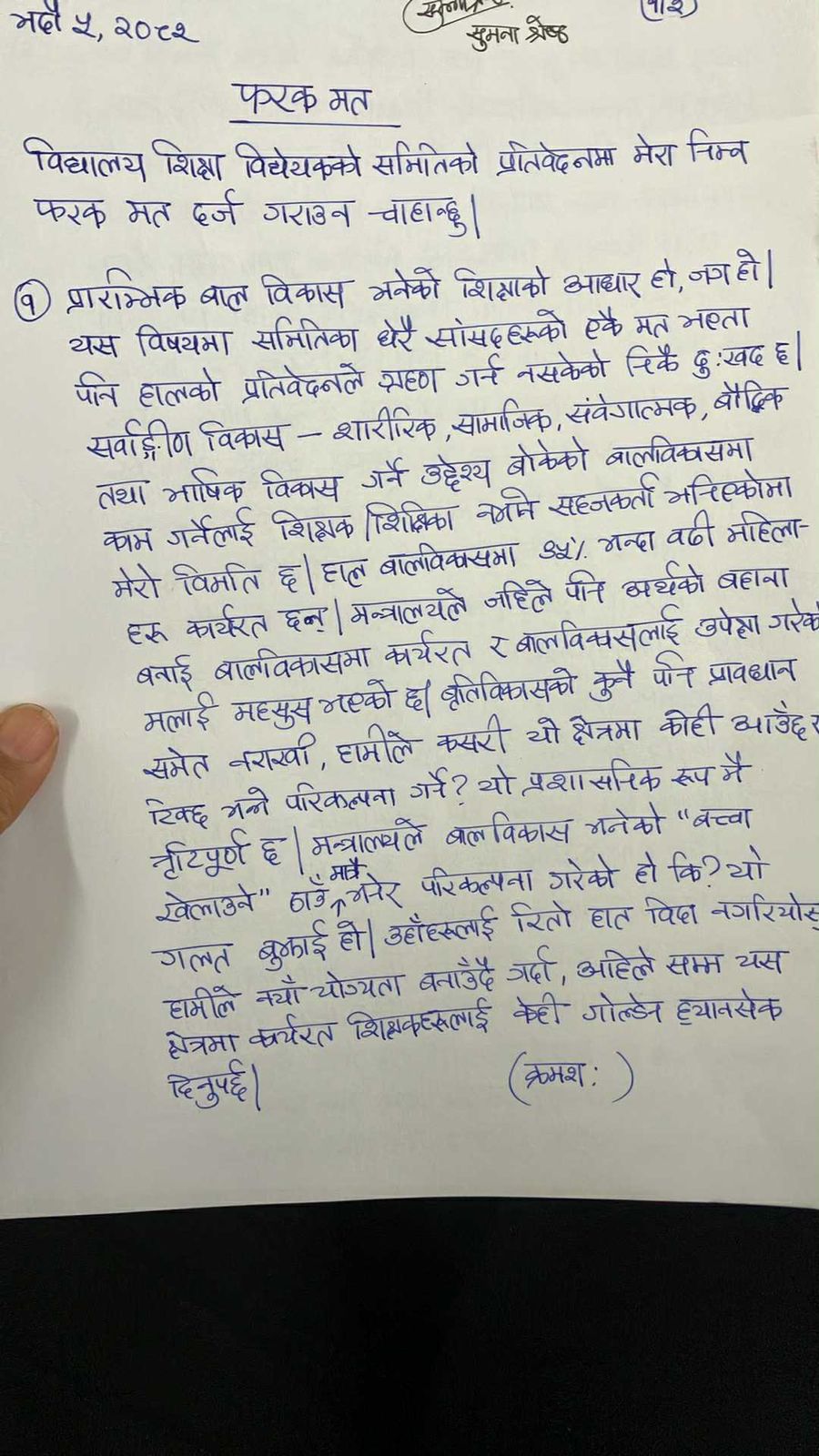
Point 1: Neglect of Early Childhood Development and Its Facilitators
MP Shrestha expressed strong dissatisfaction that the committee's report failed to incorporate the widely agreed-upon importance of Early Childhood Development (ECD), which is the foundation of education. She objected to the term "facilitator" for those working in ECD instead of "teacher," noting that over 95% of workers in this field are women. She feels the ministry has consistently neglected ECD and its workers under the pretext of financial constraints. Shrestha questioned how anyone would be attracted to or retained in this field without any provisions for career development. She argued this is an administrative flaw and a wrong perception that ECD is merely a place for "children to play." She urged that these dedicated teachers not be sent away empty-handed and that they receive a "golden handshake" or recognition when new qualifications are set.
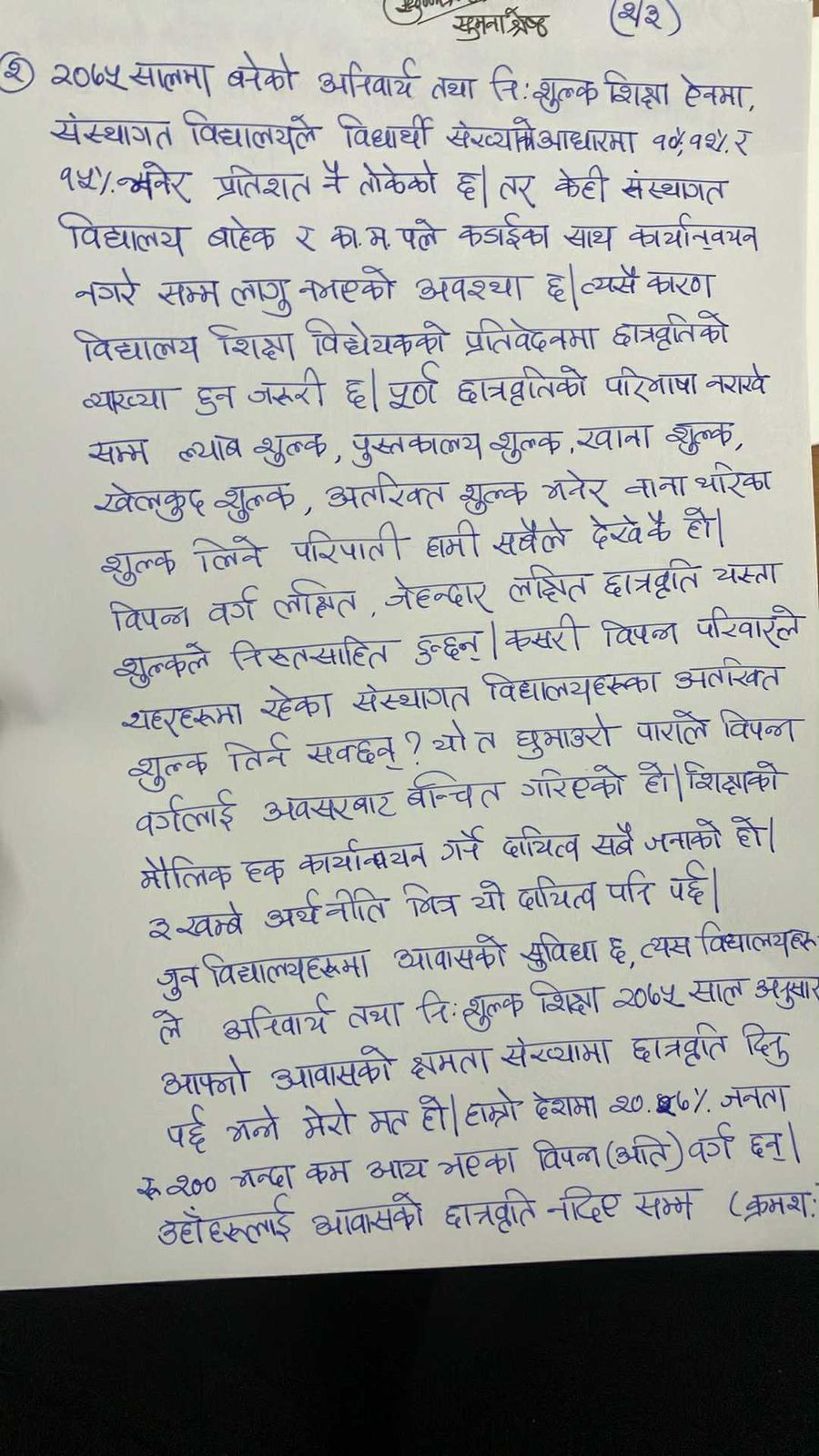
Point 2: The Critical Need for a Clear Scholarship Definition
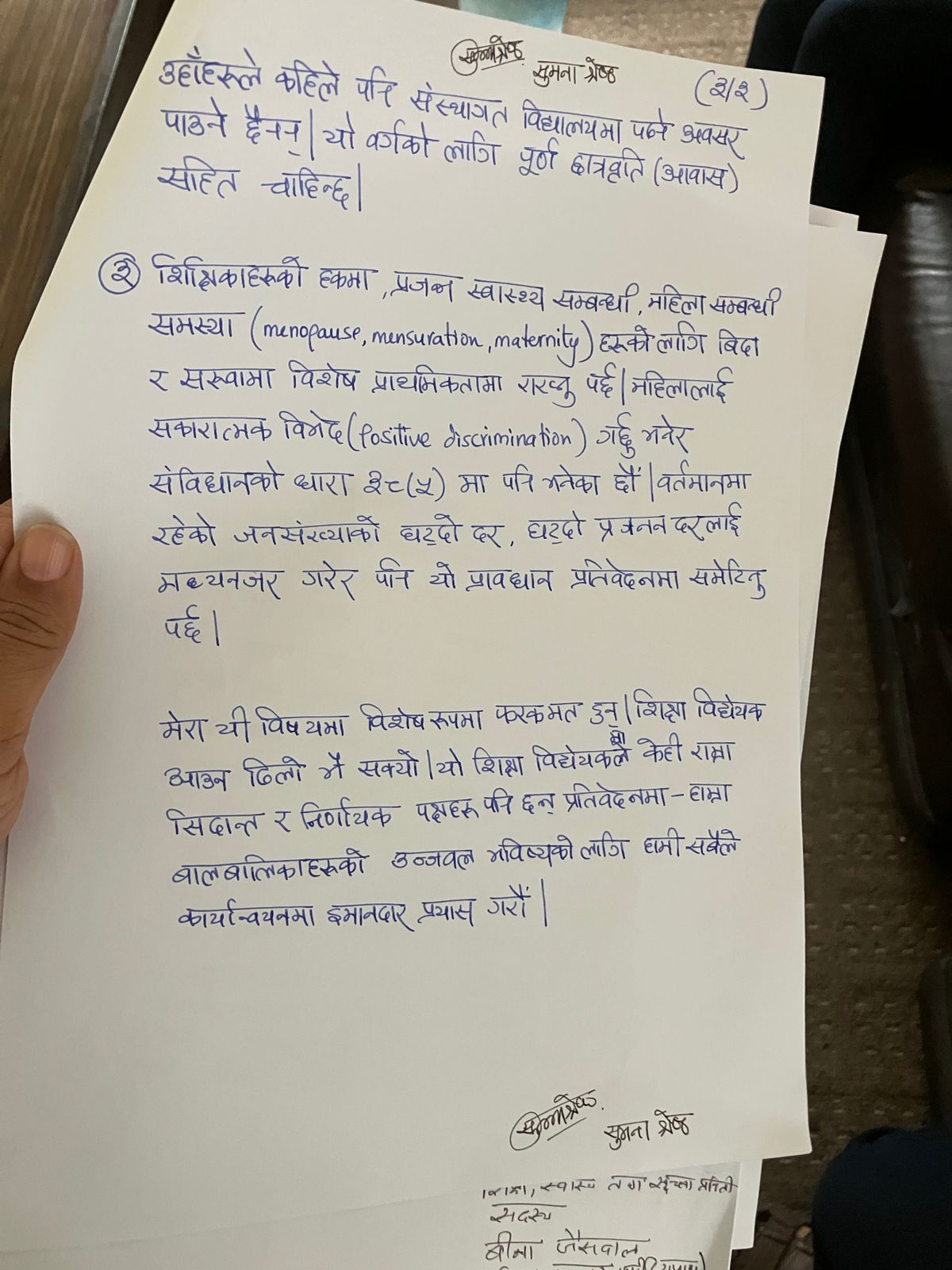
MP Shrestha pointed out that the Compulsory and Free Education Act of 2075 BS mandates institutional schools to provide scholarships to 10%, 12%, and 15% of students based on their total number. However, this has not been effectively implemented except in a few schools and without strict enforcement from bodies like the Kathmandu Metropolitan City. Therefore, she stressed that the bill's report must include a clear definition of a scholarship. Without a definition of a full scholarship, the practice of charging various fees like lab, library, food, sports, and extra fees will continue. She argued that targeted scholarships for the poor and deserving students are discouraging. She questioned how impoverished families can afford the extra fees of urban institutional schools, calling it an indirect way of depriving them of opportunity. She stated that the responsibility to implement the fundamental right to education lies with everyone and should be part of the three-pillar economic policy. Her opinion is that schools with hostel facilities must provide scholarships for accommodation up to their capacity, as per the 2075 Act. With 20.37% of the population living on less than Rs. 200 a day, she believes this class will never get an opportunity to study in institutional schools without a full scholarship that includes accommodation.
Point 3: Special Provisions for Female Teachers' Health and Transfers
MP Shrestha advocated for special provisions regarding leave and transfer priorities for female teachers related to reproductive health and other women-specific issues. She referenced Article 38(5) of the constitution, which allows for positive discrimination in favor of women. Considering the country's declining population and fertility rates, she insisted that this provision must be included in the report to support female educators.
MP Shrestha concluded by acknowledging that the Education Bill, though delayed, contains some good principles and decisive aspects. She urged all involved to make an honest effort in its implementation for the bright future of the country's children.
-education-and-sport_c0BHyFjlfq.jpg)