Government Introduces National Integrity Policy 2083 to Combat Corruption and Ensure Good Governance


Kathmandu. The government led by Prime Minister Balendra Shah has introduced the 'National Integrity Policy, 2083' to control corruption, irregularities, and moral decay and to ensure good governance. The policy, approved by the Council of Ministers and made public, has set strict conduct and standards for government and public bodies, as well as private, non-governmental organizations, and political parties.
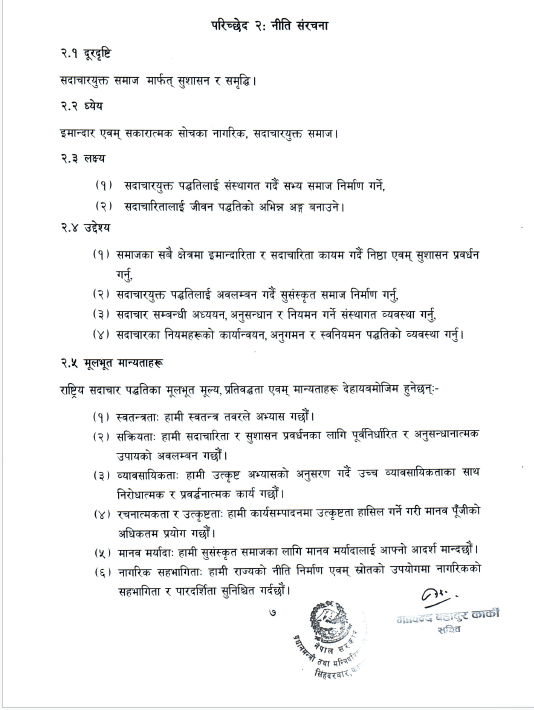
The Integrity Policy aims for 'Good Governance and Prosperity through an Integrity-based Society'. The policy has made various arrangements to make individuals in public office more responsible and transparent.
Why is an Integrity Policy Necessary?
Although Nepal has made provisions for constitutional, legal, policy, and institutional arrangements for the promotion of integrity, the lack of effective implementation, coordination, and integrated direction has prevented the overall system from being as result-oriented as expected. As a result, citizens' trust in the state is declining due to the selective implementation of improvement activities for systemic weaknesses in public administration, limited transparency, weak accountability, and lack of institutional discipline.
'Citizens are increasingly dissatisfied due to delays, complexities, and unequal access in public service delivery,' the Integrity Policy states, 'In such a situation, a clear policy is deemed necessary to improve service delivery and make it citizen-friendly, transparent, accountable, and result-oriented.'
What are the Problems and Challenges?
Due to scattered and partially overlapping existing laws, policies, and standards, the overall integrity system has not been able to operate in an integrated and consistent manner. At the implementation level, the tendency to make decisions based on discretion, self-interest, and pressure, rather than the equal and impartial application of prevailing laws, has weakened governance based on systems.
'The internal control system has not been effective because the capacity, resources, and professional expertise of the regulatory, investigative, and monitoring bodies within the institutional structure have not developed to the expected level,' states the Integrity Policy issued by the government.
In addition, the lack of coordination between public bodies, ambiguity in roles, and duplication have led to complexities and delays in decision-making processes. 'The weak culture of accountability and increasing impunity have added challenges to controlling irregularities,' the policy states, 'Lack of transparency, obstruction in information flow, and limited use of digital systems have weakened the ability of citizens to effectively monitor the governance process. Delays in public service delivery, procedural complexities, inequality in quality, and discrimination in access have increased citizen dissatisfaction and, in some cases, encouraged informal and unethical practices.'
It is stated that the development of an integrity culture has not been as expected due to the lack of institutional strengthening of values such as ethics, honesty, and professional integrity.
'The existence of conflicts of interest, the influence of personal or group interests on decision-making processes, and the limited effectiveness of investigation and regulation systems have increased the risk of corruption and irregularities,' the policy states. Similarly, the overall contribution of society to promoting integrity has remained limited due to the lack of development of citizen participation, social monitoring, and public pressure as expected. 'Looking at the overall picture, past efforts have been fragmented, uncoordinated, and often reactive or ad-hoc in nature, limiting the effectiveness of the integrity system,' the government itself admits.
Among the multi-dimensional and systemic challenges for promoting integrity, the development of a comprehensive integrity system with clear goals, standards, implementation structures, and monitoring mechanisms by integrating scattered laws, policies, and institutional arrangements remains a major challenge. 'Reducing the gap between policy and implementation and ensuring the equal, impartial, and strict enforcement of rules appears indispensable,' the public policy states, 'For this, it is necessary to strengthen the professional capacity, resources, autonomy, and technology-friendly work style of regulatory, investigative, and monitoring bodies.'
Similarly, strengthening the system-based decision-making process within public administration and developing clear role division, effective coordination, and shared responsibility among bodies is another significant challenge.
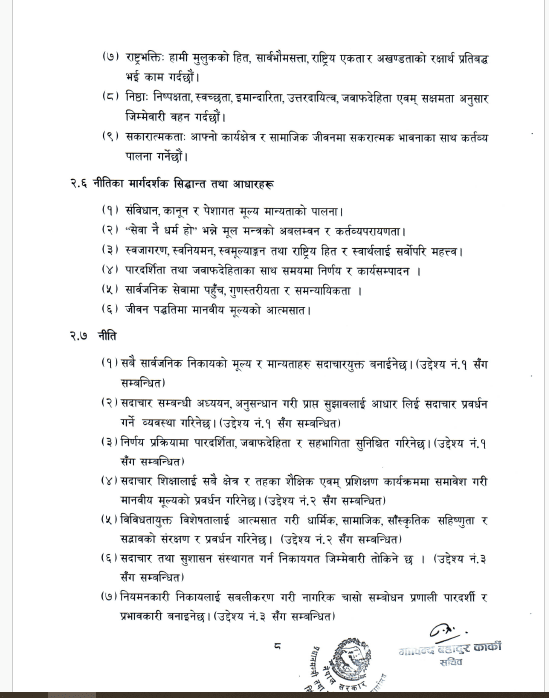
'It is necessary to enhance transparency, promote an open governance system, and make information flow easy, fast, and reliable through the extensive use of digital technology,' the policy states, 'It is equally important to establish a clear accountability framework to ensure accountability and make the system of punishment and incentives effective, and to develop a result-oriented monitoring and evaluation system.'
This specific news has been automatically translated by AI. As a result, there may be some inaccuracies or language errors.