Energy Minister Balen Shah's Government Completes 100 Days Amidst Mixed Reactions

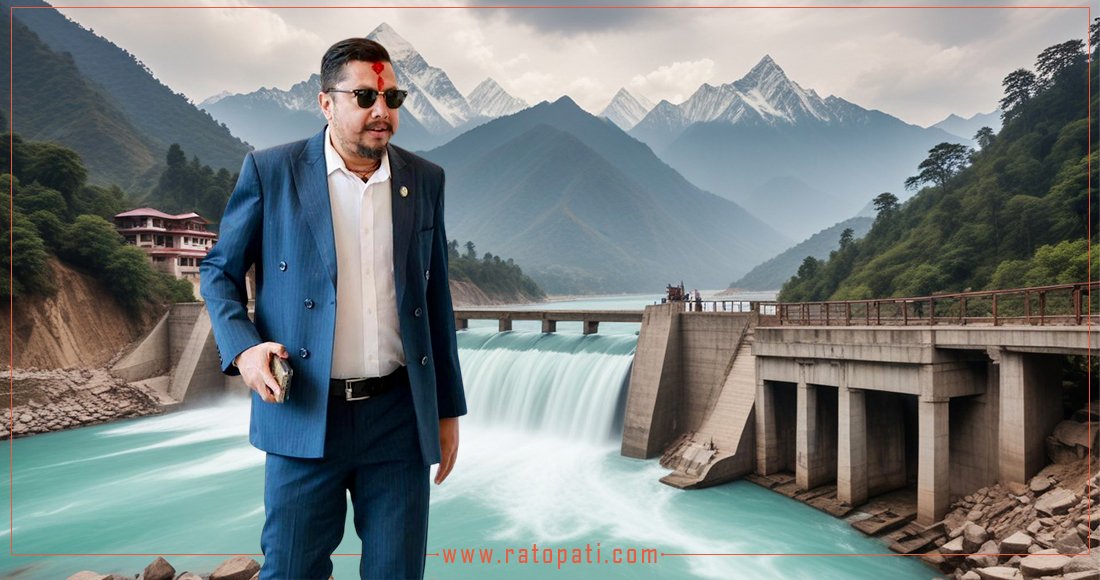
Kathmandu. The government led by Balen Shah, senior leader of the Rastriya Swatantra Party (RSP), is nearing 100 days. With the slogan of bringing good governance and prosperity to the country, Shah's government was formed on April 13, 2082, after receiving a massive mandate in the elections held on March 7.
Birajbhakta Shrestha held the responsibility of Minister of Energy, Water Resources and Irrigation in the government led by Shah. Along with the government, Minister Shrestha's 100-day honeymoon period is also coming to an end.
Upon taking charge, he stated that he would focus on policy reform, good governance, and service delivery. In the period of 100 days, he has undertaken various structural and policy initiatives. Although an attempt was made to implement a 'delivery'-based governance system to increase the effectiveness of the ministry's internal work, it has not been fully implemented.
A few days after taking charge, Minister Shrestha formed a good governance unit under the convenorship of Joint Secretary Rudra Singh Tamang. This unit has been regularly monitoring the performance, adherence to timelines, and resource utilization of the ministry and its subordinate bodies.
Similarly, the hotline number 1151 for electricity service has been activated. More than 10,000 complaints received through this hotline have been addressed. The ministry claims that all complaints received via phone, WhatsApp, email, and 'Hello Sarkar' have been resolved.
The promises made by the RSP to the public before the election and the 100-point agenda for governance reform published immediately after the government formation had generated great hope among the general public. However, as the 100-day mark approaches, there have been mixed reactions in the energy sector regarding Minister Shrestha's working style and results. On one hand, there is a strong momentum for reform, while on the other hand, some immature decisions have created apprehension and anger in the private sector.
- Encouraging Start, Controversial Results
As soon as Minister Shrestha took office, he initiated some policy reform efforts. In particular, the formulation of an energy export strategy, review of inactive licenses, and the initiation of a digital system for public service delivery sent a positive message. However, as the saying goes, 'the morning shows the day,' some actions during this period have appeared contradictory.
According to energy entrepreneurs, the policy that the minister is calling a reform policy has, in practice, become a tool to drive away investors. The Ministry's strategy to revoke licenses of projects that have Power Purchase Agreements (PPAs) but are delayed in construction has caused concern among entrepreneurs who have invested billions, said Mohan Dangi, Chairman of the Independent Power Producers' Association of Nepal (IPPAN). He analyzes that the attempt to unilaterally revoke bilateral agreements has severely damaged the government's investment-friendly image.
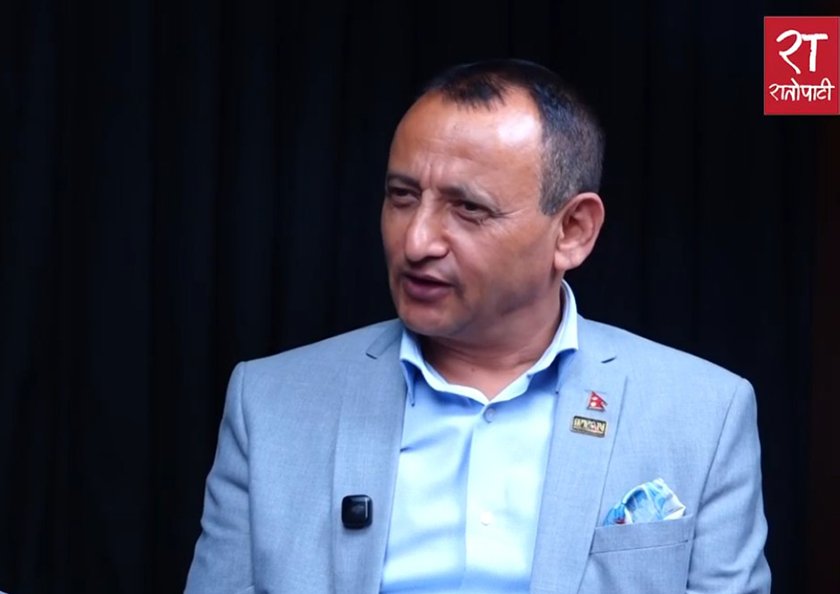
He said, 'The Energy Minister's commitment to reform is good. However, some recent decisions seem to be aimed at excluding the private sector. The policy of immediately providing PPAs for projects below 10 megawatts while the government itself builds projects above that is not good.'
- Growing Distance with the Private Sector
The RSP's manifesto mentioned making the private sector a partner in energy development. The Energy Minister has also stated in public forums that private sector energy producers will be taken as partners. However, energy entrepreneurs complain that the government's behavior has been hostile in practice. The committee formed under the convenorship of Joint Secretary Dr. Rajan Bhattarai has recommended the cancellation of PPAs for 38 projects totaling 1388 megawatts. They state that entrepreneurs are in uncertainty and fear because the ministry has not yet made this report public.
An IPPAN official said, 'The Energy Minister talks about driving a car on the expressway, but he is trampling on investors' dreams on the road. Putting projects with PPAs and financial arrangements on the cancellation list is creating terror for the private sector.'
Similarly, the budget announcement to immediately open PPAs for projects up to 10 megawatts has not yet been implemented. As the Nepal Electricity Authority (NEA) shows no interest in new PPAs, small investors are tired of visiting the ministry.
- Electricity Tax Through Budget: A Controversial Move
The biggest contradiction between the government's policy and practice is seen in electricity tariffs. On one hand, the government talks about bringing an energy consumption increase strategy, and on the other hand, it has introduced a provision in the budget to impose Value Added Tax (VAT) on electricity consumption above 50 units.

Minister Shrestha has remained silent after the VAT was imposed on electricity. He has not spoken much about it publicly. There is talk that the VAT was imposed on his recommendation as he is in charge of the ministry. However, sources say that the VAT provision was included in the budget without consulting the Energy Minister. After the Finance Minister unilaterally imposed the VAT, Minister Shrestha repeatedly discussed it with the Finance Minister. Following those discussions, the government appears to be preparing to adjust electricity tariffs and impose VAT. Nevertheless, the VAT issue has put Minister Shrestha in a difficult position.
The government's claim of increasing electricity consumption by raising tariffs appears ridiculous and contradictory. On the other hand, the problem of transmission lines remains a serious challenge. Although allocating 85.54 billion rupees for this in the budget is positive, there has been no review of the financial losses incurred by the private sector due to the non-construction of a single transmission line for 11 years because of the delays by government agencies themselves.
- Struggle to Collect Electricity Arrears
Minister Shrestha has also not been able to resolve the long-standing dispute over dedicated and trunk lines. This issue was not on his 100-day agenda nor was it a government priority. However, by reviving the administrative review that was scrapped by the then Energy Minister Kulman Ghising, who had complicated the dedicated and trunk line dispute, Minister Shrestha has chosen a legitimate path to resolve the dispute.
Industries that had paid regular tariffs and were at ease believed they did not have to pay the bills sent by the authority. When the authority demanded premium charges, they refused to pay. Currently, the arrears, including interest and fines on the premium, have reached billions of rupees.
Minister Shrestha has formed a review committee under the convenorship of Director Krishna Basel through a meeting of the NEA board of directors. Although the committee is said to be proceeding with the process of reviewing the electricity arrears of the industries, further arrears have not been collected. The then Energy Minister of the KP Oli government, Deepak Khadka, had initiated the review process in April 2081. However, Ghising had scrapped the committee on October 10 last year.
- Diplomatic Failure and Slow Implementation
Although the government prepared the 'Energy Consumption Increase and Export Strategy, 2083,' the implementation aspect is weak. While 40 megawatts of electricity is being exported to Bangladesh, the plan to send an additional 20 megawatts of electricity has remained on paper due to a lack of diplomatic initiative. There has been no significant progress in exports to India either, which is seen as a diplomatic failure of the government.
Similarly, there have been delays in the appointment process. The process of appointing an executive director has not moved forward even though it has been nearly two months since the Nepal Electricity Authority has been without leadership. Although the appointment process has been initiated in the Electricity Regulatory Commission, it has not yet been completed.

- 100-Point Agenda: Where is the Progress in the Energy Sector?
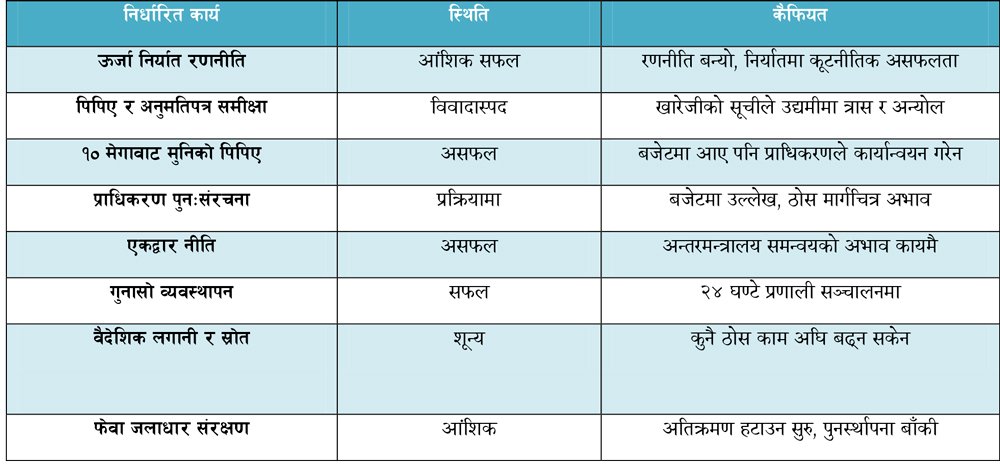
Analyzing the points related to the Ministry of Energy under the 100-point governance reform agenda brought by the government, the results are not encouraging. Although an energy export strategy has been prepared, diplomatic failure has been seen in its implementation. There have also been delays in decisions related to PPAs and licenses. Although decisions were supposed to be made within 180 days, the process has not moved forward yet.
Although the announcement to restructure the NEA into three separate companies was made in the budget, a concrete roadmap has not been formed. The promise in the manifesto to end the compulsion for energy producers to visit 23 ministries and 8 departments has not been implemented yet. The project facilitation mechanism, which was supposed to be prepared within 60 days, is 38 days late, and there is no sign of it.
- Strictness on PPAs
The current government has signaled stricter PPA (Power Purchase Agreement) policies for energy sector reform through the budget for the upcoming fiscal year. Although the budget announced immediate 'take and pay' PPAs for projects up to 10 megawatts, the government remains silent on large projects and the previous 5,000-megawatt projects of the authority.
The high-level committee formed by the Ministry of Energy, Water Resources and Irrigation to study PPA issues has also submitted its report to the minister in line with the budget policy. To discourage the practice of holding licenses for a long time in the hydropower sector without starting work, the government has also signaled policy tightening on licenses.
The committee formed to review the current status, progress, and effectiveness of licenses has recommended canceling the licenses of 38 hydropower projects with a capacity of 1,388 megawatts that have PPAs but have not started construction, pointing out the need for reform. As the budget policy and the committee's recommendation align, it will further strengthen the ministry's efforts to end the irregularities in the hydropower sector.
- Positive Aspects
Not everything is negative. Some administrative reforms have also been carried out during Minister Shrestha's tenure. A 24-hour assistance system to listen to complaints from citizens across the country, the effectiveness of a one-stop service center for industry registration, and training for 'front desk' staff have been completed.
To implement the governance reform agenda approved by the Council of Ministers, Minister Shrestha had formed various committees. Separate study committees are active to prepare an energy consumption and export strategy, review sick projects, remove obstacles in the PPA process, and improve the licensing system. Most of the committees formed by the minister have submitted their reports.
The ministry has prioritized new bills related to energy, water resources, and irrigation. The draft of the Renewable Energy and Energy Efficiency Bill is being prepared, and discussions with stakeholders are ongoing to finalize the Electricity Policy. Similarly, employment has been provided to 16 members of the families of martyrs of the 'Gen-Z' movement. The NEA has decided to include more affected families and has provided them with employment.
Dialogue has been increased with development partners, including the World Bank, to attract investment in the energy and irrigation sectors. A decision has been made to submit a project proposal worth approximately 3 billion rupees to the climate change-related 'Loss and Damage Fund'. Under Minister Shrestha's leadership, priority has been given to completing incomplete and delayed projects within their scheduled deadlines.
Work has been advanced on projects such as the Sun Koshi-Marin Diversion Project, Hetauda-Dhalkebar Transmission Line, and Budhigandaki Reservoir Project. Preparations have been intensified in flood-prone and river erosion-affected areas, keeping in mind the undergrounding of electrical structures in the Kathmandu Valley and the risks of the monsoon. Furthermore, the process of providing aviation weather services digitally at Tribhuvan Airport has also been initiated.
Overall, reviewing Minister Birajbhakta Shrestha's 100-day tenure, while his eagerness to work and 'expressway' speed are evident, the lack of necessary checks and balances and coordination with the private sector is noticeable. The ministry needs to be aware that the steps taken to displace investors in the name of removing procedural complexities could cause significant damage to the energy sector in the long run.
This specific news has been automatically translated by AI. As a result, there may be some inaccuracies or language errors.
_bHthPq6v9e.jpg)