Ratopati Organizes Dialogue on 'Barriers to Good Governance and Prosperity'

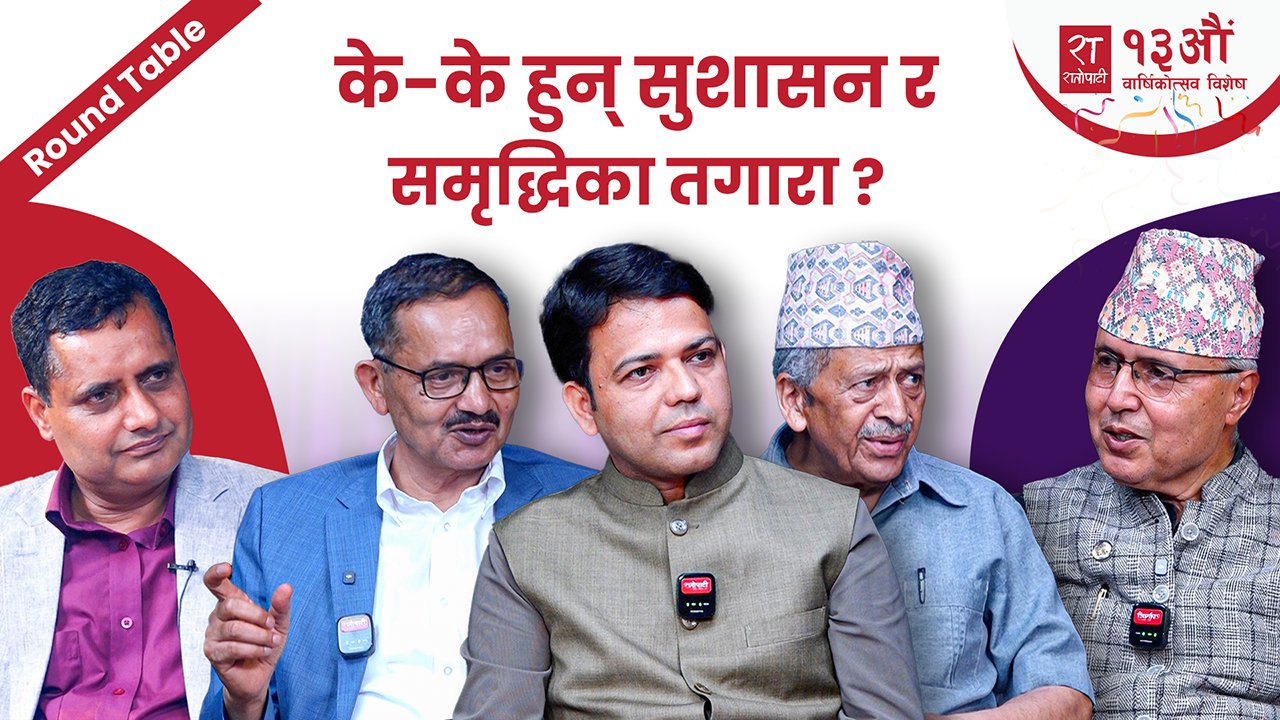
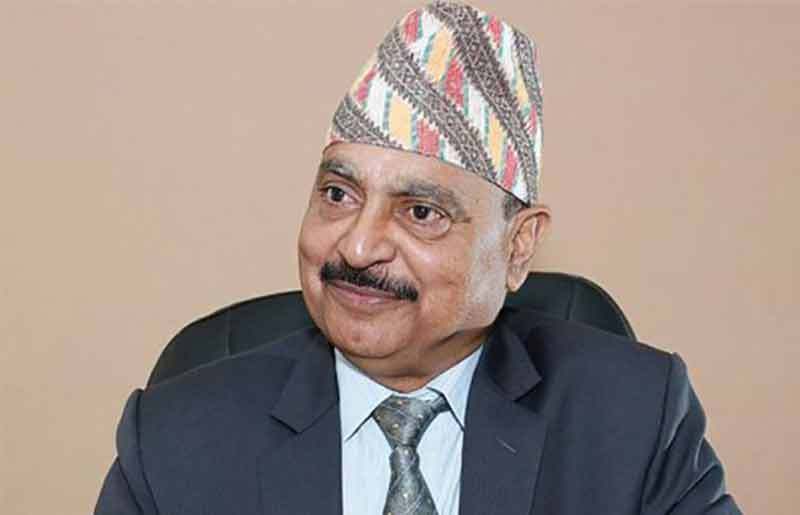
Kathmandu. On the occasion of its 13th anniversary, Ratopati held an interactive session on 'Barriers to Good Governance and Prosperity'. Former Finance Minister Rameshwor Prasad Kharel's concept paper was reviewed by House of Representatives member Bipin Acharya, former Vice Chairman of the National Planning Commission Dr. Govinda Pokharel, and former Governor of Nepal Rastra Bank Dipendra Bahadur Chhetri. It was moderated by Ratopati correspondent Rohit Dahal.
Here is the 'Ratopati Interactive Session' on 'Barriers to Prosperity and Good Governance' (can be watched and listened to in the detailed video):
We are going to discuss the topic 'Barriers to Good Governance and Prosperity' prepared by former Finance Minister Rameshwor Kharel. Looking at these 10 points, where do the main barriers to Nepal's development and good governance lie?
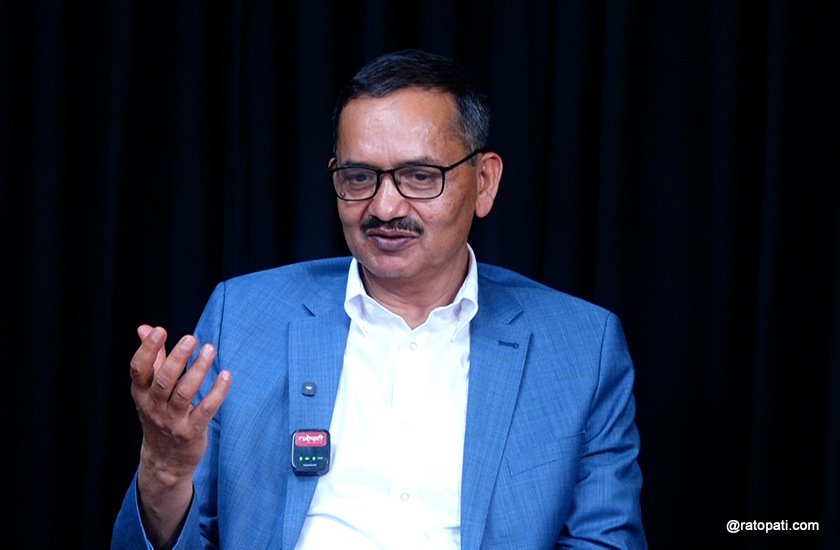
Dr. Govinda Pokharel: The 10 points presented by Rameshworji have covered the macroeconomy and governance very well. Looking at these points, the issue of political thinking and culture immediately came to my mind. I would like to quote analyst Puranjan Acharya here. The thinking that dominated during the unification of Nepal is important. The Malla kings had built beautiful cities with excellent drainage systems. A civilization was built by bringing architects from South India. It was a trading society that connected both China and India for trade. If our society had developed in a different direction with that commercial and civilization-oriented culture. But the unification was done by a clever and strong king from Gorkha, trapped in a cycle of poverty, using force. Since then, the culture of 'force can do everything' became dominant. The kings after Prithvi Narayan Shah also emphasized the use of force more than establishing a culture of development and innovation.
When we were in the Planning Commission, a team including myself, Swarnim Wagle, and Govinda Nepal used to discuss, 'Why hasn't Nepal developed?' Swarnimji researched and found that Nepal's per capita income at the time of America's independence was the same as America's, but where are we today? The main reason for this is that whoever has the resources also holds political and economic power.
Our kings and landlords did not prioritize innovation. The state always went towards protectionism. We hear legends of artisans who built temples in Arghakhanchi having their hands cut off, which means the state destroyed creativity.
From politicians to the bureaucracy, a mentality of middlemen or commission-seeking has been dominant in us from the beginning. Another major reason why Nepal's democracy has not been able to function properly is the lack of managerial capacity. Governments changed from the democracy of 2007 BS to 2015 BS. Even a leader as brilliant and visionary in both literature and politics as BP Koirala could not fully manage the games of other players in the then circumstances.
When political parties lack managerial capacity, democracy remains limited to slogans. Democracy means good governance, participation, transparency, accountability, and service. But despite repeated changes in power and the constitution, these things could not be established due to the lack of managerial capacity of the parties.
Another important point raised by Rameshworji relates to the capacity of the bureaucracy. Our Public Service Commission's recruitment process is very restrictive and archaic. Although there have been some improvements due to inclusivity, people with the same class and mindset reached there for a long time. Upon passing the public service exam, they considered themselves rulers and the mindset of 'I am perfect in everything' became dominant. They did not consider themselves 'servants'.
The state did not invest in the bureaucracy machine. For example, when the Arun III and Fast Track PDA agreements were being made, no joint secretary in the ministry could scrutinize the legal and technical aspects. They shied away saying, 'We don't have training in international law and agreements, and we might get into trouble in a Singapore court tomorrow.' The main reasons for low capital expenditure, weak service delivery, and inability to negotiate at the international level are the lack of capacity building of employees.
The concept paper also talks about the narrative constructed by the media. I myself am a victim of this. Before the People's Movement of 2062/63 BS, I returned from Germany and raised chickens in Kathmandu. Our farm produced 9,700 eggs daily. But in the midst of the movement, a newspaper published a misleading news item 'Bird Flu in Kathmandu Chickens'. People stopped eating eggs. 500,000 eggs piled up in our store. Even giving 30 eggs for 20 rupees did not sell. We incurred a loss of 6.3 million rupees. The media's culture of writing 'sensational' news without assessing the risks faced by entrepreneurs has ruined many.
Another of our biggest crises is 'human capital'. Only 44 percent of students passed the recent SEE results, meaning 56 percent of students dropped out. More than 12 million youth aged 16 to 40 are our main resource. If we cannot provide skill-based education to this 56 percent workforce, no matter how much we talk about IT or digitalization, it will not work. Without skilled manpower, foreign investment will not come, nor will the country's resources be managed properly.
Dr. Saab spoke about everything from managerial capacity to human capital. Now I come to Dipendra Sir. When talking about the barriers to good governance and prosperity, the constitution states 'socialism-oriented' but the practice is different. Representatives of the private sector have started saying that the word 'socialism' should be removed from the constitution. In your opinion, what are the main barriers to prosperity?
Dipendra Bahadur Chhetri: This concept paper brought by Rameshworji has been prepared with great effort. The experiences and realities of working in high positions in the administrative machinery are reflected in it. It would be very good if it could be implemented.
The current Finance Minister has also raised the question of why we are suffering despite having ample resources, potential, and goodwill. Despite all these things, the main reason for our lagging behind is the absolute lack of 'accountability'. We have received ample assurances from political leaders. From 'I will bring down the stars from the sky after winning' to 'We will bring it to Asian standards in 10 years'. But our leaders did not have the character of public accountability to be punished for not fulfilling their promises.
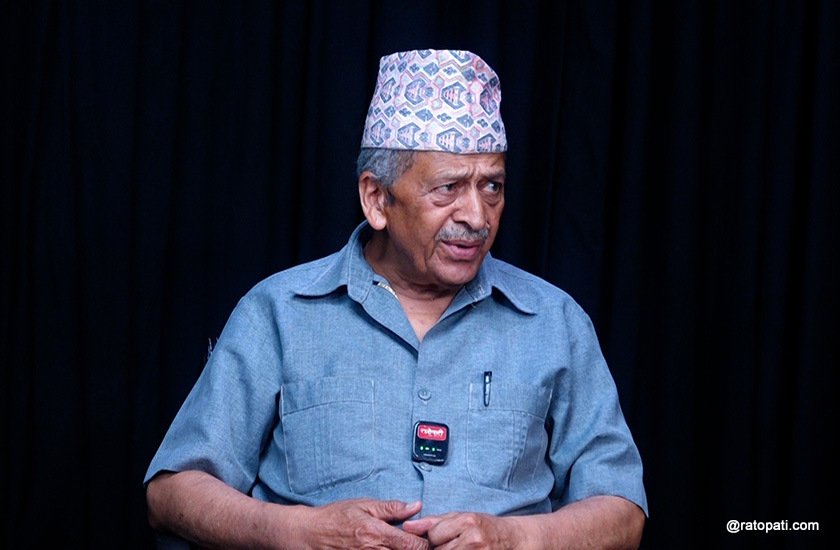
From 2007 BS, 2017 BS, movements and changes have occurred every 10 years. Everyone came with a mission. But all these movements and changes ended in compromise midway before maturing. When revolutions are compromised before completion, the change remains incomplete. This immature political change is the main reason why the public has been betrayed.
Currently, the Prime Minister is saying, 'We are short of money.' But looking at the budget situation, the allocated budget itself has not been fully spent. If there was only a shortage of resources, then the things arranged in the budget should have been implemented 100 percent, and then it should be said, 'Now we don't have enough money.' In practice, that is not the case.
This time, the budget has set a target of collecting revenue of approximately 14 kharba 5 billion 31 crore. However, on one hand, the rates of taxes and excise duties have been reduced, while on the other hand, an ambitious target has been set. How is this possible?
Meanwhile, the government has brought a proposal to invest 5-7 percent of foreign exchange reserves in 'risky' sectors like venture capital or AI stations. For the immediate time, we have sufficient reserves, and the idea of bringing some returns from it might sound good. But this is very risky. In the future, when a natural disaster occurs or when it is time to repay the principal and interest of foreign loans, these reserves will be useful. Moreover, we are currently at risk of being on the FATF grey list for money laundering.
If the government's actions cannot reassure them and we get stuck there, the commission and guarantee fees charged by foreign banks for transactions will increase significantly. In such a situation, foreign exchange reserves are our lifeline, and we should not play with them.
Furthermore, NGOs are spending many times more money in Nepal than the government budget. While the mobilization of foreign resources in education, health, and awareness-raising is acceptable, if such investments are made in a way that adversely affects our sovereignty, the state must be able to monitor and even take strong action.
Now I come to Bipin Acharyajyu. They said that all the movements so far have been immature. The Rastriya Swatantra Party (RSP) has emerged carrying the aspirations of the Gen Z generation. You do not have a 'global baggage' or 'national baggage' (burden of the past). You are not compelled to please anyone. But isn't it possible that this new generation's politics will also get stuck in the same old immaturity?
Bipin Acharya: It is not as easy to work inside as it looks from the outside, as Govinda Sir sees it. Managing ministries from the outside or implementing the budget in 6 months seems easy, but in reality, it is very difficult to extract results by linking the bureaucracy and governance structure with performance indicators.
Listening to Sirs and looking at all 10 points of Rameshwor Sir, I feel that although structures have changed in Nepal, the tendency has never changed. Even today, we believe in individualistic politics. As long as individualistic politics exists, the party system cannot function.
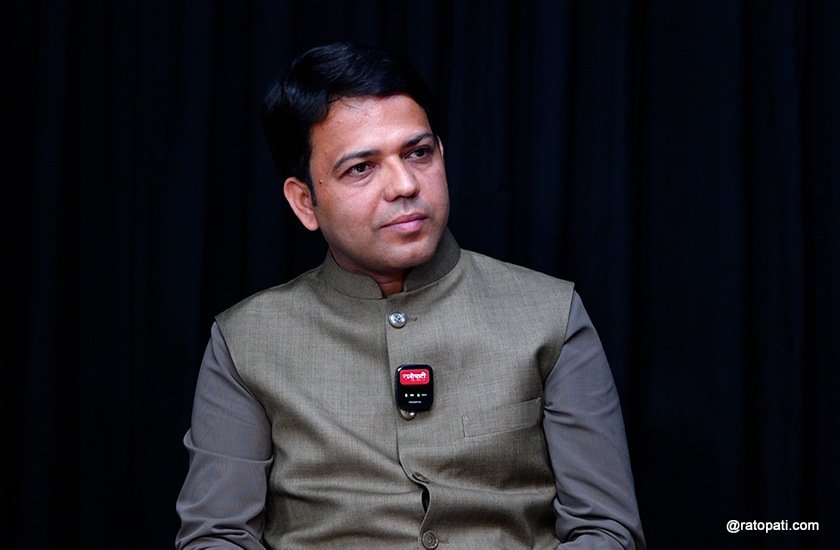
The main thing RSP is trying to do now is to make politics 'scientific'. Scientific means based on facts and measurable. The work done by our ministers in the ministries is measured by linking it to their performance.
The biggest misfortune of our society is that we think about everything emotionally. Building a nation is not magic or trickery; it is a long process. But today's society lacks patience. People who used to wait for the next day after reading the newspaper that came once a day have now reached a state of panic if the internet doesn't work for 15 minutes.
Today's citizens have seen the extraordinary progress made by people around the world. They compare that development with their own country's resources and seek results overnight. It is precisely this tendency to seek results immediately that led political parties in the past to make false promises and fail by not being able to fulfill them. We clearly understand that the politics we do is only linked to delivery. If we cannot deliver, we have no future.
Dr. Govinda Pokharel (adding in between): I also say as a central member of a political party that if the current RSP or new parties cannot deliver, the disillusionment with the entire political system and parties will increase further. The narrative that 'new ones also couldn't do anything, parties don't build the country' is the most dangerous for democracy. Therefore, my best wishes are for this government to succeed for the sake of protecting democracy.
Finally, Bipin Acharyajyu, this concept paper has a beautiful sentence: 'Nepal will be built, not by chance, but by resolve.' Isn't the RSP also here by chance? How will you manage geopolitics and address the impatience of the people?
Bipin Acharya: We are not here by chance; this is a presence with resolve. As I said earlier, any new government or leadership, in the first 3 to 6 months, does not give complete results, but a 'signal' of the right path. We are giving signals whether we are on the right track or not. Citizens should give us at least one year to examine whether that path is correct or not.
As for geopolitics, we will move forward by prioritizing our national interest. We want to correct the disrespect shown by past parties to the sentiments of the citizens and the chaos in the development model. Our resolve is to explain to society the reality that some policies can only yield results after 10 years and to make honest efforts based on facts. There are certainly challenges, but there are also extraordinary opportunities for Nepal. We are striving to turn those opportunities into reality.
Video/Photo: Manoj Khadka, Ayush Dhami
Video Editing: Rupak Thapa 'Riwaj', Dasharaj Shrestha
Presenter: Rohit Dahal
Executive Producer: Khem Risal
Watch in the video
This specific news has been automatically translated by AI. As a result, there may be some inaccuracies or language errors.