Finance Minister Attempts to Validate Arbitrary Tax Rate Amendments in Economic Bill

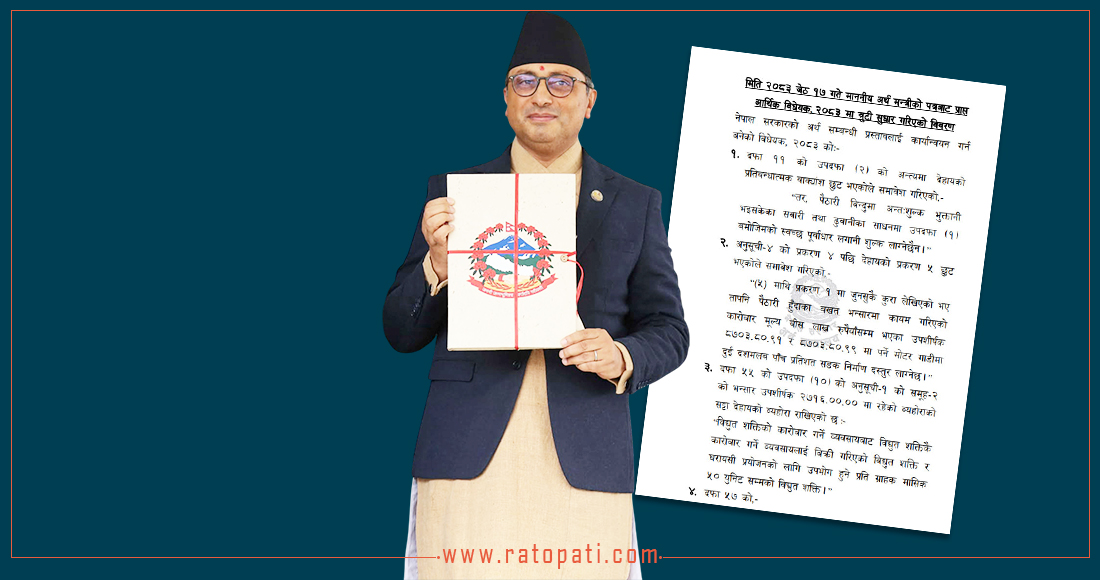
Kathmandu. Finance Minister Dr. Swarnim Wagle has attempted to validate amendments to arbitrary tax rates in the economic bill.< /p>
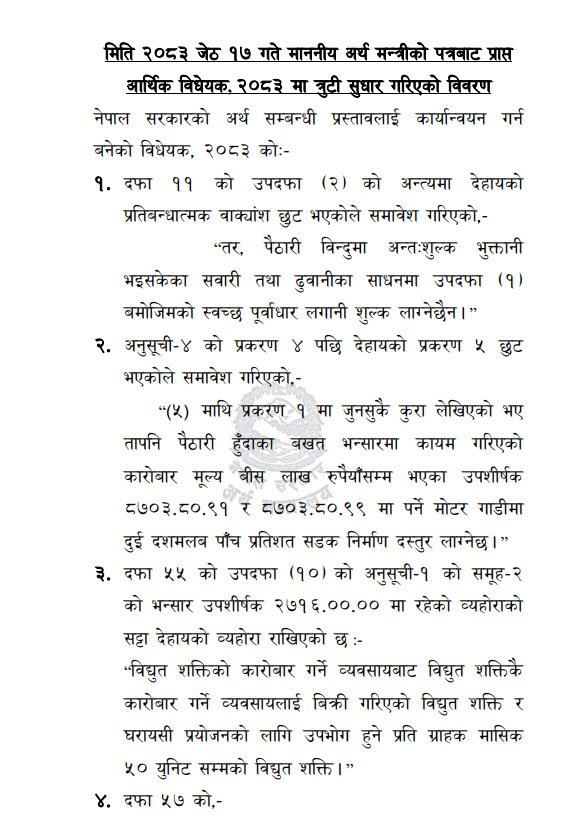
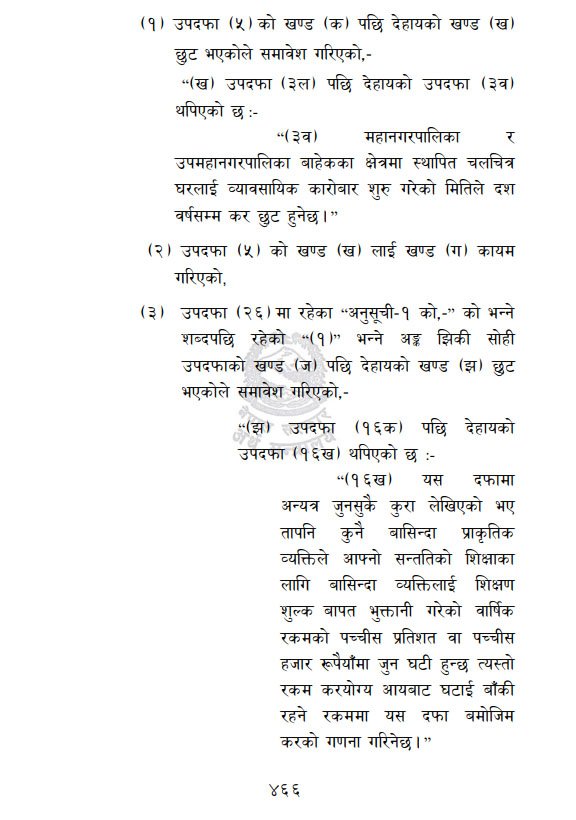
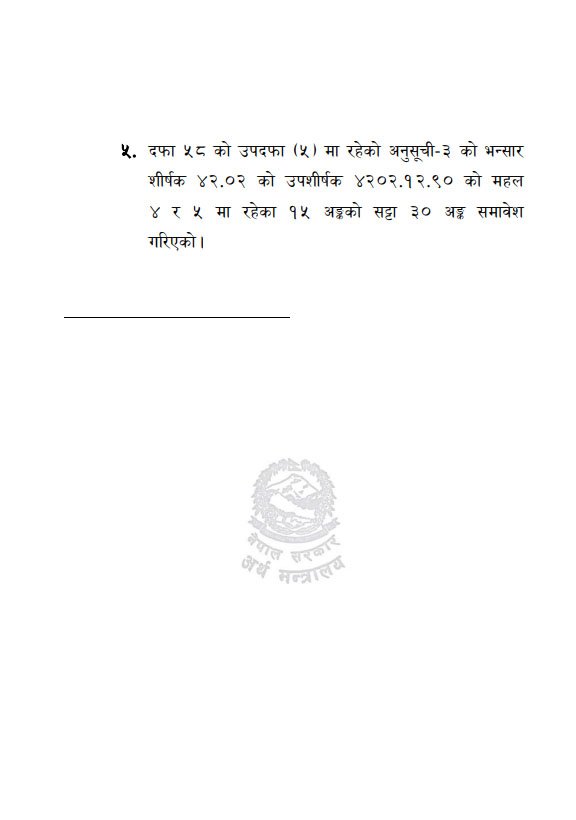
Against parliamentary rules and practices that only the full house or committee of the parliament can amend any bill already tabled in the parliament, Finance Minister Dr. Wagle has politically pressured the Parliament Secretariat to register a letter as 'error correction'.< /p>
The Finance Ministry had sent a letter to the Federal Parliament Secretariat on Jestha 17 as 'error correction'. However, the staff of the Federal Parliament Secretariat stopped it, stating that amendments to a bill already tabled in the parliament cannot be registered at the secretariat.< /p>
After that, Finance Minister Dr. Wagle pressured the Secretary-General of the Federal Parliament Secretariat, Padam Prasad Pandey. Pandey and House of Representatives Secretary Prakash Adhikari approved it for upload and distribution. Subsequently, on Jestha 20, it was re-uploaded to the Parliament's website, adding it at the end of the economic bill as 'error correction'.< /p>
Federal Parliament Secretariat Spokesperson, Joint Secretary Ekram Giri, informed that the letter sent by the Finance Ministry as 'error correction' reached the secretariat on Jestha 17. 'The staff of the concerned branch informed me that a letter came from the Finance Ministry on Jestha 17 as 'error correction',' Spokesperson Giri told Ratopati. 'It has been updated and uploaded on the website. There is no information about it being registered.'< /p>
Deputy Secretary of the Federal Parliament Secretariat's Law Management Branch (House of Representatives), Trivikram Parajuli, informed that the bill was uploaded with additions because a letter came from the Finance Ministry as 'error correction'.< /p>
'It did not come as a bill dependent on amendment. A letter came,' Deputy Secretary Parajuli told Ratopati. 'We have uploaded the letter from the Finance Ministry at the bottom of the previously uploaded bill. We have also distributed it.' Regarding whether it was registered, he stated that registration does not happen in the Law Management Branch.< /p>
Since Dr. Wagle took office as Finance Minister, the staff of the Parliament Secretariat have become fed up with almost every bill being presented with the excuse of 'errors'. A staff member informed that previously, the Alternative Development Finance Mobilization Bill, 2082, and the Nepal Rastra Bank (Third Amendment) Bill, 2083, also caused a stir due to differences in hard and soft copies, and were corrected.< /p>
In the parliament, there is a practice of passing budget and related bills without any changes from the form in which the government presented them to the parliament. Although amendment proposals have come for budget and related bills, previous parliaments have been rejecting them.< /p>
If the amendment proposals presented by the opposition in the budget are passed, it is interpreted as the budget itself has failed and the government has lost the confidence of the parliament. However, the secretariat staff themselves are surprised that the Finance Ministry has now sent a 3-page letter calling it 'error correction'.< /p>
If there are indeed errors in the economic bill, the government can propose amendments during the theoretical and clause-by-clause discussion in the parliamentary session. During that process, the minister can say in the meeting, 'During the theoretical discussion of the economy, the Finance Minister has made this amendment proposal due to some errors in the previous economic bill, and it should be discussed as part of the economic bill.' Only if the house accepts his proposal will the bill be amended and the errors corrected.< /p>
Apart from that, there is also a process to amend the economic bill by having ruling party MPs submit amendments within the time given by the parliament for amendments.< /p>
Even after the budget is passed, there is a legal provision for the government to reduce, increase, or provide exemptions on tax rates by making a decision from the Council of Ministers.< /p>
- These are the 5 points sent by the Finance Ministry to the Parliament Secretariat as 'error correction'
This specific news has been automatically translated by AI. As a result, there may be some inaccuracies or language errors.