Finance Minister Swarnim Wagle Claims Electric Vehicle Prices Have Decreased

Kathmandu. Finance Minister Swarnim Wagle had stated that the prices of electric vehicles (EVs) priced below 5 million rupees have decreased, in his public response regarding the tax rates mentioned in the budget statement.
He made this claim on Monday at a post-budget event organized by the Nepal Economic Journalists Association (NAFEJ). Various criticisms are also being made regarding this. Some are even claiming that the prices of such vehicles will increase, not decrease.
This time, the government has reviewed the tax system for passenger-type EVs and has made arrangements to base it on price instead of motor capacity. Accordingly, it has now made arrangements for any importer to pay taxes based on the price determined by adding insurance and transportation costs to the price at which the vehicle is purchased from the manufacturer (CIF).
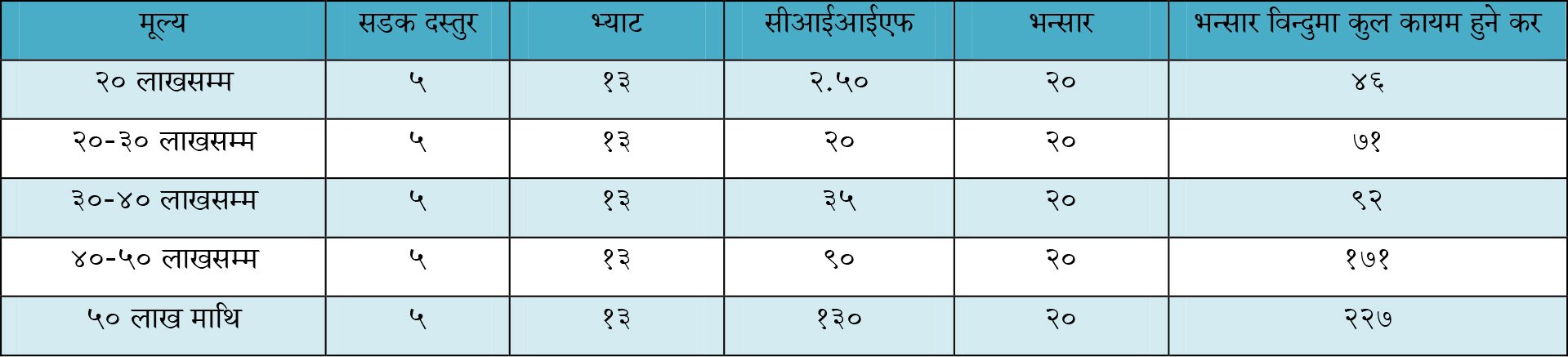
According to this, the customs duty for all types of vehicles has now been fixed at 20 percent. Road toll and value-added tax have been kept at 5 percent and 13 percent respectively, while the Clean Energy Infrastructure Investment Fee (CEIIF) based on capacity has been determined according to price.
This is the tax according to the new tax structure (in percent)
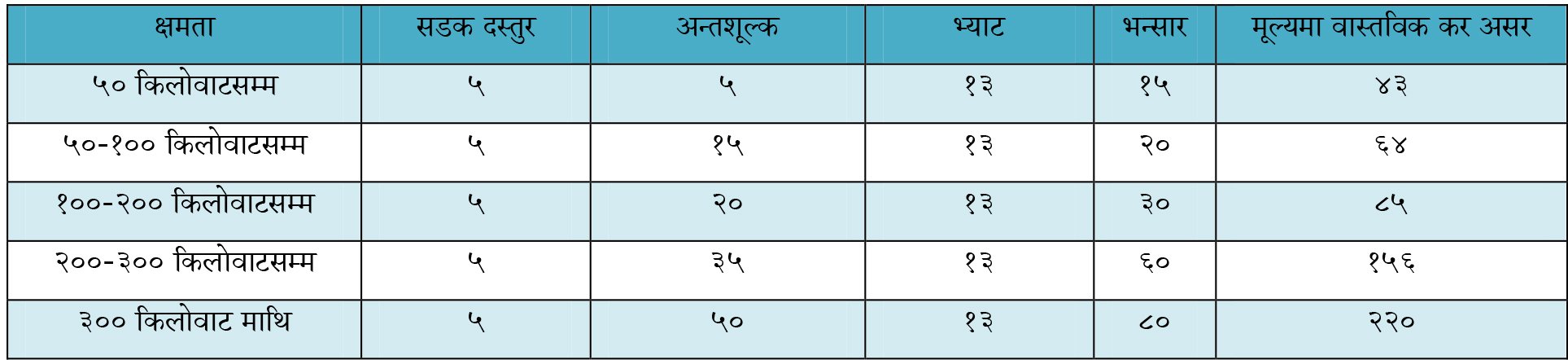
Previously, such taxes were determined based on capacity. According to this, the road toll for all vehicles was 5 percent and VAT was 13 percent. Customs duty and excise duty were determined based on the vehicle's motor capacity.
- According to the previous tax structure (in percent)
The taxes mentioned in determining customs duty are not based on the price determined at customs. That is, first, customs duty is added. Then, excise duty, VAT, and road construction fee are levied sequentially. This makes the tax cyclical.
For example, with 20 percent customs duty, 2.5 percent CEIIF, 13 percent VAT, and 5 percent road construction toll, the total tax comes to 145.94 percent (approximately 146 percent) instead of 40.5 percent, which is called the actual price impact. Whether the price of any vehicle has decreased or increased is determined based on this.
According to the taxes mentioned in the government's economic act, vehicles up to 2 million rupees will have a customs impact of 46 percent, 20-30 million rupees 71 percent, 30 to 40 million rupees 92 percent, 40 to 50 million rupees 171 percent, and vehicles above 50 million rupees will have a 227 percent price impact. The direct meaning of this is that the specified tax will be levied on the price at which the vehicle arrives at the customs point.
Previously, vehicles up to 50 kW were subject to 43 percent customs duty, 50 to 100 kW 64 percent, 100 to 200 million rupees 85 percent, 200 to 300 million rupees 171 percent, and for those above 300 kW, 220 percent price was determined.
- Confusion and Reality about Vehicle Tax
Here, there are two confusions in the understanding of the general consumer. They think that the price determined by the previous government's tax is the market selling price. Based on this, it has been commented that expensive taxes are levied even on cheaper cars.
However, this is not the case. Shyam Prasad Bhandari, Director General of the Customs Department, states that the Clean Energy Infrastructure Investment Fee slab in the economic act is determined based on the price determined at customs. Bhandari says, 'The price is determined based on the amount it costs the importer to import the vehicle up to the customs point.'
On the other hand, there are comments that the tax has increased further by comparing the slabs of two financial years. Here, by comparing the slabs of the previous and current economic acts, it is commented that the tax rate will increase instead of decreasing. That is, the tax which was 43 percent in the first slab has now been increased to 46 percent. In the second slab, it has increased from 64 to 71 percent, the third from 85 to 92, the fourth from 156 to 171 percent, and the fifth slab from 220 to 227 percent. Based on this, it is being commented that the price has increased, not decreased.
- How True is the Finance Minister's Claim that Vehicle Prices Will Decrease?
The claim made by the Finance Minister is partially true. Let's understand this with an example.
Tata's Tiago EV has a capacity of 55 kW. Its market price is fixed at 2.8 million rupees. Its estimated CIF price is only around 1 to 1.2 million rupees. Due to the previous 64 percent customs duty, its cost price after customs clearance reaches 1.7 to 1.8 million rupees. The selling price was determined by adding the importer's costs, profit, etc.
Now, this vehicle is subject to only 46 percent tax. Looking at this calculation, this vehicle will be 21 percent cheaper based on CIF price, which means it will be cheaper by 2 to 2.5 lakh rupees.
According to this, vehicles falling within the 50 to 100 kW range, which previously paid 64 percent duty but had a CIF price of less than 2 million rupees, are now in a situation where their prices will decrease.
However, the prices of vehicles with a capacity of less than 50 kW are expected to increase by about 3 percent compared to before.
Deepak Thapaliya, General Manager of Laxmi Inter-Continental, says that vehicles with a CIF valuation of up to 2 million rupees will become slightly cheaper for consumers based on the reduced tax.
Thapaliya stated that the Finance Minister's statement that all electric vehicles with a selling price of less than 5 million rupees will become cheaper is correct. He said, 'He clearly said that the prices of EVs in the first slab with a customs value of up to 2 million rupees will decrease. This is correct. The problem arises only from misunderstanding.'
- Risk of Under-invoicing and Grey Area
There is also a possibility of market distortions when the government implements a price-based tax structure. The unnatural gap in the tax slabs mentioned in the economic act is the biggest risk.
The Clean Energy Infrastructure Fee has been increased from 35 percent in the 30 to 40 million rupees slab to 92 percent in the 40 to 50 million rupees slab in one go. Stakeholders say that due to this unnatural increase, there is a risk that importers may claim a lower CIF value than the actual value (under-invoicing) and try to fall into the lower slab.
This means that the economic act has provided a large grey area where importers can manipulate bills by colluding with manufacturing companies to reduce the declared value. This arrangement also presents a situation where vehicles may pass customs, but a different type of irregularity may be found in the Auditor General's report.
This specific news has been automatically translated by AI. As a result, there may be some inaccuracies or language errors.