Imbossed Number Plate Plan Becomes State Burden


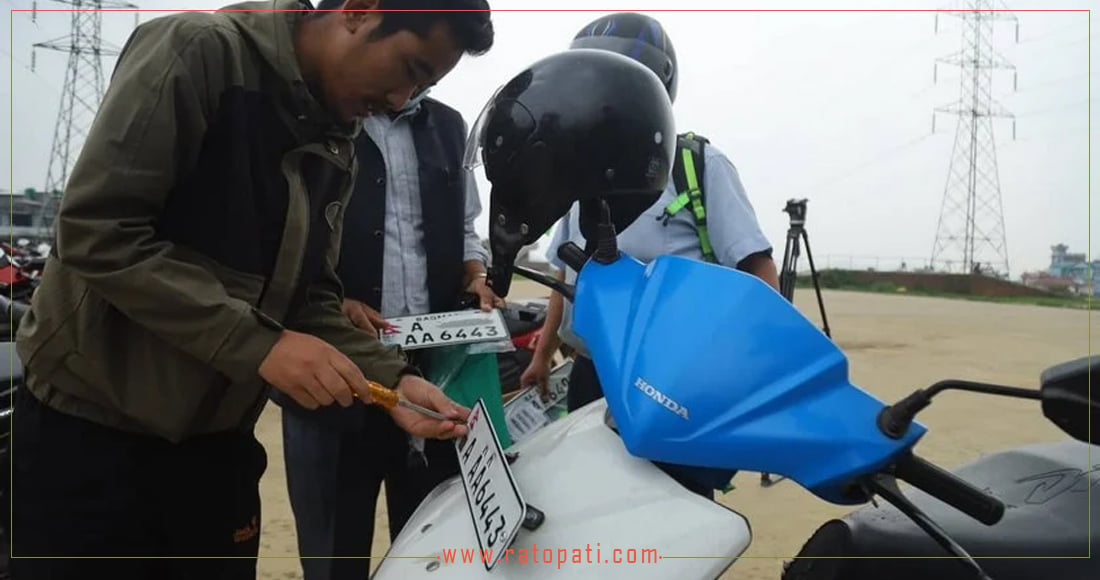
Kathmandu. The embossed number plate installation plan, initiated to modernize Nepal's transportation system, has now become a burden for the state. On one hand, this number plate has been installed on 90,000 vehicles in 9 years, and on the other hand, the cost has increased by nearly 2 billion in Nepali rupees due to the contract being made in US dollars.
The cost of the project has reached around 6 billion rupees as the contract signed 9 years ago when the dollar's exchange rate was 105 rupees has now reached 153 rupees.
The Department of Transport Management stated that the cost has increased due to the failure to install the plates on time as per the contract. The government had awarded the contract to Decatur-Tiger IT Company, a joint venture of Bangladesh and America, on Jestha 17, 2072, with the goal of producing 2.5 million embossed number plates within five years.
Work could not proceed due to language disputes and court proceedings. The deadline was extended by two and a half years on Jestha 13, 2078. As the installation work could not gain momentum even during that period, its deadline was extended to Mangsir 11, 2082, on Ashwin 23, 2080.
The government had started preparations assuming the installation would be completed by Mangsir 2082. The Ministry of Physical Infrastructure and Transport had already directed the department to make embossed number installation mandatory from Ashwin 1, 2082. Accordingly, while the department was preparing, the factory burned down during the Gen Z protest on Bhadra 23/24. After that, the installation of embossed numbers was postponed indefinitely. The department stated that after the deadline expired on Mangsir 11, the deadline has been extended for another 3 years.
The government had started preparations assuming the installation would be completed by Mangsir 2082. The Ministry of Physical Infrastructure and Transport had already directed the department to make embossed number installation mandatory from Ashwin 1, 2082. Accordingly, while the department was preparing, the factory burned down during the Gen Z protest on Bhadra 23/24. After that, the installation of embossed numbers was postponed indefinitely.
According to the department, the supplier has termed the first year of the extended three years as 'preparation period'. The supplier's goal is to complete the factory preparation and printing work and return to the old state within the first 9 to 12 months. After that, the printing work will be done for two years. It is stated that the installation of embossed number plates will resume within one year.

Even after five months of the deadline extension, the work of factory restoration has not started. Director of the Department of Transport Management, Maniram Bhusal, accepting the current sluggishness, says, 'Not much work has been done on embossed numbers recently. They say they are doing paperwork. Let's wait for 2-4 months, then we can say something.'
1.87 Billion Burden on the State
So far, only about 671,000 embossed number plates have been printed. The remaining plates are to be printed within the next three years, for which the deadline has been extended. The factory and the embossed number plate company itself will have to bear the damage caused to the factory during the Gen Z protest, but the cost has increased due to the delay in work.
A high-ranking official from the department informed Ratopati that the cost is increasing due to the rise in the dollar's exchange rate. 'There is no issue of increased cost with the deadline extension,' the official said, 'Our contract was in dollars. When the dollar's exchange rate increases, it may appear a bit higher in Nepali rupees, but there is nothing outside the terms of the contract.'
According to the current exchange rate, the amount of the same contract has reached 5 billion 928.7 million rupees (approximately 6 billion). Even though the work is 'zero', due to the contractor's delay and the increase in the dollar's exchange rate, the state has directly incurred an additional expenditure of 1.87 billion rupees.
The biggest 'policy corruption' in this project is found in the contract's currency itself. In Jestha 2073, a contract was signed with 'Decatur-Tiger IT JV', a joint venture of Bangladesh and America, for 38.75 million US dollars including VAT.
At the time of the contract, the dollar exchange rate was around 105 rupees, according to which the cost of this project in Nepali would have been 4.1679 billion rupees. However, after 9 years of no work, the dollar's exchange rate has reached 153 rupees today. According to the current exchange rate, the amount of the same contract has reached 5.9287 billion rupees (approximately 6 billion). Even though the work is 'zero', due to the contractor's delay and the increase in the dollar's exchange rate, the state has directly incurred an additional expenditure of 1.87 billion rupees. This price increase has indirectly benefited the contractor, who is not working, by billions.
95 Percent Payment Required Even If Work Is Not Done
The contract stipulated the production of embossed number plates for 2.5 million vehicles, RFID gates for tracking 10 embossed number plates, 100 handheld devices, and the handover of a functional number plate printing factory to the government. In return, the government was to pay the contractor company 38.75 million dollars. Along with this, one clause states that even if the company fails to complete the work within the stipulated time for any reason, the government must pay 95 percent of the contract amount.
The official says, 'If the department (or we, the buyers) fails to place the order for number plates as per the contract within the stipulated deadline, or if the project is obstructed due to our reasons, the contract states that the Nepal government has to pay 95 percent of the total expenditure to them (the company). This provision is a bit strict, which binds us.'
Because of this condition, the contractor company is assured of receiving payment even if they do not work. Whether citizens install the plates or the company prints them, the government will eventually have to pay the amount, which has reached around 6 billion rupees.
So far, plates have been installed on only about 90,000 vehicles. Two RFID gates have been constructed, which is only 4/5 percent of the total target. However, the company has already received more than 900 million rupees in payment.
Supreme Court's Interim Order on Language Dispute
This plan was further controversial due to the decision to use only English, sidelining the Nepali language (Devanagari script). Recently, on Magh 25, 2082, the Supreme Court issued an interim order again not to use only the English language.
This plan was further controversial due to the decision to use only English, sidelining the Nepali language (Devanagari script). Recently, on Magh 25, 2082, the Supreme Court issued an interim order again not to use only the English language.
Although the government had previously decided to amend the law to include the Nepali language, the contractor has made this a new opportunity to earn. Claiming that the software and machines need to be changed due to the language change, the contractor is demanding more than 700 million dollars. Thus, the contractor appears to be aiming to loot billions of rupees again in the name of language in the same project.
Expensive Fees for the Public
While similar number plates are installed for 600 to 1000 Nepali rupees in neighboring India, the Nepali government is charging the public 2500 to 3600 rupees for them. The state has imposed the cost of its own mistakes and settings on the public.
Out of 2.5 million plates, 1.85 million are for motorcycles, with a price of 2500 rupees per number plate. The price is set at 2900 for tempos, 3200 for small cars, and 3600 for large vehicles.
In neighboring India, they are available for 500-1000, but Nepal's price includes more than just the plate. It includes the machine for printing numbers, RFID machines for tracking on the road, servers, data centers, and all technology costs. A study shows that one plate costs an average of 15.5 dollars (about 2300 rupees). In India, the cost of RFID gates and stickers is separate, while in Nepal, all these are included in the price of the plate, making it expensive, according to a study.
A high-level committee formed by the Ministry of Physical Infrastructure and Transport had recommended reducing the plate fee. The committee, chaired by Joint Secretary Krishna Raj Panth, recommended reducing the fee in its report to lessen the financial burden on consumers. However, the department stated that there is no preparation regarding whether to reduce the price or not.
Foundation of Setting: Contract Awarded to 'Blacklisted' Company
This chaotic process of embossed number plates began during the tenure of the then Minister of Physical Infrastructure, Vijay Kumar Gachchhadar. The tender was initiated with the direct involvement of Secretary Gajendra Kumar Thakur and Director General Chandra Man Shrestha of the department. The main person who evaluated and recommended the technical aspects was Bikal Poudel, who is currently in jail on various corruption charges.
At that time, after the tender for embossed number plate installation was called, 4 companies submitted proposals. The first was France's SELP SAS, which proposed 40.5 million US dollars. The second was a Bangladeshi computer service company, which proposed 42 million dollars.
The third was the Bangladeshi and American company Decatur, i.e., (Tiger IT JV), which proposed 38.75 million US dollars. And the fourth was the Chinese company Pingao JKG Consortium, which proposed 29.681 million US dollars.
Among them, the Chinese company Pingao JKG Consortium had proposed to install embossed numbers at the lowest cost. However, the Chinese company, which made a proposal nearly 1 billion rupees cheaper (at the then rate), was removed on the simple pretext of 'inadequate paperwork', and the way was paved for Tiger IT.
Furthermore, this company was blacklisted by the World Bank for 9 years and 6 months in 2019 for corruption and collusion in Bangladesh's smart card printing. Awarding a contract worth billions in Nepal to a company internationally banned clearly shows the malice of the then leadership.
Additionally, a complaint was filed with the Commission for Investigation of Abuse of Authority on suspicion of corruption in this contract. However, the CIAA shelved the case. At that time, it was rumored that Siddhartha Pandey, a relative of the former Chief Commissioner of CIAA, Lokman Singh Karki, was the Nepali agent for this company. News reports claimed that due to Lokman's pressure and Pandey's setting, the contract was awarded to an expensive and blacklisted company, bypassing the one that proposed a lower amount. The state is now facing the consequences of this manipulation, which was carried out by including Bikal Poudel in the evaluation committee.
This specific news has been automatically translated by AI. As a result, there may be some inaccuracies or language errors.