Prime Minister Balen Shah Faces Controversy Over Parliamentary Conduct


KATHMANDU. Some activities of Prime Minister Balen Shah in parliament have become controversial. So much so that his resignation has been demanded with slogans in the parliament itself.
Opposition parties have objected to Prime Minister Shah's sudden departure from the parliamentary session on April 28, when President Ram Chandra Paudel was presenting the government's annual policy and program. While discussions were ongoing about the questions raised by the opposition parties on the matter, Prime Minister Balen also broke the tradition of presenting a proposal to initiate discussions on the policy and program.
Not only that, but amidst preparations to break the tradition of the Prime Minister responding to questions raised in the discussion on the proposal, the opposition parties obstructed the House of Representatives meeting on Wednesday.
Opposition party MPs chanted slogans in the House of Representatives meeting demanding the resignation of Prime Minister Balen Shah, following which Speaker Dol Prasad Aryal postponed the meeting for some time. Although Speaker Aryal has been continuously trying to advance the proceedings of the house, the opposition parties remain firm on their single demand that the Prime Minister himself should answer the questions raised on the government's policy and program.
As no consensus could be reached, discussions on the policy and program could not take place. The meeting of the House of Representatives has been adjourned until Thursday. In the meantime, Speaker Aryal will also hold discussions with the Prime Minister.
In Nepal's parliamentary practice, the head of state presents the government's annual policy and program to the parliament, followed by discussions, and then the Prime Minister responds to the questions raised during the discussions before it is presented for decision.
Some leaders from the ruling side argue that any minister can respond to questions raised on the government's annual policy and program as per the Prime Minister's instructions. Some interpret this as breaking tradition.

Constitutional expert Dr. Bhimarjun Acharya argues that one cannot act arbitrarily in the name of breaking tradition. He clarified that the Prime Minister is bound to answer questions raised in the discussion on the government's policy and program. He said, 'This is also a constitutional tradition. The leader of the government is the Prime Minister. When the Prime Minister is in the country, it is not appropriate for others to respond.'
_hH0g1HkvTR.jpg)
Dr. Acharya, who is also a senior advocate, questioned why the Prime Minister is unwilling to answer questions raised on the government's policy and program. He told RatoPati, 'If he (the Prime Minister) does not have to come to parliament, does not have to be accountable to parliament, then what is the meaning of being in that position?'
According to Dr. Acharya, the most important characteristic of our parliamentary system is that the government is accountable to the parliament. 'Neither a minister nor the Prime Minister can evade that. It is mandatory,' he said, 'If all this is done just to break tradition, then why have elections, why are parliament and the speaker needed? Why is the Prime Minister needed? That too is part of the tradition.'
Advocate Bhadra Prasad (Swagat) Nepal, however, has a different argument on this matter. He states that in Nepal, the head of state has been presenting the government's annual policy and program, but it can also be presented by the Prime Minister. 'The President is not the government. Although the annual policy and program belong to the government, it is the tradition for the President to present it,' he said, 'In parliamentary traditions, in most countries, the President presents the government's policy and program.'

He argued that no one becomes great just by asking questions to the Prime Minister. His argument is that MPs ask questions in parliament and anyone from the government can answer.
Advocate Nepal further said, 'In a parliamentary system, the Prime Minister is directed by his parliamentary party as he is the leader of the parliamentary party. Secondly, he is directed by the parliament. That means he is directed by the Speaker. After that, he is directed by the central working committee of his party.'

Advocate Nepal cited the example of Winston Churchill of Britain, who strongly opposed when details of the meeting between the head of state and the then Prime Minister were not made public. 'Later, when Churchill himself became Prime Minister, a journalist asked him – what did you discuss with the head of state? Churchill replied that it is not necessary to reveal everything that happens between the head of government and the head of state,' he said.
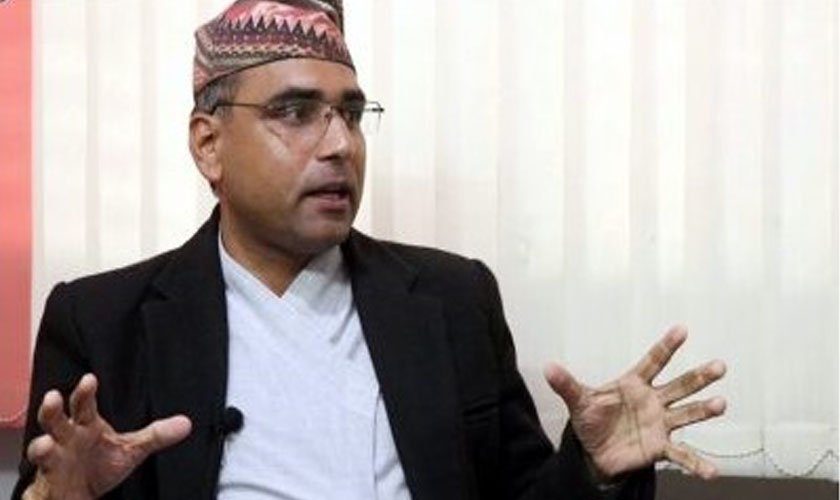
Giving an example from Britain, Advocate Nepal further said, 'Britain's then King George I grew up and studied in Germany. He had difficulty speaking English. The Prime Minister started saying that he would answer all the questions raised on the policy and program presented by the head of state to the parliament. Then the tradition of the Prime Minister answering questions on the policy and program presented by the head of state began. If the President presented something, perhaps the President should have answered it. Should we do here what was done in Britain? Whatever tradition is established, that is what happens.'
However, in Nepal's parliamentary history, there is a tradition of the head of state presenting the government's annual policy and program to the parliament and the Prime Minister responding to the questions raised in the discussion. Opposition parties are objecting, saying that the government is trying to break this tradition.
Prime Minister Balen Shah has not yet addressed the parliament. He took charge of the Prime Minister's post on March 13 and has completed a month and a half without addressing the parliament.
This specific news has been automatically translated by AI. As a result, there may be some inaccuracies or language errors.