Government Pushes Ordinances Past Parliament, President Holds Key


Kathmandu. The government, nearing a two-thirds majority, has sent five ordinances on various subjects to the President by bypassing parliament (ending the session).
The government recommended the issuance of ordinances to amend the Constitutional Council (Functions, Duties and Powers) Act, 2066 and the Cooperatives Act, 2074 on April 14, and the Health Professional Education Act, an ordinance to amend some Nepal laws, and an ordinance related to universities on April 15.
Now, it is up to President Ram Chandra Paudel whether to issue these five ordinances or not. In the past, President Paudel had put on hold the ordinance related to the Constitutional Council brought by the Sushila Karki government. And what will happen if he holds these ordinances now? How much crisis will the government face? Questions have started to arise. But if the President holds the ordinances, not only the government, but he too could face a crisis. That is, the government could opt for impeachment against him.
If the President arbitrarily stops the ordinances recommended by the government, the powerful government can file an impeachment against him, but the parliament could face difficulties if the government says 'I will impeach' simply because a decision was not made in its favor. However, it does not seem that the opposition parties will support Rastriya Swatantra Party in the parliament.
Advocate Anantaraj Luintel says that the President should be able to say that the ordinance sent by the government is 'wrong' and 'deceptive' and ask to 'send it after correction'. There is a clear provision that the President exercises the rights obtained in accordance with the constitution and federal laws and works on the recommendation and consent of the Council of Ministers. But he says that if the Council of Ministers does wrong, the President should be able to use his discretion.
Advocate Luintel says that it is wrong to suddenly suspend parliament, bring ordinances in the middle, and force the President to accept them. 'If the government incites the President to act against the constitution, and if the President is threatened with impeachment for not doing so, it will be an extreme abuse of power,' Luintel argues, 'Putting pressure on the President with the arrogance of a two-thirds majority is not a democratic practice.'
Explaining that impeachment requires lack of work efficiency, serious violation of the constitution and laws, or failure to fulfill the responsibilities of the office, he said, 'But showing the threat of impeachment to the President while he is trying to protect the constitution in the current situation will be deceitful.'
Similarly, senior advocate Surendra Bhandari also says that the President's withholding of ordinances cannot be a basis for impeachment. 'The President's withholding of ordinances cannot be confirmed as a serious violation of the constitution,' Bhandari said, 'The government might create other constitutional difficulties due to the ordinances being withheld.'
He cited examples from the past when ordinances recommended by the government were withheld during the tenure of the KP Oli-led government and the Sushila Karki-led government. 'The President can withhold the ordinances sent by the current government,' Bhandari says.
How long does it take for a bill to become law?
It seems to take at least four months for a bill to become law. A draft of a law presented in parliament is called a bill until it is in the drafting stage. The bill goes through various stages and procedures in parliament. Along with this, the bill passed by the parliament must be authenticated by the President. Then it is published in the gazette and becomes an act.
Some bills are passed quickly by parliament, while others take time. If a bill cannot be made into law immediately by parliament, it is done through an ordinance. For example, a bill is sent to the Ministry of Law and Parliamentary Affairs for legal drafting after preparing a report. The Ministry of Law gives legal form to the draft provided by a ministry and sends it back to the same ministry. A subordinate ministry submits the same bill to the Council of Ministers. The Council of Ministers sends it to the legislative committee under it. The legislative committee modifies and amends the draft and sends it back to the Council of Ministers. After being passed by the Council of Ministers, the concerned ministry is allowed to present the bill in parliament. Then it is registered in the bill branch of the Parliament Secretariat.
If the President arbitrarily stops the ordinances recommended by the government, the powerful government can file an impeachment against him, but the parliament could face difficulties if the government says 'I will impeach' simply because a decision was not made in its favor. However, it does not seem that the opposition parties will support Rastriya Swatantra Party in the parliament.
The minister seeks permission to present the bill, and the Speaker grants permission. The minister presents the bill in the House of Representatives for consideration. Time is given to the MPs to amend the bill.
After the proposal to send the bill presented by the minister to the committee is passed, it is sent to the concerned committee. After clause-by-clause discussion on the bill, the bill is presented in the full meeting of the House of Representatives and can be passed on the same day.
After being passed by the House of Representatives, the bill is sent to the National Assembly on the same day. After the National Assembly informs the House of Representatives that it has been passed, the parliamentary cycle of the bill is completed.
After the Law Division of the Parliament Secretariat prepares the bill in legal form, the Speaker signs it and sends it to the President for authentication. And as soon as the President authenticates it, it is published in the gazette and gets legal form.
Thus, if the work is done on a fast track, it takes at least three months for a bill to get legal form in Nepal. However, if the bill is returned by the National Assembly and the President, the process can become longer and more complicated.
Ordinance route to avoid the long process of bills
To bypass the long procedural hurdles of parliament through bills, the government now seems to have taken the path of ordinances by suspending the parliamentary session. Article 114 of the Constitution of Nepal contains provisions regarding ordinances, stating that if 'something needs to be done immediately' when both houses of the Federal Parliament are not in session, an ordinance can be issued.
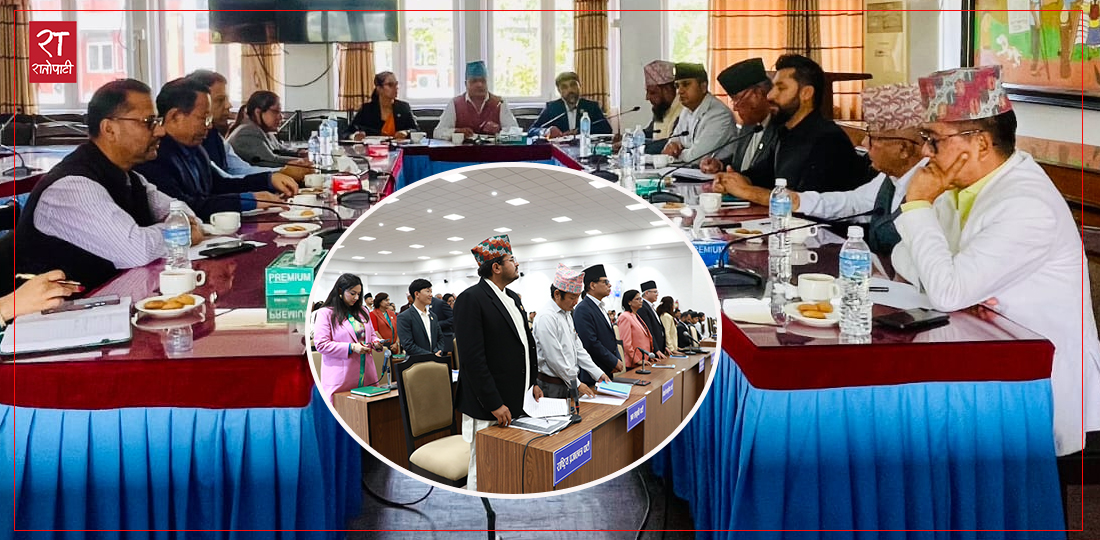
The main reason for the government to bring an ordinance related to the Constitutional Council at present seems to be that Prime Minister Balendra Shah is in the minority in the Constitutional Council. That is, through the ordinance related to the Constitutional Council, the government seems to be trying to get recommendations for the appointment of officials of various constitutional commissions and the Chief Justice of the Supreme Court with the presence of the Chairperson and two members of the Constitutional Council.
It is written in this article (Article 144) subsection 1, 'Except when the sessions of both houses of the Federal Parliament are in session, the President may issue an ordinance on the recommendation of the Council of Ministers if it is necessary to do something immediately.'
Subsection 2 (1) contains provisions regarding the age of the ordinance. The ordinance, once issued by the President, is valid like an act. Those ordinances must be passed by the parliament, and that too within a certain time.
Even though the ordinance gets recognition like an act once issued by the President, it will not have a lifespan. The constitution states that the ordinance 'shall be presented in both houses of the Federal Parliament convened after its issuance, and shall automatically become ineffective if not accepted by both houses.'
There is another provision for the ordinance to fail, which is '(b) it can be repealed by the President at any time.' Apart from these two situations, the ordinance becomes ineffective if it is not passed by the parliament. That is, '(a) it shall automatically become ineffective after 60 days from the meeting of both houses, unless it becomes ineffective or is repealed according to (a) and (b). '
Even though the ordinance gets recognition like an act once issued by the President, it will not have a lifespan. The constitution states that the ordinance 'shall be presented in both houses of the Federal Parliament convened after its issuance, and shall automatically become ineffective if not accepted by both houses.'
The ordinance that the President can issue on the recommendation of the Council of Ministers becomes ineffective within 60 days of the commencement of the Federal Parliament session. For the past few years, abusing the provision in the constitution, ruling parties have been using ordinances, which are issued like acts, for their own benefit.
After the President issues the ordinance, it will be easier for the government to appoint officials of constitutional commissions and the Chief Justice and judges of the Supreme Court in its favor. If the ordinance is issued, the appointment of officials of various constitutional commissions can be done on a fast track from the second day.

This specific news has been automatically translated by AI. As a result, there may be some inaccuracies or language errors.