Ruling Party MPs Divided Over Controversial Ordinances


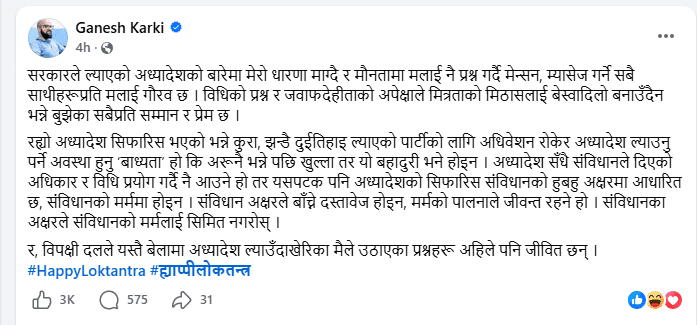
Kathmandu. Divided opinions have emerged from two lawmakers of the ruling Rastriya Swatantra Party (RSP) regarding the ordinances proposed by the government led by Balendra (Balen) Shah. Following the government's recommendation to President Ram Chandra Paudel to issue two ordinances concerning the Constitutional Council and cooperatives by suspending the parliamentary session, debates have ensued, with differing viewpoints from RSP MPs surfacing. While opposition parties criticize the ordinances, RSP MP Ganesh Karki stated that bringing ordinances by suspending the parliamentary session is not an act of bravery. However, another House of Representatives member, Rajiv Khatri, defended the ordinances.
MP Karki wrote on social media on Wednesday, "I am proud of all the friends who have asked for my opinion on the government's ordinances and have tagged and messaged me, questioning my silence. I respect and love all those who understand that the question of procedure and the expectation of accountability do not spoil the sweetness of friendship." He further added, "The situation where an ordinance needs to be brought by suspending the session for a party that secured nearly a two-thirds majority is a 'compulsion' or something else will be revealed later, but it is not an act of bravery."
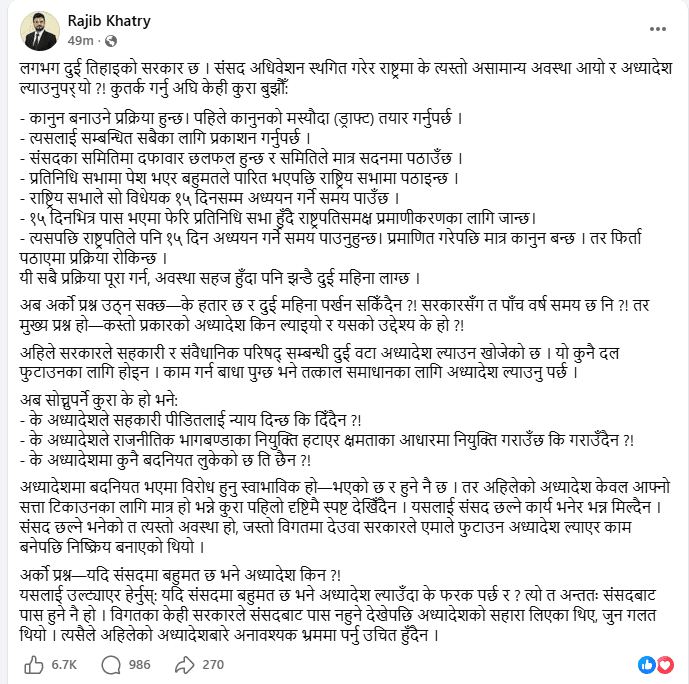
A few hours after Karki posted on social media, another MP, Khatri, responded via social media to the questions being raised about why ordinances were brought by adjourning the parliamentary session when there is a government with nearly a two-thirds majority. He termed the questions, "What extraordinary situation has arisen in the nation that necessitates bringing ordinances?" as "fallacious arguments." He also stated that before making such fallacious arguments, some points should be understood. Khatri explained that the process of making laws involves first preparing a draft of the law. After publishing the prepared draft for all concerned, it is discussed clause by clause in parliamentary committees, and only then is it sent to the committee for the House. Khatri mentioned that this procedural process, even in a normal situation, takes nearly two months.
He also responded to those who question why the government cannot wait for two months. "But the main question is—what kind of ordinance was brought, why, and what is its objective?" Khatri said. He added that the government has brought two ordinances related to cooperatives and the Constitutional Council, and it is not trying to split any party. He stated that if there is an obstacle to work, the government can bring ordinances for immediate solutions.
He suggested that instead, at such a time, one should consider whether the ordinance will provide justice to the cooperative victims, whether the ordinance will remove political appointments and ensure appointments based on capability, and whether there is any malice hidden in the ordinance.
He stated that while opposition is natural if there is malice in the ordinance, it is not immediately clear that the current ordinance is solely for sustaining the current government.
"This cannot be called circumventing parliament. Circumventing parliament is a situation like when the Deuba government in the past brought an ordinance to split the UML and then rendered it inactive once the work was done," Khatri attempted to clarify.
This specific news has been automatically translated by AI. As a result, there may be some inaccuracies or language errors.