Nepal Govt. Criticized for Bypassing Parliament with Ordinances


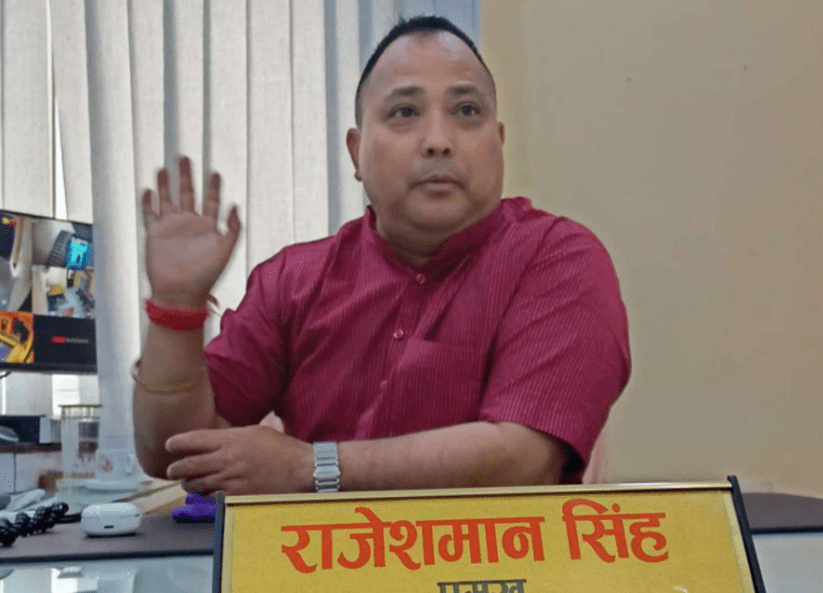
Kathmandu. The government led by Balen (Balen) Shah, a senior leader of the Rastriya Swatantra Party (RSP), is moving towards running the country through ordinances, bypassing the parliament, the supreme representative body of the people.
The government has brought ordinances even after postponing the parliamentary session, which was already called by the President at its own recommendation.
The Council of Ministers meeting held on Monday decided to bring ordinances related to the Constitutional Council and cooperatives and recommended them to the President. Kiran Pokharel, press advisor to the President, informed that President Ram Chandra Paudel is studying the ordinances recommended by the government. 'The President is studying the ordinances sent by the government,' said Presidential Press Advisor Pokharel.
Earlier, at the government's recommendation, President Paudel had postponed the parliamentary session called for Baishakh 17, after the government sent another letter to the President to stop it for special reasons. As per the government's letter, President Paudel postponed the parliamentary session called on Baishakh 9 to Baishakh 10. Prior to that, the Council of Ministers meeting held on Baishakh 8 had decided to call both sessions of parliament and recommended it to the President.
It is said that the government has chosen the path of ordinances by bypassing parliament, as it is not permissible to bring ordinances while parliament is in session.
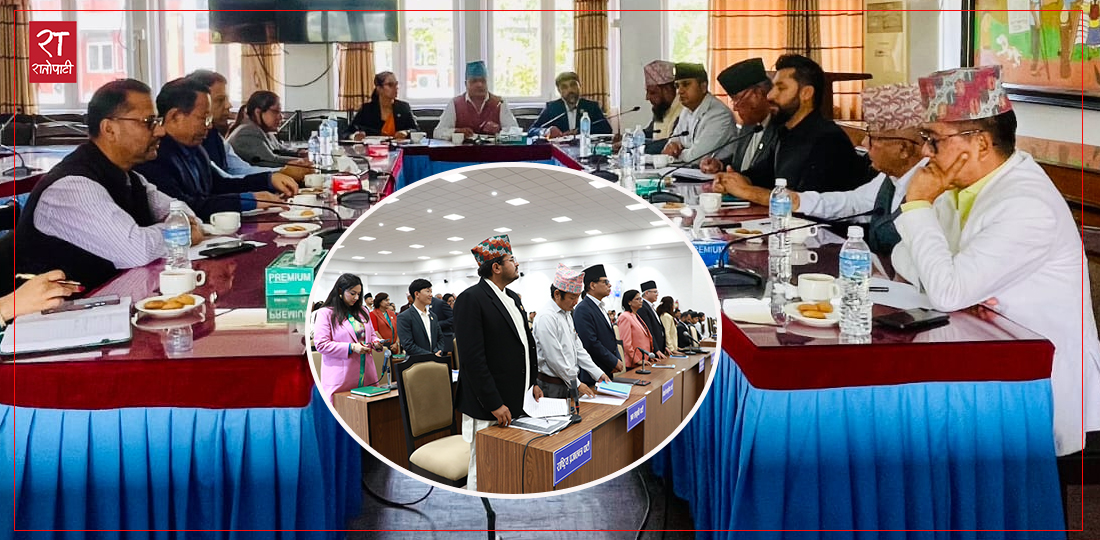
The opposition parties have called the move to bring ordinances by bypassing parliament an undemocratic step. They have commented that the government's move to postpone the parliamentary session within 24 hours of its call and to bring ordinances by bypassing parliament is against democratic practice and established norms.
Opposition leaders have stated that postponing the session without specifying a clear reason when it has already been called is not a good intention.
'It is not good in any way for the government to postpone a called session without any political, constitutional, or legal obstruction and opt for ordinances,' said CPN-UML Chief Whip Ain Mahar. 'I never thought a government with nearly a two-thirds majority would take this path. This step has led the government, which should be accountable to parliament, to ridicule democratic norms.'
The main opposition party, Nepali Congress, has also said that the government has taken the wrong path by opting for ordinances. According to Nepali Congress General Secretary Pradip Paudel, a government with a near two-thirds majority has insulted the mandate of the people by bringing ordinances.
'The government led by RSP leader Balen Shah, with a near two-thirds majority, had called a parliamentary session for the first time in Nepal's history to bring ordinances and postponed it without meeting,' Paudel told Ratopati. 'Ordinances are being brought out of fear of parliament, by disrespecting parliament.'
Leader Paudel also said that this move by the government is a severe insult to parliament. 'It is an insult to the mandate given to the Rastriya Swatantra Party by the people on Falgun 21,' Paudel said. 'It is clear that ordinances are being brought because the law is not wanted to be taken to parliament due to opposition from one's own party's representatives.'
Nepali Communist Party (NCP) Chief Whip Yuvraj Dulal commented that the government has initiated a wrong practice.
'This is the beginning of a wrong practice. When the government has a clear majority, laws could have been made through the process,' Chief Whip Dulal told Ratopati. 'Calling and postponing parliamentary sessions and moving towards ordinances, and trying to run the country through them, raises questions about the government's intentions. This has tarnished the role and dignity of parliament and attempted to curtail its role.'
After postponing the parliamentary session, government spokesperson and Minister of Education, Sashmit Pokharel, had said on Baishakh 10 that the decision to postpone the parliamentary session was not a big deal. He also stated that the government was not in favor of bringing ordinances by stopping parliament. When asked by journalists about ordinances during the press conference to announce the Council of Ministers' decisions at Singha Durbar on Baishakh 10, Minister Pokharel said that the session had to be postponed to provide sufficient business.
'Postponing parliament is not a big issue. We are bringing many bills in the budget session. Some bills still need more work to have sufficient business, so the session was postponed to ensure the parliament has business when it convenes. It's a normal matter,' said Minister Pokharel. 'There has been no discussion about bringing ordinances.'
He also stated that the government's plan was to bring laws in the form of bills. Minister Pokharel said this, and within a few days, the government brought ordinances.
Ravi had criticized ordinances while in opposition
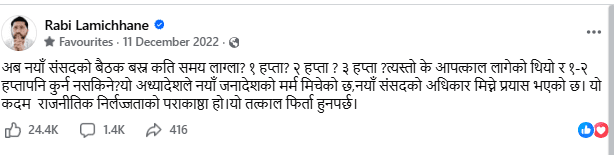
Earlier, when the RSP was in opposition and KP Sharma Oli was the Prime Minister, RSP Chairman Ravi Lamichhane had strongly opposed ordinances, stating that it was an attempt to encroach upon the rights of parliament.
Lamichhane had said at the time, 'How long will it take for the new parliament to convene? 1 week? 2 weeks? 3 weeks? Was there such an emergency? Couldn't wait even 2 weeks?' He also stated that the ordinances had undermined the spirit of the new mandate.
'An attempt has been made to encroach upon the rights of the new parliament. This move is the height of political shamelessness. It must be withdrawn immediately,' Lamichhane had said.
However, now that the RSP-led government has brought ordinances, a screenshot of what Lamichhane wrote on Facebook has gone viral on social media.
What is the constitutional provision regarding ordinances?
It is not that the government cannot bring ordinances. The provision for ordinances is in Article 114 of the Constitution. Article 114(1) states that the President may, on the recommendation of the Council of Ministers, issue an ordinance if it is necessary to enact a law immediately, except when both houses of the Federal Parliament are in session. Similarly, Article 114(2) states that any ordinance issued under Article 114(1) shall have the force of law. However, every such ordinance shall be presented in both houses of the Federal Parliament after its issuance, and it shall become automatically ineffective if not accepted by both houses.
This specific news has been automatically translated by AI. As a result, there may be some inaccuracies or language errors.