Rupa Lake Transformation: A Major Tourism and Conservation Hub in the Making

Pokhara. It is difficult to predict how many people the Rupa Lake area will captivate in the next three years. Spanning parts of Lekhnath Municipality wards 10, 11, and 14, the lake is emerging as a premier destination for environmental conservation, aquatic life protection, irrigation, and hydroelectricity production.
The Department of Water Resources and Irrigation has prioritized the implementation of the master plan, working tirelessly on multiple fronts. Director General Er. Mitra Baral stated that the department is executing the master plan under the water resource conservation program, focusing on environmental protection, aquatic life, irrigation, and power generation.
Once the ongoing work is completed, the overall appearance of Rupa Lake—named for its ever-changing reflections—is set to transform. As one of the lakes listed in the wetland inventory, its development is being driven by the success of the Rupa Lake Integrated Development Project, now under the Irrigation and Water Resources Management Project.
Following encroachment by both natural and human factors, conservation efforts including a master plan were initiated for the lake, which touches areas of Rupakot, Hanspur, and Majhthana. Bidurman Shrestha, head of the Irrigation and Water Resources Management Project in Pokhara, noted that work is progressing steadily based on a detailed project report.
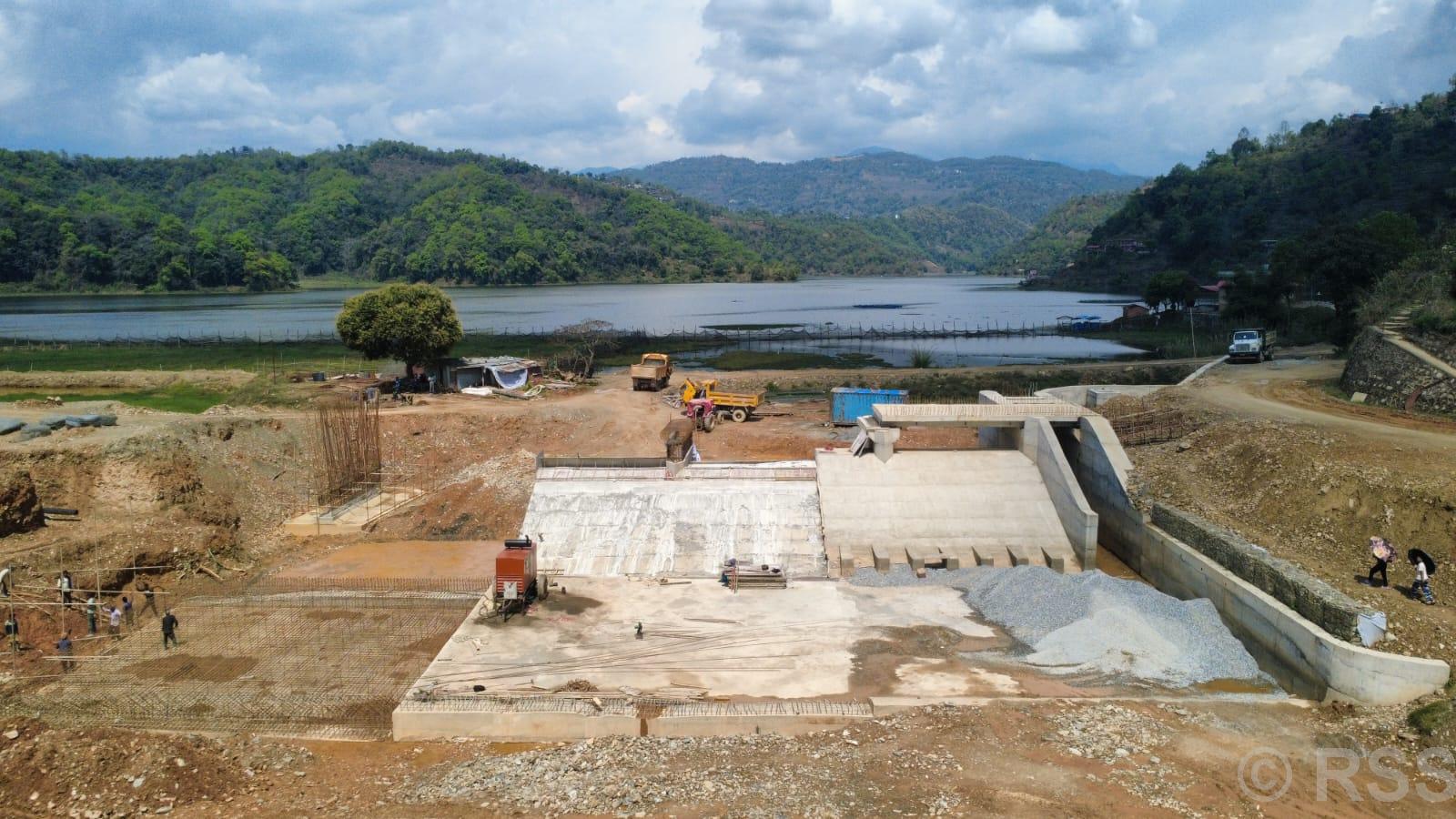
Work began in 2075/076. Out of a total budget of Rs 4.52 billion, Rs 2.70 billion has been spent so far. The project is targeted for completion by 2085/086. The lake's area will expand from 122 hectares to 183 hectares upon completion of the dam, which is being constructed by Kalika New Bato JV for Rs 290 million.
The dam construction, which is 70 percent complete, is scheduled to finish by Bhadra 23, 2083. It will feature a 590-meter earthen dam and a 45-meter concrete dam. Upon completion, the lake's depth will increase from three meters to seven meters. Additionally, a 7.8-kilometer paved road on the left side of the lake was completed last fiscal year.
The lake's length will increase from two kilometers to 3.6 kilometers. Excavation of 800,000 cubic meters of soil is underway, with a budget of Rs 400 million, targeting completion by Falgun 20. Plans also include building a temple on an island in the middle of the lake and a five-kilometer eco-trail on the right bank.
Environmental impact assessments have been conducted for the removal of trees, and land acquisition is ongoing. Out of 1,200 ropanis required, 911 have been acquired with Rs 1 billion in compensation distributed. The remaining 126 ropanis are pending due to the lack of updated district land rates.
The project was recently awarded for its excellence during the 73rd Irrigation Day anniversary. Local elders attribute the name 'Rupa' to the lake's changing appearance with the sunlight. The Rupa Lake Rehabilitation and Fisheries Cooperative has been instrumental in advocating for the lake's protection against encroachment.
Rupa Lake has become a major tourist attraction, particularly for its fish, with hundreds visiting daily. It is also a popular spot for swimming, fishing, and couples. Pearl production testing has also begun, following successful trials by the Begnas Fisheries Research Center.
Suspension Bridge and Zoological Park: The zoological park near the lake is another major attraction, featuring leopards, nilgai, deer, and various birds. The area hosts 361 plant species, 175 medicinal herbs, and 134 types of wildlife and birds. A 269-meter suspension bridge connecting Pokhara Metropolitan City-31 and Rupa Rural Municipality-6 has become a hotspot for tourists and social media content creators.
Bird Tourism Destination: Rupa Lake is a prime destination for bird tourism, attracting migratory species from China and Siberia, especially during winter, according to Manshanta Ghimire, former president of the Pokhara Bird Society.
This specific news has been automatically translated by AI. As a result, there may be some inaccuracies or language errors.
_iL3K2wYemS.jpg)