Fuel and Bitumen Shortages Stall Major Infrastructure Projects in Nepal


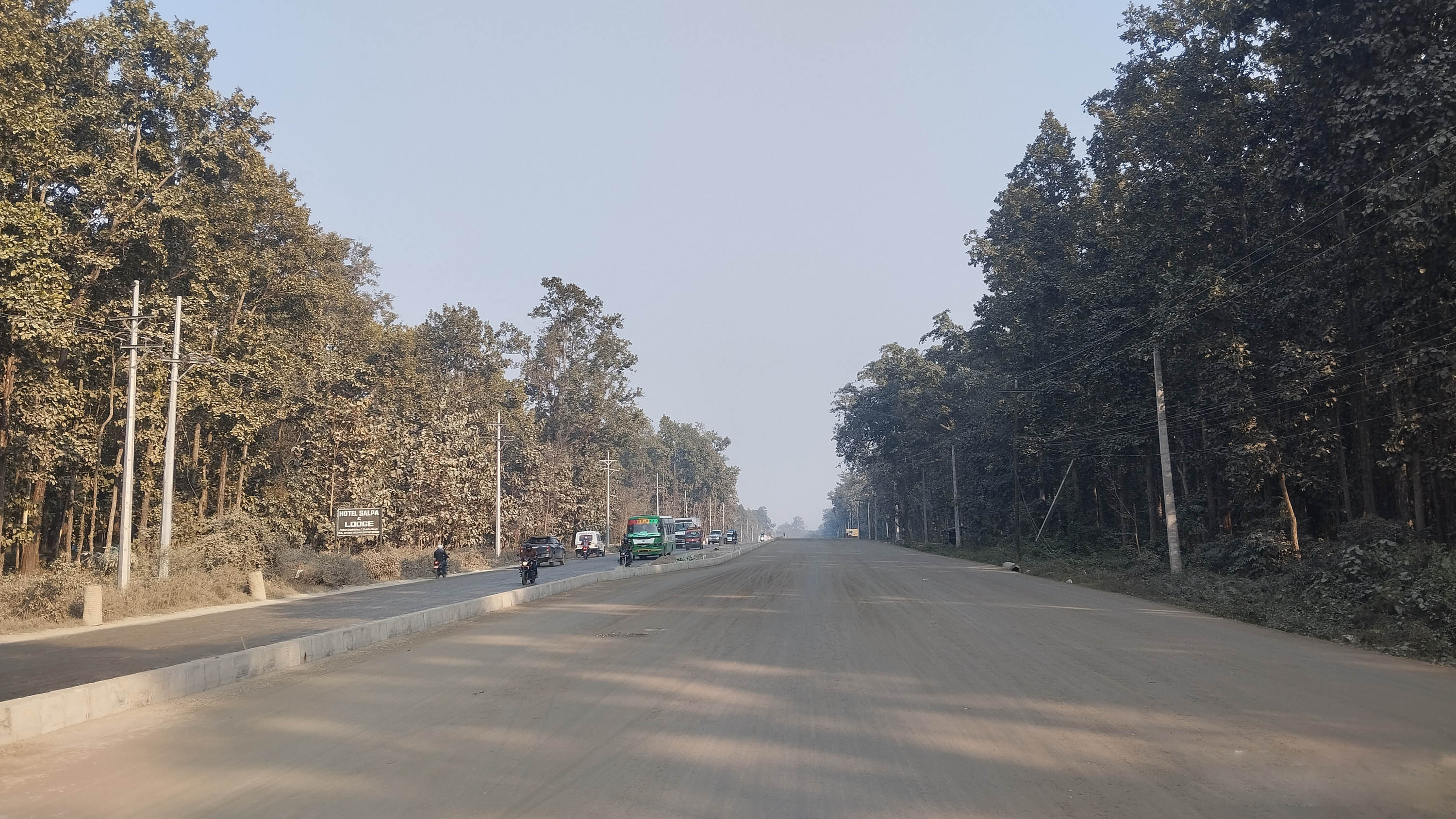
Biratnagar. The upgrade of the Kakarbhitta-Laukahi road section, part of the East-West Highway and a national pride project, is in jeopardy due to severe shortages of fuel and bitumen.
Recent surges in global petroleum prices and supply chain disruptions have brought construction work to a near standstill.
Construction companies report that they are unable to proceed with road paving due to the scarcity and exorbitant price of bitumen, a critical material for blacktopping. This crisis is not limited to the Kakarbhitta-Laukahi road but has spread across the entire construction sector nationwide.
The eastern section of the Kakarbhitta-Laukahi road (from Kakarbhitta to Sitapuri) was being rapidly developed by Evrascon Kalika JV. While the base for the first layer of blacktopping is ready for about 22 kilometers of the 45-kilometer project, the shortage of bitumen and cuts in diesel quotas have severely hampered progress.
Sunil Babu Panta, Chief of the Kakarbhitta-Laukahi Road Project (Eastern Section), expressed deep concern. "This is a national issue, not just limited to this project. Fuel prices have spiked, and it is difficult to procure the bitumen needed for paving," he stated.
According to Panta, work is currently continuing using old stock, but the situation is becoming critical. "Once this stock is exhausted, it will be difficult. We haven't stopped yet, but if prices continue to rise and do not stabilize, it will not be sustainable to continue construction," he added.
Large projects require thousands of liters of diesel daily to operate heavy equipment like tippers, excavators, graders, and rollers. However, the Nepal Oil Corporation's decision to cut diesel quotas for construction companies has slowed operations significantly.
Ujjwal Prasai, Project Manager at Evrascon Kalika JV, noted that the company is receiving only 25 percent of its daily requirement of 20,000 liters of diesel. "Due to the war abroad, we are getting only 5,000 to 6,000 liters instead of the 20,000 we used to receive," Prasai said.
He explained that government-imposed quotas on fuel pumps have made it difficult to source fuel from the market. "Bitumen prices have nearly doubled. The rising costs of bitumen, furnace oil, petrol, diesel, and kerosene are creating immense challenges," he added.
He warned that if the problem is not resolved within a few days, work will stop completely. "We have enough bitumen for 10-15 days. If this is not resolved within 15-20 days, all work will cease," he said.
Mahesh Mishra, President of the Federation of Contractors Association, Morang, stated that it is currently impossible to carry out any road paving. "With the shortage of bitumen and the rising costs of diesel and kerosene, contractors are in a difficult position," he said.
Contractors are demanding government intervention and discussions with experts. Mishra emphasized that without adequate fuel, progress is impossible. "We are getting only 3,000 liters where we need 10,000; the work speed has naturally dropped," he said.
Ramesh Adhikari, President of the Federation of Contractors Association, Jhapa, reported that small contractors in the district have completely halted blacktopping work. "The Oil Corporation cites the international conflict for the supply cuts, and the prices of all construction materials have skyrocketed," he said.
He noted that the gap between the contract price and current market rates is forcing contractors to consider abandoning projects. "When we signed the agreement, the rate for bitumen was 90-92 rupees; now it is 135 rupees. It is simply not feasible to work under these conditions," Adhikari said.
The Koshi Province government is also concerned about this crisis. Minister for Physical Infrastructure Development, Pradip Kumar Sunuwar, noted that projects in Jhapa are the most affected. "This has become a major problem. Contractors in Jhapa have stopped work," he said.
He highlighted the unexpected rise in bitumen prices, which have jumped from 80-90 rupees to 148 rupees. However, he stated that the provincial government has limited power. "The provincial government cannot do much. Unless the federal government introduces a 'contract holiday' or a relief package, we are bound by the Public Procurement Act," Minister Sunuwar said.
-(1)_xi0NSvZoS0.jpg)
There are construction projects worth 10 to 12 billion rupees under the Koshi Province government, most of which are at the blacktopping stage. Minister Sunuwar warned that the lack of fuel and bitumen puts all these projects at risk of being abandoned.
Meanwhile, the Federation of Contractors Associations of Nepal has threatened a 'construction holiday' if the government fails to control price hikes and ensure smooth fuel supplies. If this happens, projects ranging from national pride initiatives to local schemes will stall, dealing a major blow to the country's capital expenditure and development goals.
The Kakarbhitta-Laukahi road is being built at an investment of 10.694 billion rupees. Completion of this section is expected to facilitate trade and movement through Nepal's eastern border. The current crisis is likely to increase both the time and cost of the project.
This specific news has been automatically translated by AI. As a result, there may be some inaccuracies or language errors.