
CPN-UML Leader Thakur Gaire Discusses Election Defeat and Chairman Oli's Arrest


Kathmandu. Following a humiliating defeat in the elections, most CPN-UML candidates from across the country have arrived in Kathmandu. They came with the preparation to say, 'A party meeting will be held, where we will exchange election experiences, and depending on the situation, we will also vent our frustrations at the leadership.' However, they have had to wait a few days. The reason was the demise of party Chairman KP Oli's father.
They were hoping for a meeting after the Chairman completed the funeral rites for his father. But, the meeting never materialized as Oli was arrested by the government the very next day after finishing his father's duties. In this situation, they have taken to the streets and are currently protesting Oli's arrest with slogans and rallies. So, how will UML move forward now?
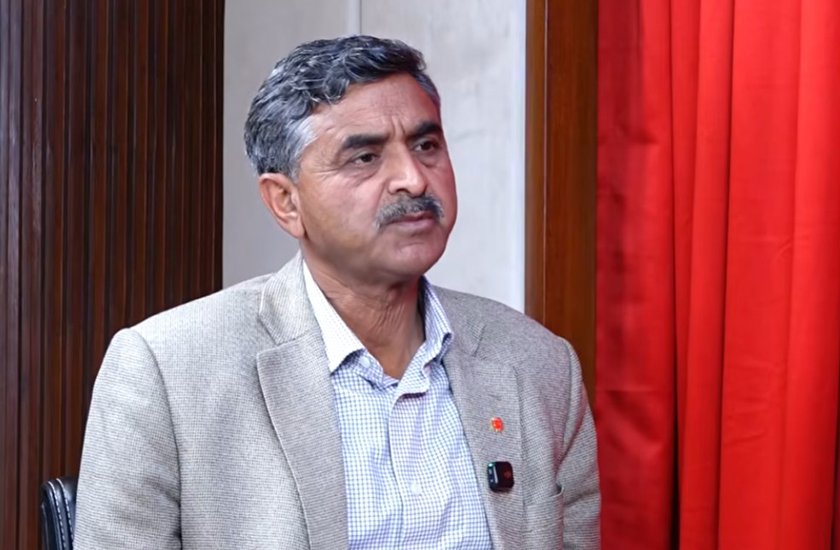
CPN-UML leader Thakur Gaire, who was recently defeated in the Palpa-2 constituency despite being considered popular among the public, spoke at length with Ratopati on contemporary issues. Here is the edited excerpt of the conversation with Gaire: (The detailed video of the conversation can be viewed/listened to)
- You have returned after being defeated in the election. If asked why you were defeated, the answer might be 'because we received fewer votes.' If asked why fewer votes were received, the answer might be 'the people did not give them.' Why did the people not vote for you this time?
This time, the voters or the public felt like giving a chance to 'someone new' for once.
- But you are not exactly new, are you?
I myself was not old. But the voters considered me old too, and they moved towards giving their vote to someone new.
- To put it plainly, candidates like you had to bear the burden of the UML's unpopularity and the unpopularity of its chairman, isn't that right?
This can be a topic of discussion. But overall, the mandate went towards new parties, new candidates, or new faces, not towards the old parties.
- Did you feel that if the party or its leadership had acted differently, you might have won the election? Did you conduct any such review?
There was certainly a question that the leadership in the state or the party should have been in a position to explain the reality of the events of Bhadra 23-24 in a way that the public could feel, but that did not happen.
- There is the issue of the arrest of your party chairman, a commission was formed, and the commission made recommendations. The Council of Ministers said it would implement the commission's recommendations, and then the government arrested him. Why are you protesting this? Does UML not believe in the rule of law?
Reports given by investigation committees or commissions are presented as suggestions to the government. Our legal arrangement is that state bodies should further investigate the suggestions expressed in the report, gather evidence, and based on that evidence, complete the legal process to decide whether to take someone into custody or not.
This process does not appear to have been completed in the arrest of the party chairman. The government should not err in adhering to procedure, following the law, and respecting the constitution while working. The government erred this time, which is why we are protesting the arrest.
- Suppose, for a moment, that someone other than Gauribahadur Karki was made the chairman of the commission, would the commission not have implicated the then Prime Minister and Home Minister in the events of the 23rd and 24th in some way?
I won't say it wouldn't have. The events of the 23rd and 24th are not and were not ordinary incidents. That is why UML is saying today that an impartial investigation committee led by a sitting judge should be formed for the events of the 23rd and 24th.
Moreover, what I have been continuously saying in the media and everywhere is that my argument is that a single commission cannot and should not investigate the events of the 23rd and 24th. I have been advocating for establishing a separate judicial commission for the 23rd and another separate judicial commission for the 24th.
- What UML leaders are saying now is that they will not spare the culprits of the 24th incident, only targeting the 23rd? But the data does not suggest that. 949 people allegedly involved in the 24th incident have been arrested. 207 are still in custody. 470 are on general bail. Only two accused from the 23rd incident have been arrested. So, can it be said that the government has not touched the 24th incident at all?
The facts today also show that this government has not viewed the incidents of the 23rd and 24th with the same lens. For instance, if we consider Gauribahadur Karki's recommendation, the names of the then Prime Minister, Home Minister, and Inspector General of Police are explicitly written in the same line. Isn't the name of the then Inspector General of Police mentioned?
- The way you are teaching or lecturing the government about the rule of law, people also teach UML about it. Why did you take to the streets? If someone is arrested, shouldn't the legal path be followed? Why the vandalism on the streets again?
That is a separate matter. Our party has an official decision to oppose wrong things through three channels: the streets, the parliament, and the legal process. The streets are for creating pressure, for raising alarms. It is wrong if those in government can violate the law, but those outside the government must obey the law.
- You demand action against those who vandalized and set fires during the 24th incident. Yet, you yourselves are engaging in vandalism?
What was the necessity for the police to use batons and tear gas on a peaceful procession? Should the state organs be misused to create fear and terror in society? Or should the state work to create a psychology among the people that 'I do not need to be terrorized' by ensuring peace, impartiality, or any form of security?
- A Congress leader has also been arrested. The Congress has stated clearly that they will follow the legal path and have not resorted to vandalism, unlike you?
Leave the Congress's matter to the Congress itself.
- Aren't you ashamed by the number of people present in the protest?
Why should the attendance be called shameful? When King Gyanendra Shah staged a 'coup' and the army moved to occupy media offices, there were only 8-10 of us, including me, on the streets in front of you! The truth is, the number of people who show up is not the most important thing immediately. The crucial thing is whether the voice being raised is true or not.
- Doesn't this send a message that the government did the right thing by arresting KP Oli, and perhaps there is happiness within UML about it?
Who is happy and who is sad is a matter for the concerned individual. People are allowed to be happy, and people are allowed to be sad. But the question is, the government must be the most responsible and accountable entity in upholding the constitution we created, the system we adopted, the laws we made, and the rule of law we expected.

- A party that received 2.8 million votes in the last election, a party carrying the legacy of Madan Bhandari and Manmohan, has reached this state under KP Oli's leadership. What spectacle did the UML cadres put on to protect such a person? They say, 'Why did you break your heads?'
CPN-UML has formally expressed happiness over the people giving nearly a two-thirds mandate to the Rastriya Swatantra Party and congratulated them. Didn't UML accept this by saying, 'Work well according to the constitution and law, and we will support you'? Did UML reject those who voted for them because they didn't vote for UML? No, it did not. Therefore, the people are supreme. We have complete acceptance of the 'verdict' or mandate given by the people.
- Is there or is there not a moral responsibility after the party loses?
There is a moral responsibility. A serious review must be conducted regarding this. The people's mandate has certainly drawn our serious attention to the issues related to the leadership, the policies we adopted, our working style and lifestyle, and where the alignment failed between what we did and public expectations—where did we fall short? A review of this entire matter must be conducted within the party's internal life, and overall, we must review the communist movement.
- You all tried to stop KP Oli from continuing as party chairman but failed. The government did the job you couldn't. You must be happy that the wind swept away the dirt that needed sweeping with a broom?
That is incorrect. The issue should not be viewed that way. Matters within the party happen according to its own rules, regulations, and procedures; discussions take place. The party is connected to society itself. This is not something opaque. Therefore, the party is an open entity. It is in dialogue with the public. We cannot separate ourselves from the public dialogue. We cannot evade responsibility by saying this is a party matter when the public draws our attention to something.
- It seems you are rejecting the current public mandate. The people voted for the Rastriya Swatantra Party in a number that could form a government. They also demanded the implementation of the Karki Commission report. Yet, you are back on the streets after the government was formed. Why do you demand resignation the day after the government is formed?
Why would I deny the expectation that the people had that the Karki Commission report should be implemented? I won't deny it. But if they think, or if you are trying to convey that the people said, 'You have the license to violate the law because you are implementing the Karki Commission report, you became Prime Minister, you have a two-thirds majority, therefore you are above the law,' then that is wrong.
- The court will say that, won't it? That is not something you should be saying on the streets, is it?
What would you do if I said that dialogue should only happen after the court rules? If I ask you, 'Should KP Oli's arrest be considered right or wrong only after the court rules?' what would you say? That's not it. There is a debate. If someone who is elected by the people says, 'I am above the law,' that cannot and should not be accepted.
- When you call for protests, party cadres don't even show up, let alone the general public. There has been no review within the party. So, what will the party do? Will it continue like this?
There will be a review within the party. It's just a matter of a few days' delay. But the events took a turn in a different direction than where we were supposed to go; that is true. But even if the path changed, why did the mandate given by the people manifest against us in this manner? What did our party fail to pay attention to, where did we err, what could we not do? A review of that subject must certainly take place.
- Will you also go to the streets for the release of Chairman KP Oli?
If I have come here on television to say that the government's arrest is not lawful and not procedural, then I will certainly speak on the streets too, why wouldn't I?
- If the government hadn't arrested the Chairman, you would have demanded a Central Committee meeting, right? And perhaps the plan was to demand KP Oli's resignation and remove him. Are you disappointed that the government's arrest prolonged KP Oli's chairmanship?
We don't need to go into that. There is no need to connect the issue in that manner. What we have to do is certain. A meeting must happen, sooner or later. The meeting will review things. Whatever the meeting decides will be implemented.
This specific news has been automatically translated by AI. As a result, there may be some inaccuracies or language errors.



_XRgO2ypobQ.jpg)


